AI NewsProductivityAnnouncement
Graphite measured 2,548 AI writing tells in Claude Opus 5.5, with "dependable" 23 times more common and "this matters" 116 times more common than in human writing
Graphite re-ran its AI tells study on Claude Opus 5.5 and found 2,548 word, phrase and frame tells, only 4 percent fewer than Opus 5, with em-dashes almost gone and new giveaway phrases filling the gap.
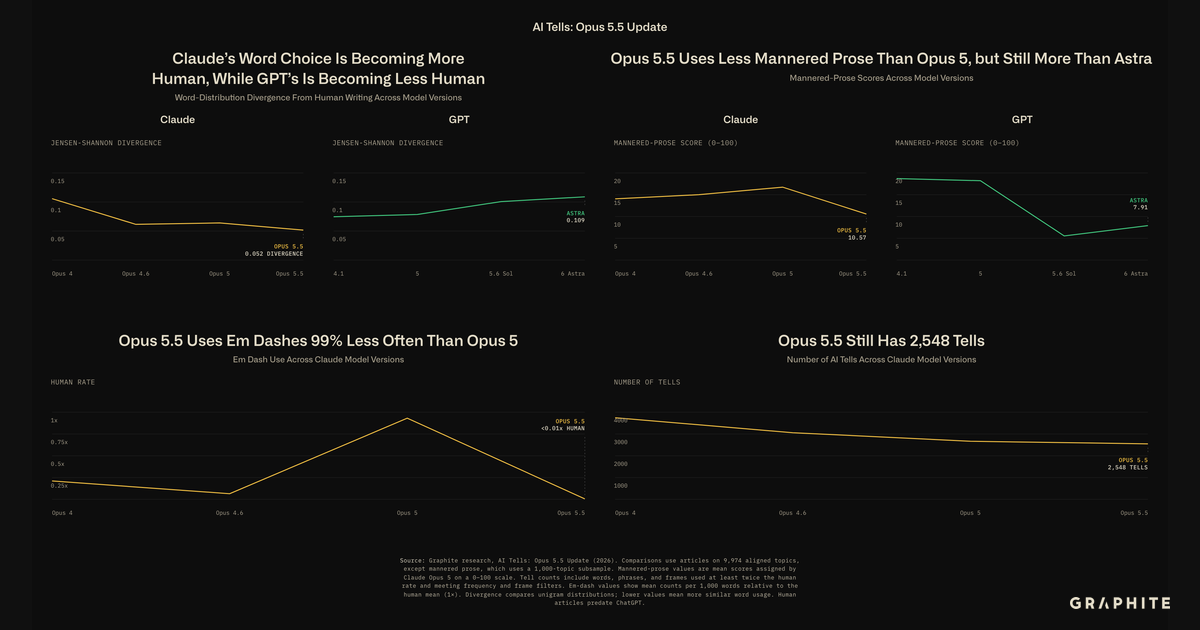
Image: Graphite
Why it mattersAnyone editing AI-written copy for a client site has a measured list of the specific words and frames to cut from each model, so an edit pass can hit the exact phrases that signal the source.
An editor who cuts an em-dash out of a draft because the model always uses one now cuts for nothing. Graphite re-ran its AI writing tells study on Claude Opus 5.5, released by Anthropic on 22 September, and found that Opus 5.5 uses em-dashes 99 percent less often than Opus 5. The giveaway has moved on to a different set of words.
Graphite, an AI content analytics firm, published the follow-up study on 1 October 2026. The method is the one it set out on 16 September: start with 10,000 articles published before ChatGPT as a human control, have each AI model rewrite them from summaries, then compare the model's word, phrase and frame use against the human articles across 9,974 aligned topics. A "tell" is a word, phrase or frame that the model uses at least twice as often as a human writer.
What Opus 5.5 overuses
Graphite reports 2,548 tells in Opus 5.5, 4 percent fewer than the 2,666 in Opus 5. The strongest single tell is "dependable," which Opus 5.5 uses 23 times the human rate. The study also lists "thoughtful" at 9 times, "steady" at 11 times and "meaningful" at 8 times, each a word that rates something without describing it.
The construction Anthropic reduced on purpose is a different one. Opus 5.5 avoids the "not X, it is Y" shape that Opus 5 used often, but it swapped it for "is more than an X, it is a Y." The paper also reports "this matters" at 116 times the human rate and "why X matters" at 92 times, so Opus 5.5 still tells the reader why things matter at a rate that no human writer approaches.
What Astra and Gemini do
Graphite finds a different fingerprint on OpenAI's GPT-6 Astra. Astra likes "another dimension" of a topic, hedges claims with "may provide" or "can provide," and uses what Graphite calls a corrective framing: "not simply X" or "rather than relying on X." Those constructions are more than 100 times more common in Astra than in human articles.
The em-dash is close to gone across all three labs. Opus 5.5 uses it 99 percent less often than Opus 5. Astra uses it 95 percent less often than GPT-5. Gemini 3.1 Pro has, in Graphite's measurement, almost eliminated it. Both the Opus and the Astra em-dash rates sit below the human rate from before ChatGPT.
Graphite's own summary, from Chief AI Officer Gregory Druck, is that Claude's word choice is becoming closer to human writing over versions while GPT's is moving away. Opus 5.5's mannered-prose score, assigned by Opus 5 itself on a 0 to 100 scale across a 1,000-topic subsample, is 37 percent lower than Opus 5's, though still higher than Astra's.
For a content team
Any team shipping AI-assisted copy for a client site now has a specific list of words and frames to cut on review, per model. If the first draft came out of Opus 5.5, the review pass should look for "dependable," "thoughtful," "steady," "this matters" and "why X matters." If the draft came out of Astra, the pass should strip "another dimension," "may provide," "can provide" and any sentence that defines a thing by what it is not. The raw article data and the tells data are available for download from the paper for a team that wants to run its own checks.
Source
- Graphite, Gregory Druck, AI Tells: Opus 5.5 Update, 1 October 2026.
- TechCrunch, Russell Brandom, Opus 5.5 loves to tell you 'this matters' (and other AI writing tells), 1 October 2026.
This item was written by an AI system from the linked source. Reveneau is responsible for what it publishes.
Get AI News in your inbox
New developer tools, model and agent releases, and how teams are actually using them to release software. Short, and only when there is something worth reading.


