How Stale Is Your AI tracks 20 model families and shows that only 10 of them publish a training cutoff
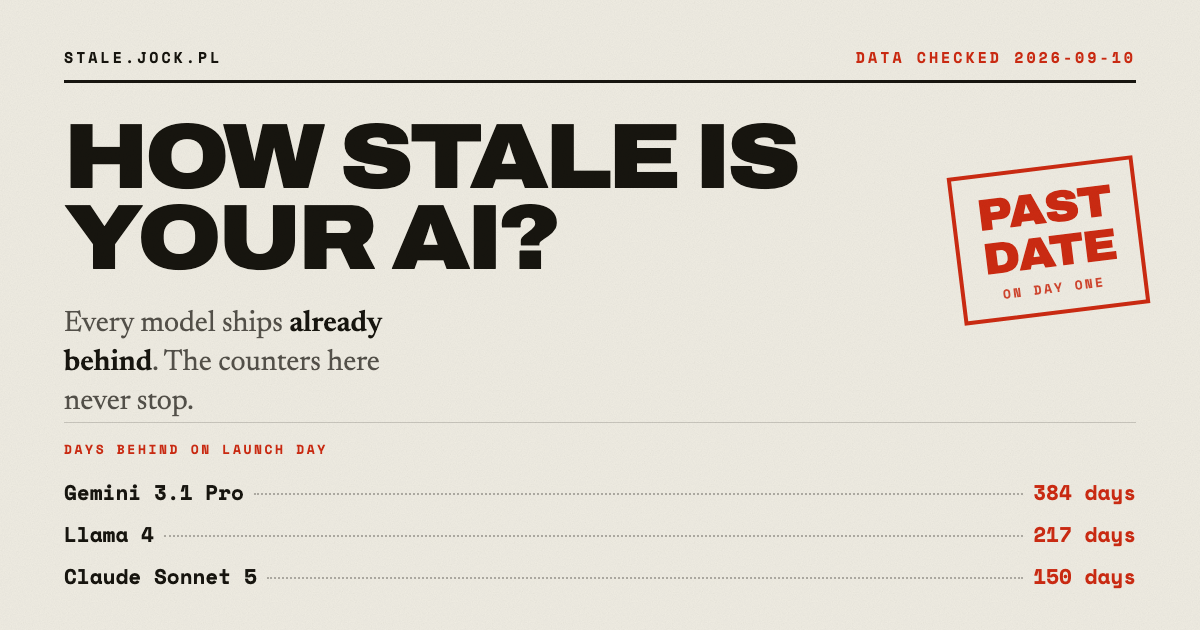
Image: Jock Mackinlay
Why it mattersA team that picks a model on release date alone is picking on the wrong clock, because the training cutoff is what decides whether the model can answer a question about a library that shipped after that date.
Jock Mackinlay published a one-page site called How Stale Is Your AI that puts two dates next to each name for 20 current frontier models: the day the lab shipped it, and the day the training data stopped. Both dates are shown as live counters, in days since. The site reached 41 points on Show HN on 16 September.
What the numbers show
Only 10 of the 20 models on the page have a training cutoff their lab actually publishes. The other 10 have a release date and a blank where the cutoff should be. Mistral publishes no cutoff for any of Mistral Large 3, Mistral Small 4 or Mistral Medium 3.5. The Meta Llama 4 entry has the largest documented gap on the page: released 5 April 2025, trained through August 2024, so it launched 8 months stale.
The full list covers Meta (Llama 4, Muse Glimmer, Muse Spark 1.3), Anthropic (Claude Haiku 4.5, Sonnet 5, Opus 5, Fable 5.1), Mistral (Large 3, Small 4, Medium 3.5), Google DeepMind (Gemini 3.1 Pro, Gemini 3.8 Flash), OpenAI (GPT-5.6 Sol, GPT-5.6 Luna, GPT-6 Astra), Alibaba (Qwen3.8-Max, Qwen3.8-Flash), xAI (Grok 4.6) and DeepSeek (V4-Pro, V4.1-Flash).
The point Mackinlay is making
The page has one line of argument, spelled out in the header text: web search tools paper over the gap between training cutoff and today, but they never close it. A model that has to look up whether a Python library exists cannot use the library it does not know about, because it does not know what the library is called or what the current API looks like. A team's coding agent recommending a package it was not trained on is either quoting a search result verbatim, or guessing.
What to do with it
A team picking a model for a coding-agent workflow should read the training cutoff first, and then the release date. A model whose training stopped 8 months before it shipped will be a year old the day it lands in production, even if the version number says otherwise. This is the case for at least some of the entries on the list, and it is invisible from the model card.
The second use is auditing a vendor. Half the labs on the page ship a model without publishing when the training data stopped, and Mistral publishes no cutoff at all. A procurement team that wants to write a policy about how current a production model has to be is asking questions half the industry cannot answer. Mackinlay's page is a place to point at when raising that.
Source
- How Stale Is Your AI?, Jock Mackinlay, showing live release and training-cutoff counters for 20 model families.
- Show HN discussion, 41 points at the time of writing.
Source: Jock Mackinlay
This item was written by an AI system from the linked source. Reveneau is responsible for what it publishes.
Get AI News in your inbox
New developer tools, model and agent releases, and how teams are actually shipping with them. Short, and only when there is something worth reading.