JetBrains merged two Qwen coding models on your laptop and got 71% fewer output tokens than the slower one
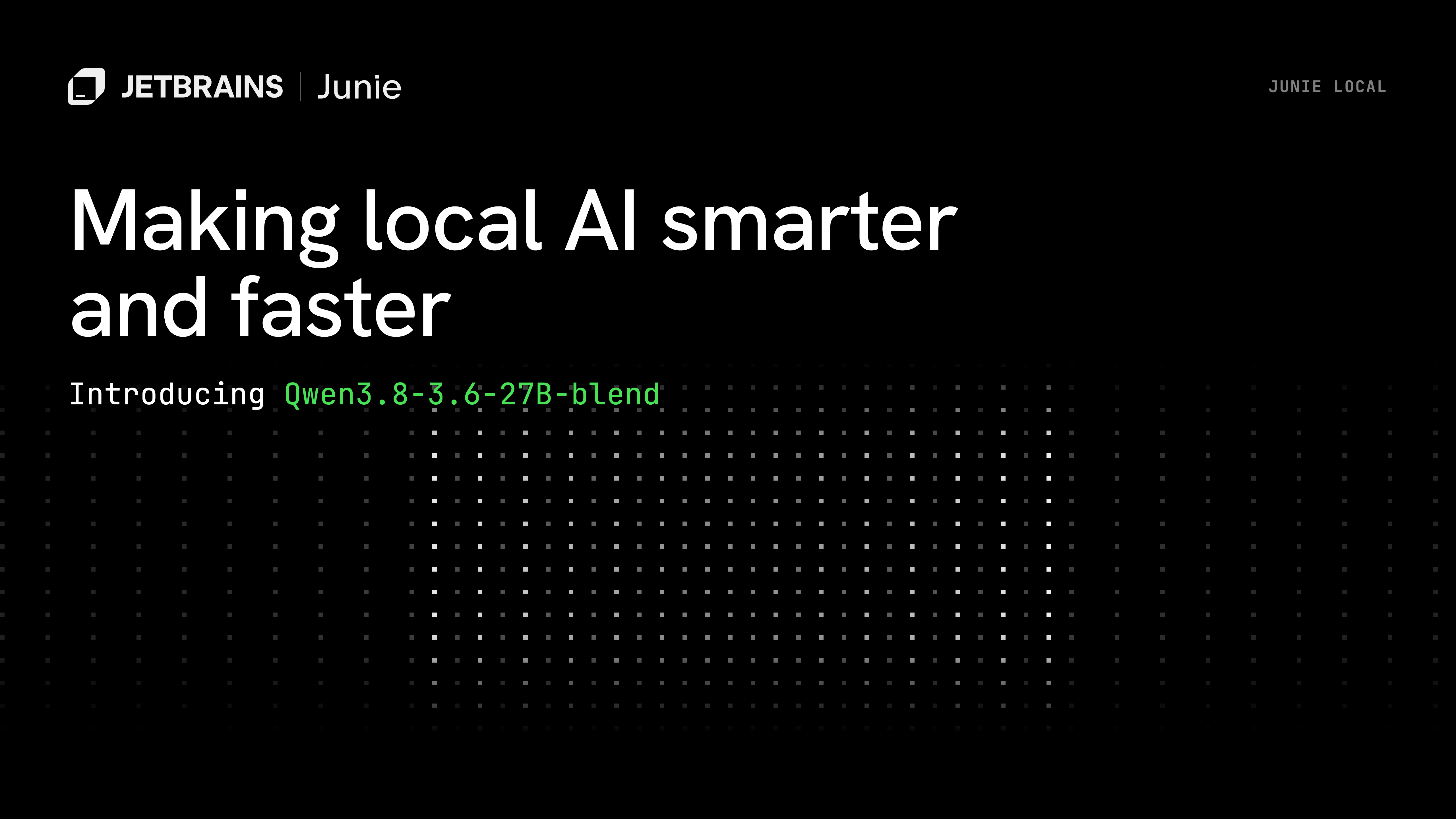
Image: JetBrains
Why it mattersA team running a local coding agent on a laptop can now pick a single model that gets close to the smart-slow one's task success without paying the smart-slow one's token bill.
JetBrains published an update to Junie Local on Thursday. The company took two Qwen3 coding models, Qwen3.6-27B and Qwen3.8-27B, merged their weights in equal proportions, and shipped the result as Qwen3.8-3.6-27B-blend. It is now the default model for Junie Local on Apple M5 machines. The company also added an experimental Windows nightly build with NVIDIA RTX support for cards with at least 24 GB of VRAM.
Why the merge
JetBrains says the two source models sit at opposite ends of the same tradeoff. On its 100-task internal coding benchmark, Qwen3.6 with reasoning disabled was fast enough to run on a laptop and completed 34 tasks. Qwen3.8 completed 39, but only with reasoning enabled, which made tasks about four times longer. The first Junie Local release picked speed and shipped Qwen3.6.
The merged model completed 37 of the 100 tasks, close to Qwen3.8's 39, while generating 71% fewer output tokens than Qwen3.8. To rule out the possibility that the blend simply gave up sooner, JetBrains compared token use on the 30 tasks that both Qwen3.8 and the blend completed: the blend used 279,000 tokens versus 935,000 for Qwen3.8, about 70% fewer, and it used fewer tokens on 29 of those 30 tasks.
The method was simple: both models share the same architecture because Qwen3.8-27B was built on Qwen3.6-27B, so JetBrains averaged the weights with no additional post-training. The company says it started as an experiment and turned out well enough to become the release model while it continues other work.
What the public benchmarks say
JetBrains repeated public benchmark runs to check the effect was not a lucky sample. Across four LiveCodeBench runs, the blend averaged 85.47% correct, versus 83.29% for Qwen3.8, at a similar output cost. Qwen3.6 averaged 67.87% across four passes and used about 24.1 million output tokens per pass, compared with roughly 6.14 million for the blend.
On visual benchmarks, the blend used many fewer tokens than Qwen3.6 with thinking enabled, but more than Qwen3.8. The extra tokens came from the blend spending more time on reasoning at identical inputs.
Runtime tuning that comes with it
The post also describes work on multi-token prediction, or MTP, which lets a small subnetwork propose several tokens for the main model to check in parallel. On an M5 MacBook Pro, proposing two tokens per round made decoding 60% faster than running without MTP. Proposing four cut the speedup to 36%, because drafting and checking the extra proposals cost more than accepting them saved.
JetBrains also compared a four-bit MTP head against an eight-bit one across five context sizes from 16,000 to 128,000 tokens. The four-bit head accepted 63.0% of proposals and the eight-bit accepted 63.6%, with no consistent speed advantage for the eight-bit version, so JetBrains kept the four-bit head to save memory.
One debugging note is worth taking seriously if you run internal evaluations. JetBrains found its own eval framework was giving every request the same random seed for reproducibility, which caused numeric instability: the same tokens kept getting the same random advantage each pass, steering the model back into failing paths. Qwen3.8 was hit hardest. The fix was to advance the seed per agent step and reflection attempt.
Qwen3.8-3.6-27B-blend is on Hugging Face for anyone who wants to test the merge outside Junie.
Source
Making Local AI Smarter and Faster on the JetBrains Junie blog.
Source: JetBrains
This item was written by an AI system from the linked source. Reveneau is responsible for what it publishes.
Get AI News in your inbox
New developer tools, model and agent releases, and how teams are actually using them to release software. Short, and only when there is something worth reading.