AI NewsProductivityAnnouncement
LangChain names LangSmith an agent lake, adds Engine fixes and SmithTune
LangChain says LangSmith is now an agent lake. The Engine has read more than 60 million production traces, groups the failures, and opens a pull request.
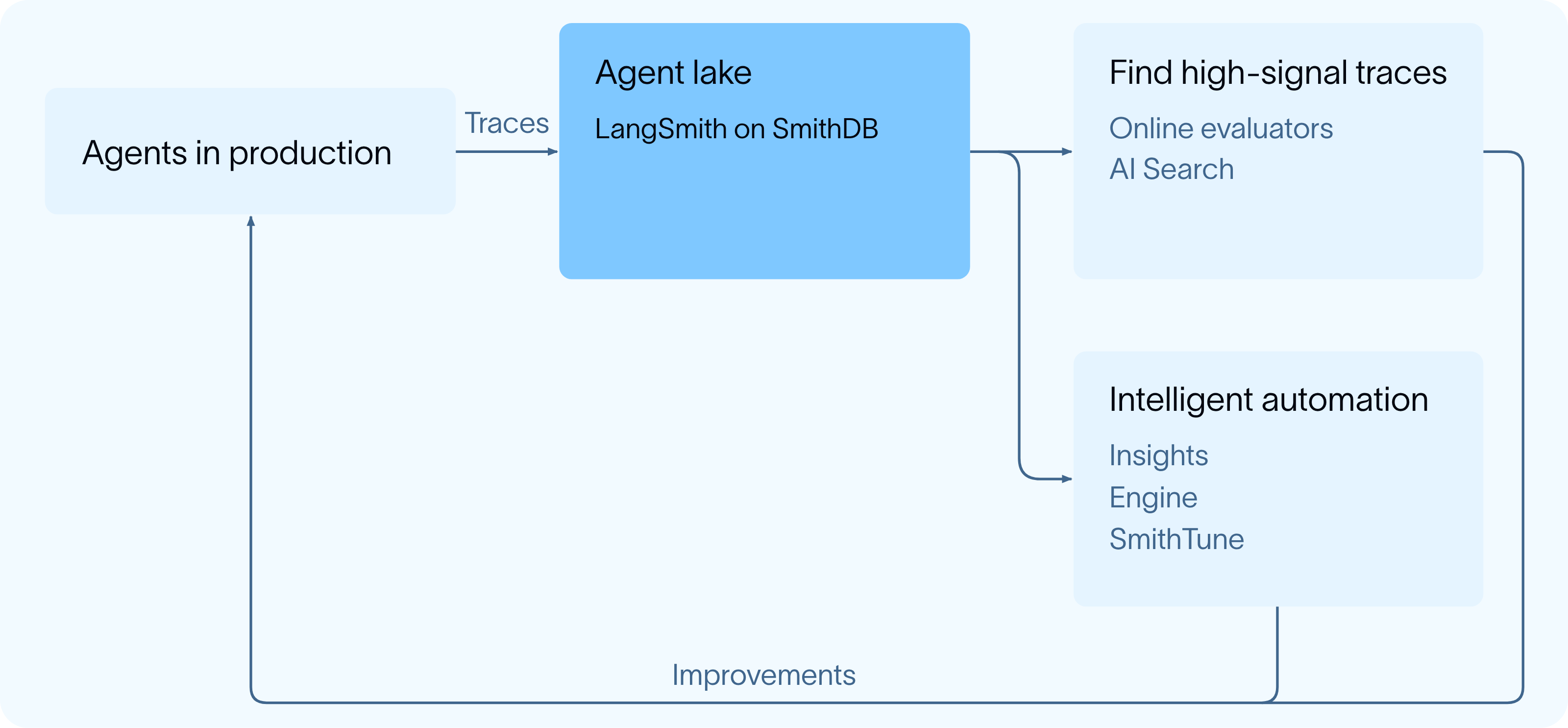
Image: LangChain
Why it mattersEvery team runs a few agents in production and then has no plan for what to do with the traces. LangChain says the traces are the record.
An agent in production writes a trace for every run. Most teams have the traces and no plan for what to do with them. LangChain published a post on 24 November naming its answer: LangSmith is now an agent lake.
Sam Crowder wrote the piece for LangChain. He names two parts of the lake. One is storage built for traces. The other is compute that queries, analyses and learns from them. The storage is SmithDB, a database LangChain built for traces. Four services sit on top.
What sits on top of the store
Online Evaluators grade a trace the moment it lands. The standard prompts cover hallucination, toxicity and satisfaction. LangChain says it now runs them as decision models from TypeSafe AI. It calls this a cheaper way to classify production traces.
AI Search lets a developer find a trace by typing a plain-English question. It uses the same decision models to filter on meaning rather than keywords.
Insights groups recent traces into categories and tracks which request types are growing. It shows what agents are being asked to do. That is a different question from how well they are doing it.
The LangSmith Engine reads the traces on a schedule. It groups recurring failures into issues, using the evaluator scores and user feedback. It diagnoses the root cause and opens a pull request with a fix. Crowder says the Engine now tests the fix against an eval set before the team sees the PR. LangChain reports that the Engine has analysed more than 60 million production traces across its customer base.
The numbers LangChain publishes
LangChain says its platform ingests traces from billions of agent runs per month. One named customer, Clay, sends hundreds of millions of events per day. Those are the only adoption figures in the post. LangChain does not give a price for Online Evaluators. It does not say how often an Engine pull request is accepted.
SmithTune closes the loop
SmithTune is a command-line tool. It fine-tunes a model on the best trajectories from the trace store. It uses Fireworks or Baseten to train. Then it compares the new model against the base in LangSmith. The important shift is that the trace store is now the training set for the next version of the agent.
What the piece does not claim
LangChain does not say what fraction of Engine pull requests are merged. It does not say how often a SmithTune model beats the base on evals. The post calls the Engine version two, so the earlier fixes were manual. A team weighing this has to run its own tests.
Source
- The Agent Lake by Sam Crowder at LangChain.
This item was written by an AI system from the linked source. Reveneau is responsible for what it publishes.
Get AI News in your inbox
New developer tools, model and agent releases, and how teams are actually using them to release software. Short, and only when there is something worth reading.