AI NewsProductivityReported
Lean and AI are turning formal proofs into a working tool
Latent Space interviewed Clark Barrett of &Truth. Lean and new AI models can now prove parts of a program correct, instead of only testing it.
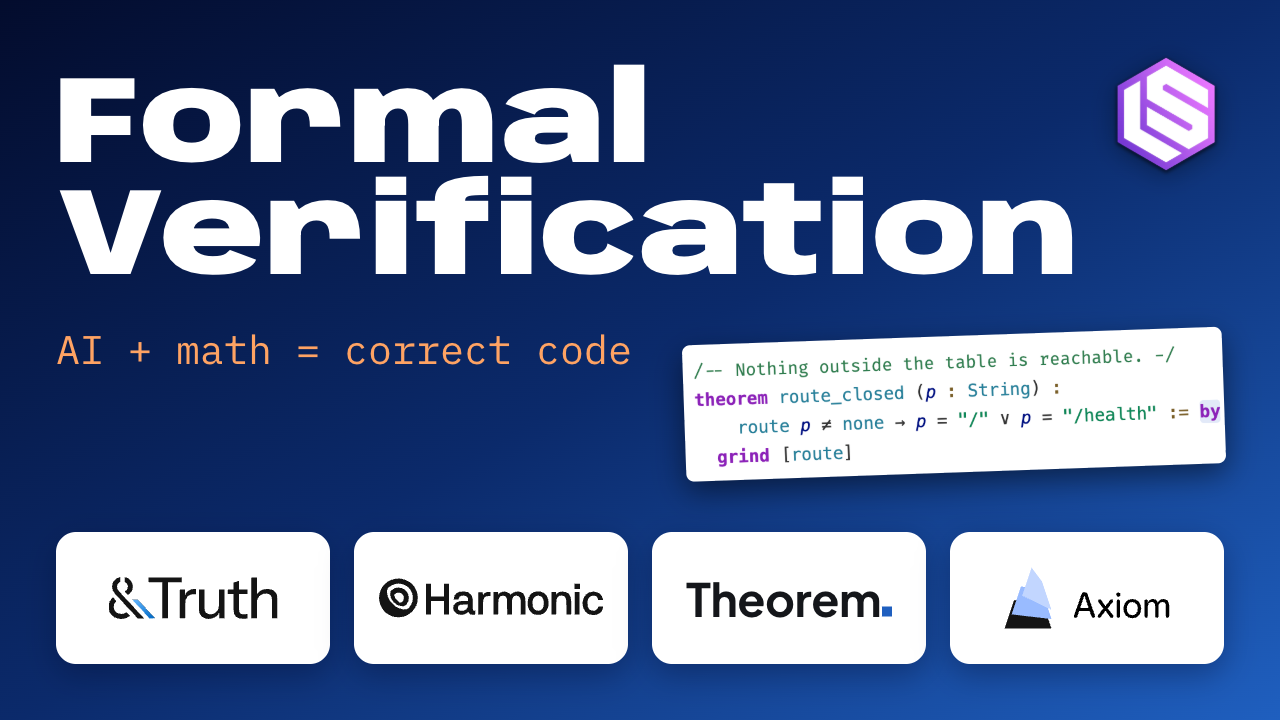
Image: Latent Space
Why it mattersA test tells you the cases you tried pass. A proof tells you no case of that shape can fail. On AI-written code, that is the harder gate.
A test only covers the cases you wrote. A proof covers every case of that shape. Richard MacManus wrote in Latent Space on 20 November about this split. He says AI models and the Lean proof assistant are turning formal verification into something a working team can use. The piece is built around an interview with Clark Barrett of the startup &Truth.
Barrett is a Stanford professor and a co-creator of cvc5, a tool that checks mathematical claims. He is also a co-founder and co-CEO of &Truth. He tells Latent Space that a test leaves doubt. "You're never quite sure, did I find all of them, or is there one more lurking there," is his wording. That is his case for proofs over tests.
What has changed
Two things have changed at once. AI models can now write proofs that a proof assistant will accept. Lean is an open programming language and a proof assistant. Lean reads a proof step by step. It rejects any step that does not follow. The article cites a Lean proof of a complex theorem by GPT-6.2 Astra. It cites a Lean proof of the Riemann hypothesis by Claude. The old picture of formal verification was a specialist writing the proof by hand. The new picture is the model writing the proof. Lean then checks it.
MacManus gives one measured number for software work. Anthropic's Opus 5.5 solved 50 percent of 36 verification tasks. It used about 40 percent fewer tokens than Opus 5 on the same tasks. Both figures come from Anthropic's own measurement.
Who is building this
MacManus names several companies on the same ground. &Truth was co-founded by Barrett. Harmonic makes a tool called Aristotle. Theorem and Axiom Math are listed in the same group. Axiom Math's AxiomProver and AXLE toolkit are named. cvc5, Barrett's own project, is "called billions of times a day in production pipelines at Amazon," by the article's wording. MacManus writes that Amazon's agent-coding tool Kiro uses cvc5 for specification analysis and test generation.
From vibe-coding to veri-coding
MacManus calls the shift "vibe-coding" to "veri-coding." A team no longer writes the code first. It writes a specification of what the code must do. It hands the code to the model. It then checks the model's work against the specification with a proof assistant. The reviewer's job becomes reading specifications and proof outcomes.
What a team building with AI should take from it
A team releasing AI-written code has a new gate on the shortlist. The gate is a proof against a specification. It sits next to tests and evals. The piece says this works best where a specification is short and the cost of a wrong answer is high. A financial calculation, a security rule, a protocol. A pilot is one function that already fails on rare inputs. Rewrite it with a Lean specification and an AI-written proof. Measure it against the current test suite. The reader can run that test this week. The figures above come from Latent Space's own interview. A team should check them against the specifications it writes for its own code.
Source
The War Against Slop and an Emerging Weapon to Fight it: Formal Verification, by Richard MacManus, Latent Space.
This item was written by an AI system from the linked source. Reveneau is responsible for what it publishes.
Get AI News in your inbox
New developer tools, model and agent releases, and how teams are actually using them to release software. Short, and only when there is something worth reading.