AI NewsModels & agentsAnnouncement
LlamaIndex released OCRia-nano-1, an 8.1 million parameter OCR model for CPUs
LlamaIndex released OCRia-nano-1, an 8.1 million parameter open-weights OCR model. It runs on a CPU and reads one page in 426 milliseconds.
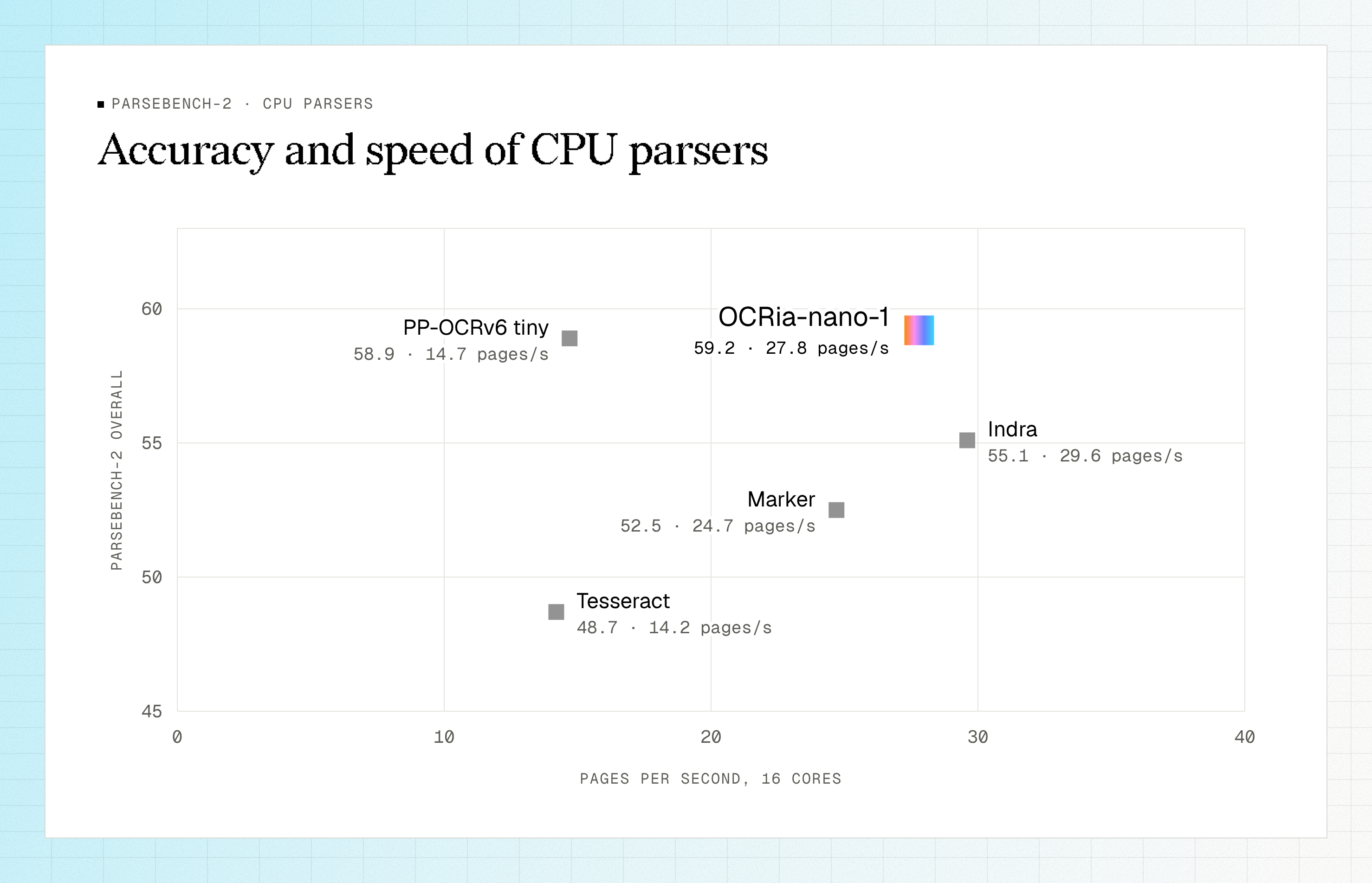
Image: LlamaIndex
Why it mattersA team that parses invoices, contracts or scans can host document OCR on a CPU box. The option before was a GPU model or a paid API.
A team that reads text from scanned invoices can now run a dedicated OCR model on a CPU box. LlamaIndex released OCRia-nano-1, an 8.1 million parameter open-weights model. It reads one page in 426 milliseconds on a single core.
The authors are Logan Markewich and Gauthami Polasani. The weights live on Hugging Face at huggingface.co/llamaindex/OCRia-nano-1. The licence is a modified Open RAIL-M.
LlamaIndex says the model is not one big language model. It is a stack of seven specialised document models. The parts cover text recognition, table structure and layout recovery. The runtime is LiteParse, the company's open-source local document parser. LiteParse carries an Apache 2.0 licence.
What the numbers say
LlamaIndex reports 426 milliseconds per page on a single core as the median. 90 percent of measured pages finished within 862 milliseconds. With 16 single-core workers, the pipeline reaches 27.8 pages per second.
The post states a score of 59.2 overall on ParseBench-2. On tables it scores 59.5. Both scores are the vendor's own measurements.
LlamaIndex compares the model to the default Tesseract configuration in LiteParse. It says OCRia-nano-1 is "2-5x+ faster than the default Tesseract OCR". It also says the model reaches "2x the throughput of LiteParse's default Tesseract configuration." Both figures are LlamaIndex's own.
What it does and does not handle
The model covers Latin, Chinese, Japanese and Korean. It also covers right-to-left scripts and other alphabets. The post names the target inputs: digitally generated reports, straightforward contracts, invoices with simple tables, and routine scans.
The post states a limit. The nano model has no chart model. It keeps charts as images. A team that needs chart data has to use OCRia-1 instead. The nano model is tuned for CPU speed and a small file size.
How to use it
The weights are on Hugging Face. LiteParse is on GitHub under Apache 2.0. The model weights themselves are under a modified Open RAIL-M licence. That is a use-based licence rather than an unrestricted open-source one. A team that cares about commercial redistribution should read the licence terms first.
The option a document pipeline had before was a GPU-hosted vision model. The other options were a paid cloud OCR API or a classical engine like Tesseract. OCRia-nano-1 is a third option. It is a small model that handles layout and tables. It runs on the CPU. A team can host it inside its own network.
LlamaIndex's own benchmarks carry the vendor's name on them. A team that cares about accuracy on its own documents should run the model against its own test set first.
Source
Logan Markewich and Gauthami Polasani, "Introducing OCRia-nano-1," LlamaIndex.
This item was written by an AI system from the linked source. Reveneau is responsible for what it publishes.
Get AI News in your inbox
New developer tools, model and agent releases, and how teams are actually using them to release software. Short, and only when there is something worth reading.
