AI NewsModels & agentsReported
METR says Anthropic's AI progress doubled in a year
A METR report says Anthropic's AI progress ran about twice as fast in the past year.
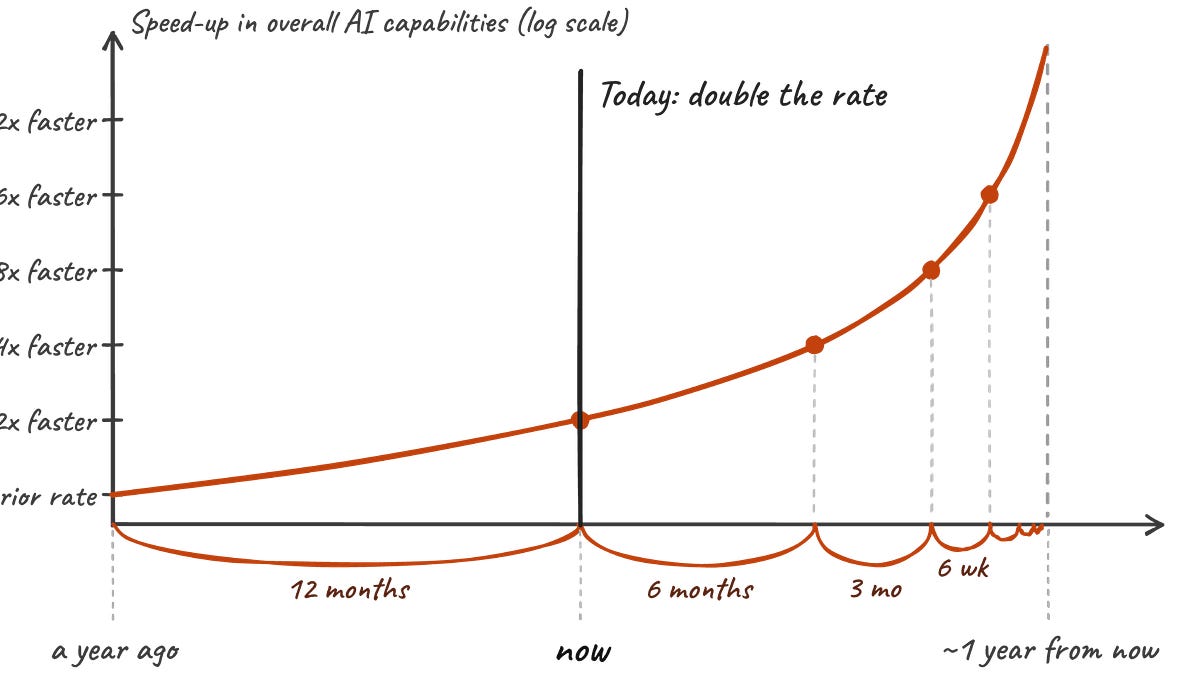
Image: Planned Obsolescence
Why it mattersModel changes at Anthropic may keep coming faster. A team that depends on one model has less time before the next one beats it.
Anthropic's own S1 filing says the company may soon cross its own "dramatically accelerated progress due to AI" threshold. Ajeya Cotra writes at Planned Obsolescence that this threshold may have already been crossed.
Cotra works at METR. She says she did not work on the project or see the unredacted report. The report authors are her colleagues. They had deep access at Anthropic.
Their finding: capabilities progress at Anthropic ran about twice as fast in the past twelve months as in the twelve months before. The measurement is an internal version of the Epoch Capabilities Index. The authors call it AECI. They say most of the evidence they found most informative is redacted.
What the threshold means at Anthropic
Anthropic set this threshold in its Responsible Scaling Policy. The threshold is met when two things hold. First, overall capabilities progress goes twice as fast. The point of comparison is the fastest sustained rate before AI was helping much with AI research. Second, AI automation is plausibly the main reason for the speedup.
The report authors say AI automation is probably the main reason Anthropic's capabilities keep improving at this faster pace. The specific evidence for that part is redacted.
What a 2x speedup means for the humans
Cotra argues that doubling overall progress means human researchers must be sped up by much more. Her reasoning: compute multipliers and training compute are two inputs into capabilities. Multipliers themselves come from researcher labor and experiment compute. She works through a simple Cobb-Douglas model. She estimates the labor speedup needs to be roughly 4x to 9x to produce a 2x in overall progress.
Cotra gives one way to picture this. Each researcher at Anthropic now gets about ten days of work done in one normal day.
The limits of what is public
Most of the report is redacted. Cotra says the authors told her a majority of the evidence they found most informative was in the redacted parts. The public summary rests on a small part of what METR actually saw. She also says the authors describe seeing some redacted evidence. That evidence suggests acceleration may already be above 2x and rising.
Cotra writes that this is the most important update she has seen about AI risk in two years. She says Anthropic's earlier RSP tied this threshold to a minimum security bar. That bar is protecting model weights against state-level theft. She says the industry is not close to it. She names recent security breaches at OpenAI and Anthropic.
For a team building products on these models, the practical read is that model changes may keep coming faster. The window between one model release and the next one that outperforms it may keep shrinking. That changes how long a feature tied to a specific model can be expected to stay relevant. It also changes how often a team should re-run its own evals against the current top models. And it raises the stakes on the security and oversight the labs themselves run. Much of the public claim rests on a redacted report, and the reader is asked to trust the process.
Source
AI is dramatically accelerating AI research, Ajeya Cotra, Planned Obsolescence. Hacker News discussion.
This item was written by an AI system from the linked source. Reveneau is responsible for what it publishes.
Get AI News in your inbox
New developer tools, model and agent releases, and how teams are actually using them to release software. Short, and only when there is something worth reading.