AI NewsModels & agentsReported
GPT-6.2 Astra and Sol think with fewer tokens, a test finds
A developer named micjm tested 18 models on real coding tasks. Astra 6.2 and Sol 6.2 used fewer output and reasoning tokens than earlier OpenAI models.
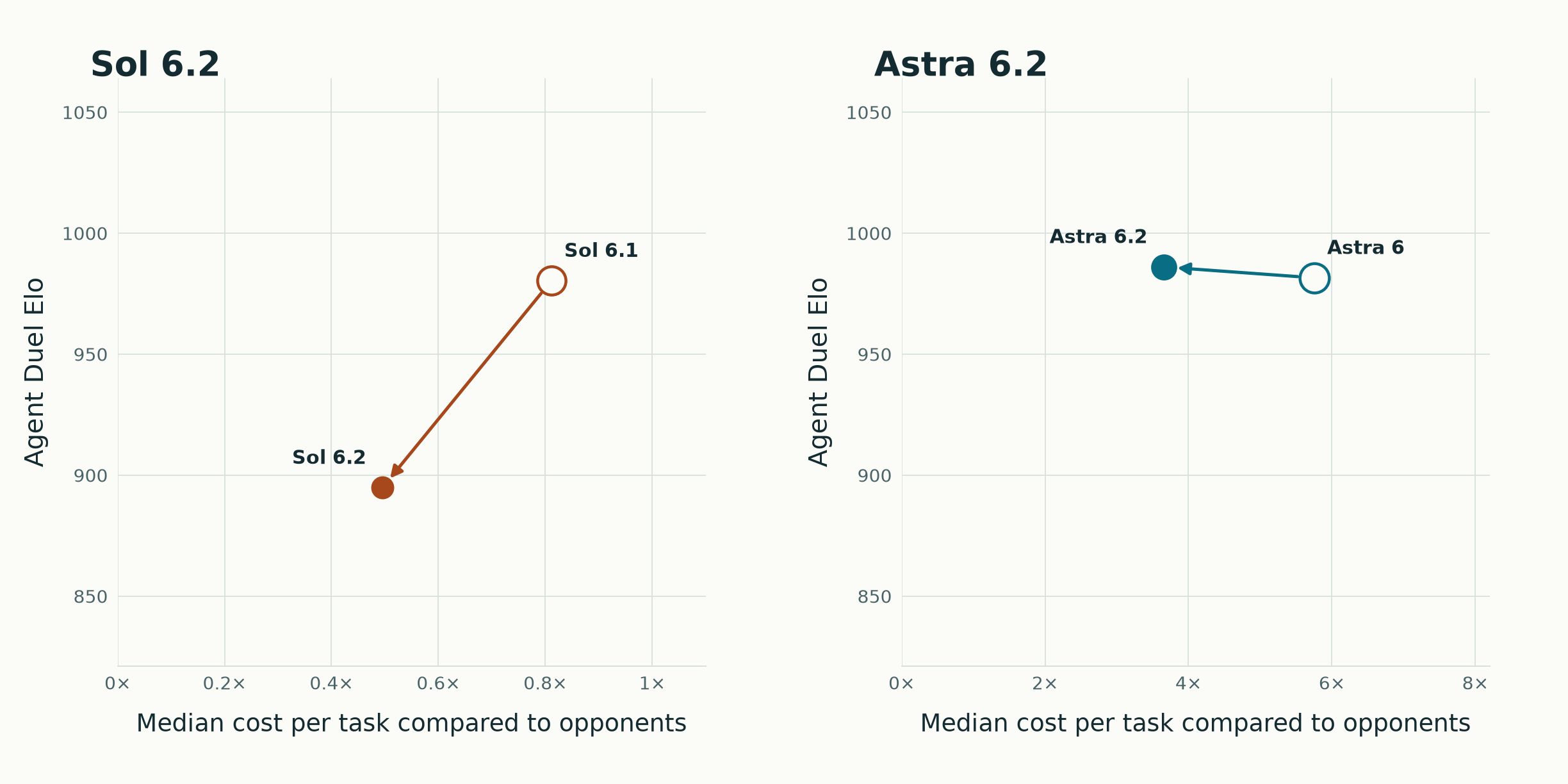
Image: micjm
Why it mattersA team routing to Astra 6.2 or Sol 6.2 may get a cheaper reply with less thinking inside. Rerun your own eval on the new version before you trust the old number.
A developer who writes under the name micjm published an analysis on 26 November 2026. The post is titled "OpenAI is in cost control mode". The claim: OpenAI's recent GPT-6.2 Astra and Sol use fewer output and reasoning tokens than their earlier GPT-6 and GPT-6.1 versions. The test is micjm's own. The sample is 18 models with over 100 eligible votes each.
The test
micjm runs a side project called Agent Duel. The post describes it as a battle system on top of OpenCode. It matches two models on the same completed task and records which output a reader prefers. Models are then ranked by Elo. The leaderboard sits at agentduel.com. The post does not list the task types in the test.
For this analysis, micjm compared each model against its matched opponents on the same tasks. He plotted two values per model. The first is the median cost per task, divided by the opponent's median cost. The second is the median output and reasoning tokens per task. He then checked whether the differences are random noise.
The numbers
The p-value on output tokens dropping is 0.0055 for Sol 6.2 and 0.022 for Astra 6.2. The p-value on reasoning tokens dropping is 0.00013 for Sol 6.2 and 0.0064 for Astra 6.2. A p-value under 0.05 is the common cut-off for a real effect. All four values are below that cut-off. Reasoning tokens dropped the most. For Sol 6.2, the p-value on reasoning is near one in ten thousand.
The post calls GPT-6 and GPT-6.1 Sol "pretty normal models". The 6.2 point release turned both Astra and Sol into what micjm calls "underthinking outliers". The cost chart places Astra 6.2 and Sol 6.2 below their peers for cost per task at the same Elo. The reply is cheaper for the same preference score.
The limits of the test
One developer wrote the post. The test uses his own ranking data and his own task set. The post does not say how many tasks each model answered, or what the tasks were. It names no bugs it caught or missed. OpenAI has not responded in the post.
A team that routes to GPT-6.2 for a coding or product task has a reasonable next step. Re-run the task set it used to pick the model on the new version. Count output tokens and reasoning tokens. Count whether the answer is still correct. Compare the two totals against the old version. If the new model gives a shorter, correct reply, it is cheaper. If it is shorter but wrong more often, the saving moves to a different cost. That cost is a retry, a review hour, or a user who leaves.
micjm's post gives no recommendation. It leaves the next step to the reader.
Source
- OpenAI is in cost control mode, by micjm.
This item was written by an AI system from the linked source. Reveneau is responsible for what it publishes.
Get AI News in your inbox
New developer tools, model and agent releases, and how teams are actually using them to release software. Short, and only when there is something worth reading.


