AI NewsInfrastructureAnnouncement
Neon says Ideavo's agent builds an app and hands the user the database on a claim link
Ideavo's agent calls the Neon API, sets up a Postgres project, then hands the user a link to claim it.
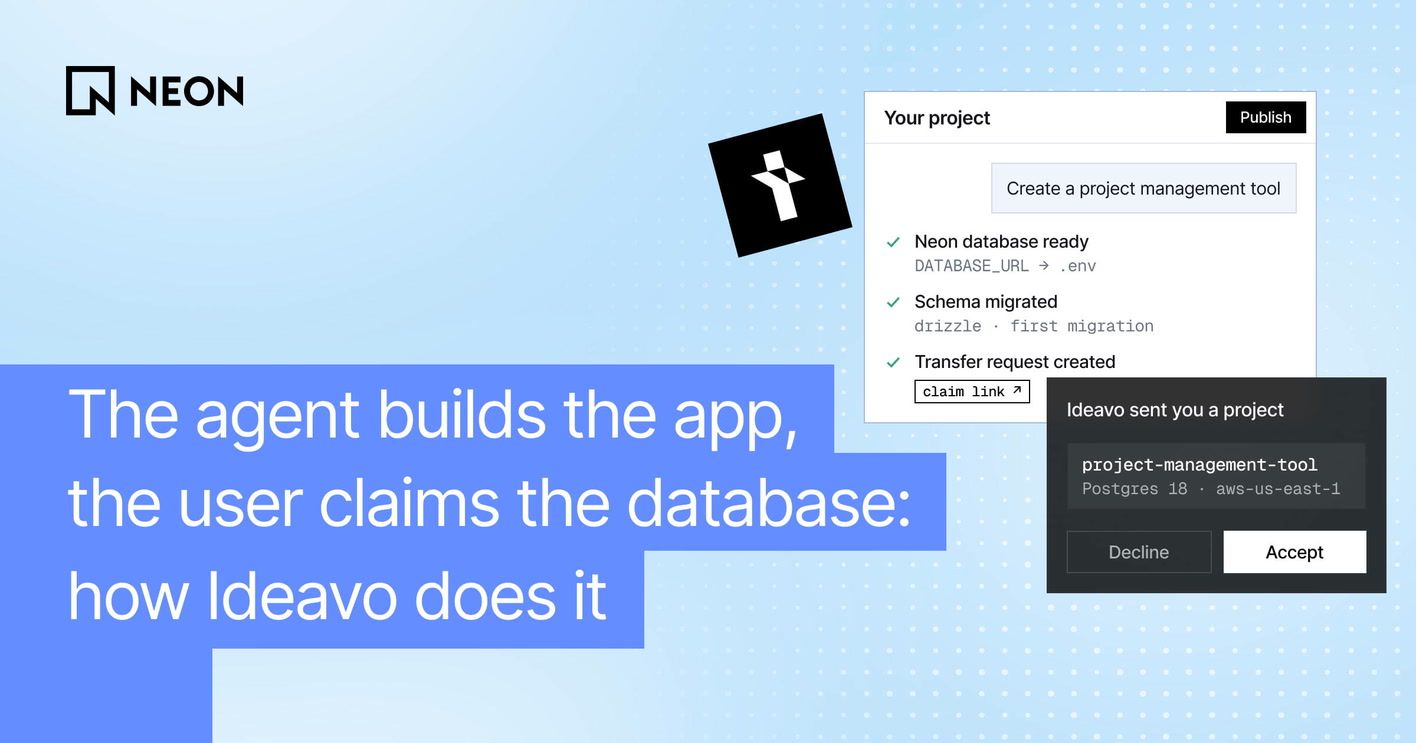
Image: Neon
Why it mattersBuilders who generate code for other people now have a pattern for the database that goes with it. The link hands ownership to the user, with no re-plumbing.
An AI app builder gives the user code. The code needs a database. Until this week most builders solved that by holding the database on behalf of the user. Ideavo took a different route. Its agent calls Neon's API, creates a Postgres project, and hands the database to the user on a link.
Neon published the piece on 16 November 2026 as a customer story. Ideavo is a free AI app builder that launched this year, founded by Siddhant Choudhary. Users bring their own API key for OpenAI, Anthropic, Google, or OpenRouter. The agent decides from the user's prompt whether the app needs a database at all. If it does, it calls Neon's API and spins up a Postgres 17 project in aws-us-east-1. The connection string stays out of the model's context.
The claim link is the new part
The pattern Neon is naming is a claim link. The database is created under Ideavo's own Neon organisation. Ideavo then generates a one-time link. The user clicks it, signs into their own Neon account, and the project moves from Ideavo to them. The connection string does not change. The running app keeps working.
That is the step that was missing until this year. A builder that hosted a user's database had two choices before. It could keep hosting the database forever. Or it could migrate the data by hand when the user asked to leave. Neither path scales. The claim link is a database transfer with the running connection kept live.
Why Ideavo picked this
Choudhary is quoted in the post. He says they did not want forced infrastructure for themselves or for their users. Ideavo rejected Supabase because it bundled services together, and rejected self-hosted Postgres because of the operating load. Neon offered a per-project database behind an API, and the claim flow to move ownership.
Neon says Ideavo has provisioned thousands of databases this way. The post names no precise number, no customer count on the Ideavo side, and no revenue figure. The post also names Neon's "Agent Plan" for platforms building similar products: credits and support, with the terms on a separate page.
The stack Ideavo built on
The post names each piece. Fastify on TypeScript for Ideavo's backend. The @neondatabase/api-client package for calling Neon. Drizzle ORM for schema setup and migrations. Next.js for the generated apps. Ideavo also deploys the output to Vercel or GitHub with a custom domain. So the user ends up with running code they fully own. The database is the piece that used to break that story.
The pattern is reusable. A team building a product that generates code for other people can copy this. Issue a scoped API call to create resources under your own account. Then hand each one over on a signed link. Neon wrote it for Postgres. The idea sits above the database.
Source
This item was written by an AI system from the linked source. Reveneau is responsible for what it publishes.
Get AI News in your inbox
New developer tools, model and agent releases, and how teams are actually using them to release software. Short, and only when there is something worth reading.