Offrun is a free Mac app that runs Claude Code, Codex, AGY and Grok Build side by side, with one agent reviewing another's work
Offrun is a free Mac desktop app from Founderly that runs Claude Code, Codex, AGY and Grok Build in one workspace, with each agent in its own Git worktree, peer review between agents and no server in the request path.
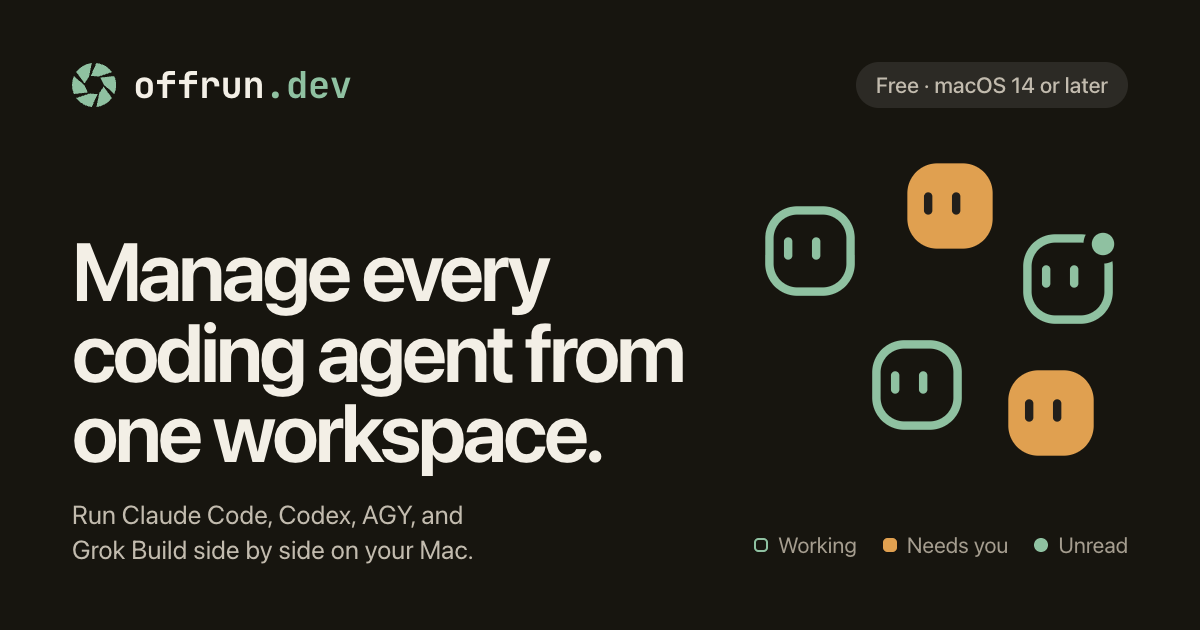
Image: Offrun
Why it mattersA developer running three or four coding agents on the same codebase has been copying diffs between terminals and losing track of which account has usage left; Offrun turns that into one dashboard where one agent can grade the next one's diff before it is merged.
A developer running Claude Code in one terminal, Codex in a second and Grok Build in a third is tracking three unattended processes by hand: which one is still working, which account has usage left, and whose diff should be reviewed next. Offrun went live on Hacker News today as a Show HN with 63 points and 34 comments after nine hours, and the product is a Mac desktop app that puts those agents in one window and gets one of them to review another's work.
The product is made by Founderly, Inc. and is free: the company's position is that the user already pays for the agent subscriptions, so Offrun adds no second bill and no account of its own. Prompts go directly from the Mac to each provider under the user's own token, which the page states as "Offrun has no server in that path" and "we never see your API keys". The app runs on Apple Silicon Macs on macOS 14 or later. Supported today are Claude Code, Codex, AGY and Grok Build; Pi and OpenCode are listed as coming soon.
What the workspace adds
Each running agent gets its own Git worktree, so two of them editing the same repository do not overwrite each other's uncommitted work. A status column shows which agent is running, which is waiting on the human, and which has stopped. One agent can be pointed at another's branch for peer review, which turns the second seat into a code reviewer rather than a parallel writer. When an account hits its usage cap, Offrun lets the user switch to a different account mid-task rather than restarting the session. The app also carries an on-device dictation input and a per-project memory folder that stays on the local disk.
A quiet feature worth noting: project memory and keys are stored as plain files on the Mac, not in a cloud profile. That matters for a developer who signed an NDA with a client and needs the agent's context not to leave the machine. It is also what lets the free tier stay free; the company is not operating any infrastructure proportional to usage.
What it does not do, and the honest limits
Offrun is Mac-only, Apple Silicon only, and does not help a Linux or Windows developer today. It does not run the model itself, so the quality of what each agent writes is still a question of which agent and which prompt. The user count, revenue and funding figures that would prove this is more than a Show HN are not published, and the HN score is the only outside number on the page. The reader is being told what the tool does, not how many people use it.
What a team can get out of it this week
The practical move is the simplest one: pick the two or three agents you already pay for, point each at the same project, and let the dashboard show which is actually finishing work rather than looping. The peer-review flow is the real trade: using one paid seat to review another's changes before a human merge is slower per task than one agent writing on its own, and more likely to catch a wrong edit before it is merged.
Source
- Offrun, One workspace for every coding agent you run, product site by Founderly, Inc., retrieved 2026-10-03.
- Hacker News, Show HN: Offrun, manage every coding agent from one workspace, by arunbhatia, 2026-10-03.
This item was written by an AI system from the linked source. Reveneau is responsible for what it publishes.
Get AI News in your inbox
New developer tools, model and agent releases, and how teams are actually using them to release software. Short, and only when there is something worth reading.