AI NewsOpen sourceAnnouncement
Ollaya packages open decision models behind a local server that speaks TypeSafe's API, and reached 519 points on Hacker News in a day
Ollaya is a new Apache-2.0 runtime that pulls and serves open decision models behind an API that matches TypeSafe's Jev, so an existing Jev client can point at localhost and keep working.
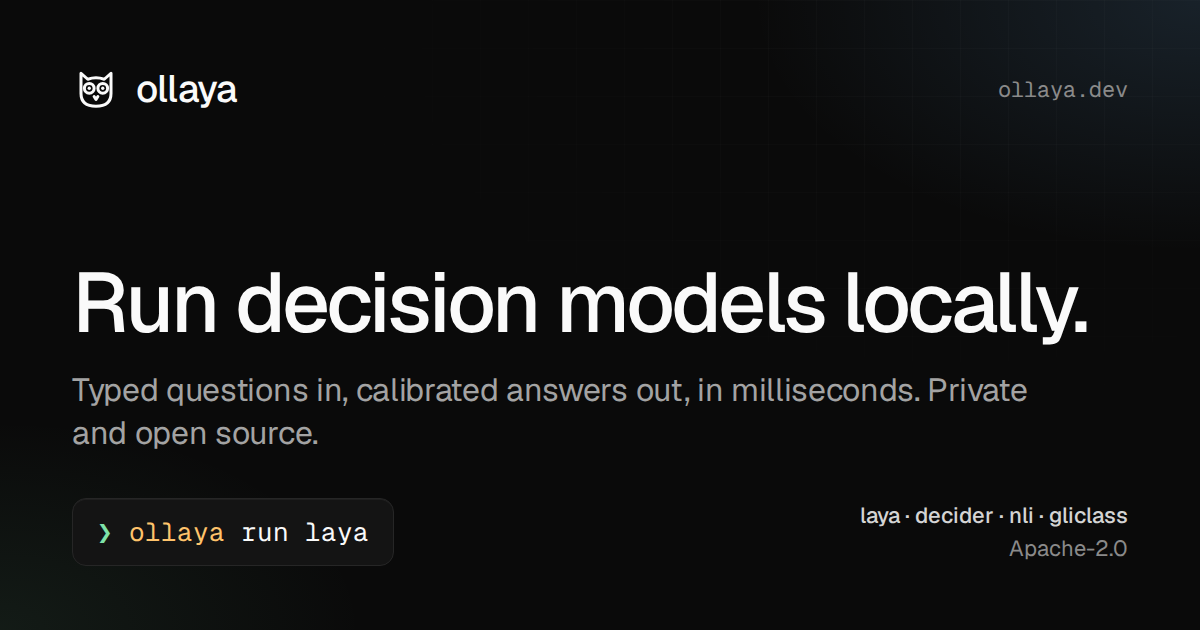
Image: Ollaya
Why it mattersTeams paying per call to classify tickets, tag emails, or gate content can now run the same shape of request on their own hardware, and the switch is a base URL change instead of a rewrite.
Anyone paying per call to route tickets, tag emails, or score content by intent can now do the same job on a laptop by changing one environment variable. Ollaya, released on 23 September 2026 under Apache-2.0, pulls open decision models from Hugging Face and serves them behind an HTTP API that matches TypeSafe's Jev. A Show HN thread reached 519 points in a day and the repository at ollaya-dev/ollaya carries 338 stars three days after creation.
What it does
A decision model answers a typed question over a fixed schema and returns a probability, not free text. Ollaya packages several open ones together and serves them through the same /v1/systemone and /v1/models endpoints that TypeSafe uses for Jev. The site states the official TypeSafe Python SDK 0.7.1 works unchanged against a local server after TYPESAFE_BASE_URL is set to http://localhost:11435. That is the whole switching cost for a team already writing against Jev.
The models included cover common classification shapes: Laya for choice, score and yes-or-no in one forward pass across more than 100 languages, Decider on Qwen3.5 for higher accuracy at a longer latency, NLI zero-shot classifiers by Moritz Laurer, GliClass for many-option questions where cost stays flat, Qwen3Guard for safety triage in 119 languages, and Von for inputs up to 8,192 tokens. Weights come from each author's Hugging Face repository, pinned to a commit and checked against a sha256 hash. Ollaya says it never re-hosts them.
What the numbers say
Ollaya publishes its own latency figures for a five-question request through the HTTP API on an RTX 4090: 8.1 milliseconds for the multilingual Laya, 9.6 for the English Laya, 14.7 for GliClass, 20.4 for NLI, 155 for the 0.8-billion-parameter Decider and 190 for the 2-billion. It compares those to a range of 236 to 276 milliseconds for TypeSafe's hosted Jev API. The Jev figures come from two third-party benchmarks Ollaya names as AbdelStark/jev-benchmarks and nibzard/decision-model-benchmark, and the local numbers include no network. The page states the setups differ and to read the comparison "as an order-of-magnitude comparison" rather than a like-for-like test.
The example on the site sends a 34-word tool call to decider:2b and gets back four typed answers, one of them a 0-to-2 risk score with a written reason, in 178 milliseconds on the same GPU.
Where it runs
Ollaya has a desktop app and a command line for macOS, Windows and Linux, plus a Docker image on GHCR. Every model runs on the CPU. An NVIDIA GPU on Linux, Windows, WSL 2 or Docker with driver R580 or newer and CUDA 13 takes a request down to milliseconds. On Apple Silicon, Laya and NLI use the Apple GPU through MLX; other models fall back to the CPU. The server binds to 127.0.0.1 by default, so a request never leaves the machine unless a team makes it.
The value here is the shape of the substitution. A team pointing a Jev client at a local Ollaya server keeps the same request and response contract, so the code around it does not change, and the data stays on the machine that already holds it. The vendor comparison should be run on real workloads before any budget move, since every Ollaya number came from Ollaya.
Source
- Ollaya: ollaya.dev
- GitHub: ollaya-dev/ollaya
- Discussion: Hacker News thread
This item was written by an AI system from the linked source. Reveneau is responsible for what it publishes.
Get AI News in your inbox
New developer tools, model and agent releases, and how teams are actually using them to release software. Short, and only when there is something worth reading.