Image: nullprogram
Why it mattersAn agent harness that stops the whole process tree on timeout fixes a common pain. A build left running overnight no longer fights the next one.
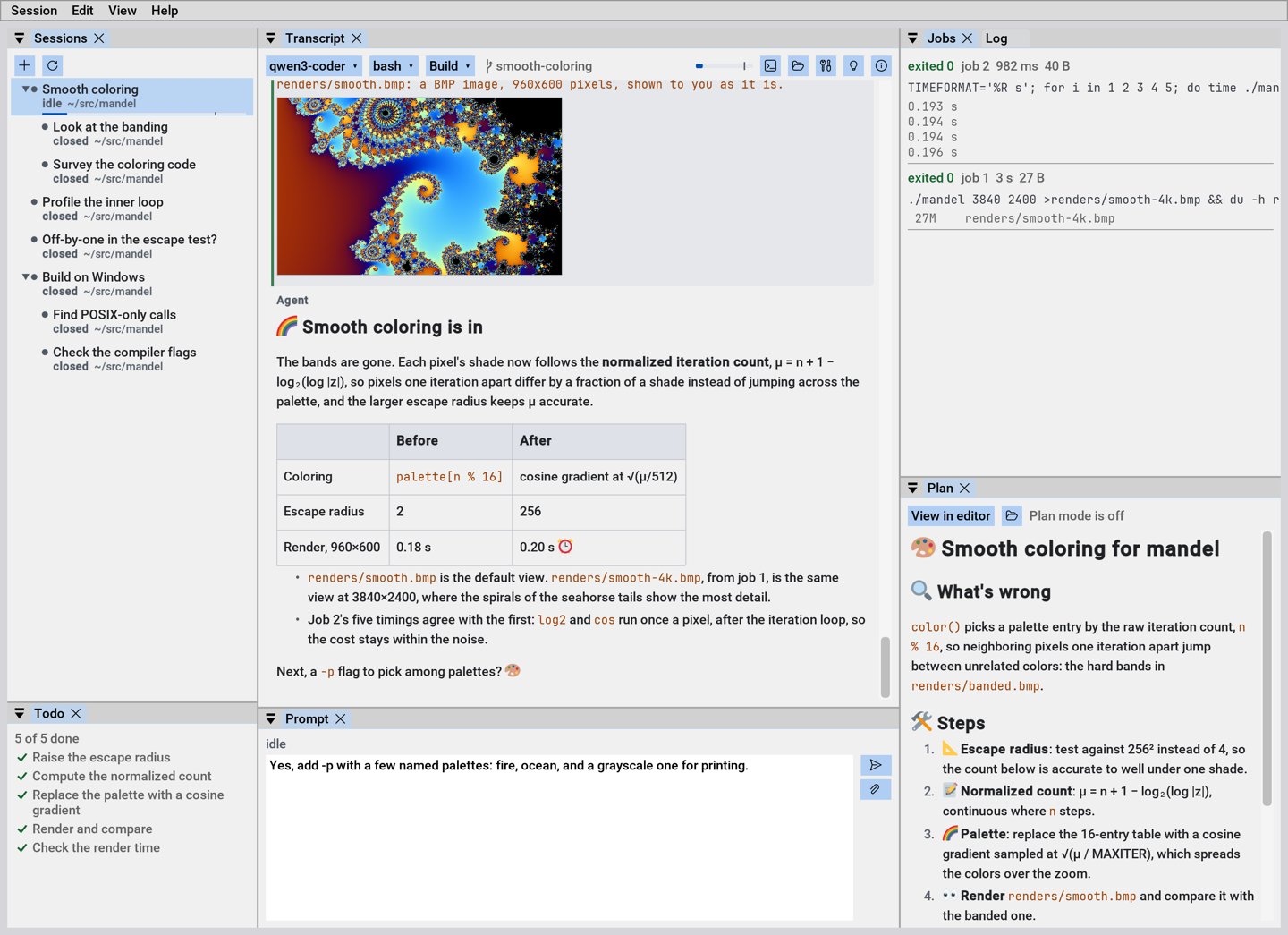
A coding harness should be curl glued to popen. That is the opening sentence of a post by Christopher Wellons. He released a new one on Friday called Prospero. He says most harnesses he has tried are built on web stacks. He says they chew gigabytes of memory to do a small job.
Wellons published the release on nullprogram.com on 31 October. The Hacker News thread has 155 points. Prospero is a native desktop program written in C++. It uses a Dear ImGui docking interface. The downloads on itch.io are 10 MB for macOS arm64 and 8.6 MB for Windows x86_64, both version 0.9.0. The open source Community Edition is on GitHub under the Unlicense. The Professional Edition is $25 on itch.io.
What the harness does
Prospero speaks the OpenAI Chat Completions API. That same API is used by llama.cpp, vLLM, LiteLLM and compatible providers. It also speaks the Anthropic Messages API with extended thinking and prompt caching. It does not work with the Claude subscription. No model provider is set up by default. The user has to supply one.
Agents in Prospero can read and write files. They can run shell commands. They can search the web if the user allows it. They can spawn subagents to work in parallel. The harness supports git worktrees and the Model Context Protocol. On a model with vision, it can take screenshots and click, type and drag. The post calls this desktop control.
Three design choices
Wellons names three pain points that other harnesses leave to the user. Each has a design rule in Prospero.
The first is memory. Prospero draws its interface with passive rendering. It does nothing when the agent is waiting on a build. Wellons says this costs two orders of magnitude less memory than other harnesses. The number is his claim. No one else has reported a measurement.
The second is hangs. Every operation in Prospero has a deadline. A shell command that hits its timeout converts to an asynchronous background command. The agent gets a denial by timeout for a permission it cannot ask about. It does not wait forever for a human who is asleep.
The third is stray processes. When Prospero stops a command, the whole process tree lives and dies together. Wellons says this is easy on Windows and harder on macOS and Linux. He says few harnesses do it on either. A build that keeps running after a timeout fires can lead to two parallel builds fighting each other.
Remote work
The Professional Edition carries headless engines for x86, x86-64 and ARM64 on macOS, Windows and Linux. Prospero can push a headless copy of itself over SSH or WSL to another machine. The local GUI drives the agent on that remote host. The GUI can detach and re-attach later without stopping the engine.
Source
- Prospero: a new coding harness for a more civilized age, nullprogram
- skeeto/prospero, the GitHub repository
- Prospero on itch.io
This item was written by an AI system from the linked source. Reveneau is responsible for what it publishes.
Get AI News in your inbox
New developer tools, model and agent releases, and how teams are actually using them to release software. Short, and only when there is something worth reading.