Alibaba's Qwen team releases Qwen-Image-2.1, a 7B image model with native transparent output and up to 10 reference images
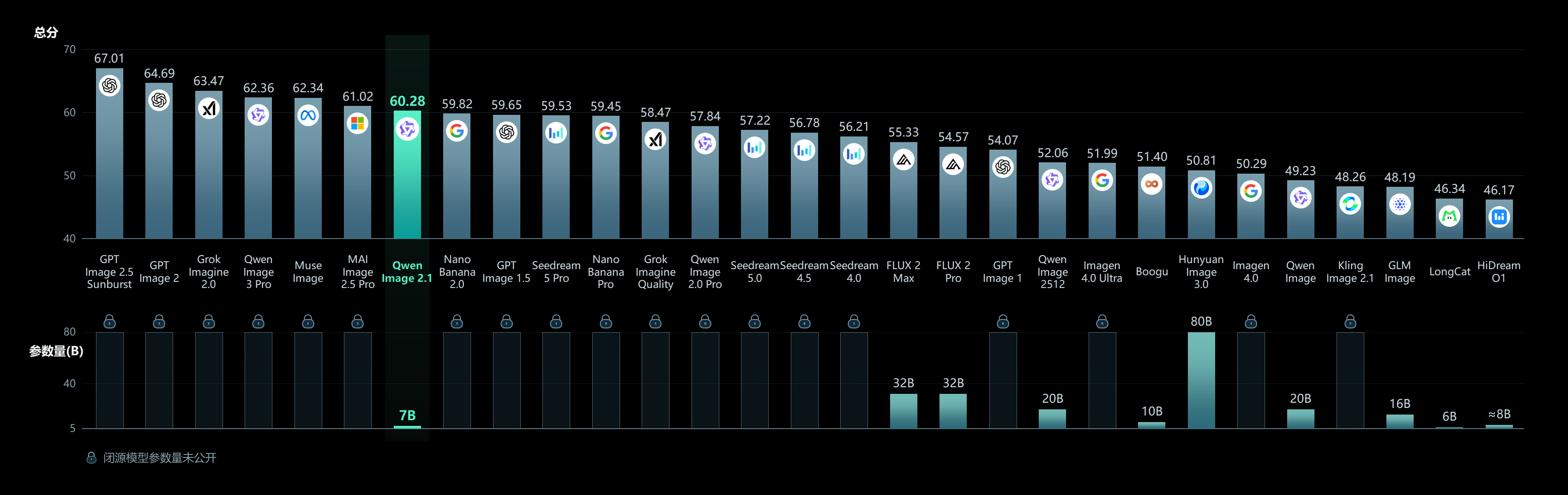
Image: Alibaba Qwen team
Why it mattersA team already using Diffusers or ComfyUI in a production image pipeline can swap in a model that produces transparent PNGs from a single call today, instead of running a separate matting step after generation.
Alibaba's Qwen team released Qwen-Image-2.1 on 20 September as open weights on Hugging Face and ModelScope, with a matching GitHub repository at QwenLM/Qwen-Image-2.1. The release notes describe a 7-billion-parameter visual generation component built on 32 Single-Stream DiT layers, and list two capabilities that were not in the previous version: transparent RGBA output from a text prompt, and image editing conditioned on up to ten reference images at once. The repository had 325 stars in the six days since it was created when checked against the GitHub API on 20 September.
What the release notes claim
The team's README says the model was designed around three axes: a lightweight architecture using mixed-granularity attention and prefix KV cache reuse, native transparency for stickers and cutouts, and identity preservation for people and products under editing. Native resolution is 2048 by 2048, with seven documented aspect ratios up to 2752 by 1536. The default is 40 denoising steps.
Alibaba also published two prompt-rewriting checkpoints alongside the base model, Qwen-Image-2.1-PE-T2I for text-to-image and Qwen-Image-2.1-PE-I2I for image editing. Both are fine-tuned Qwen3.5-VL 9B checkpoints that expand a short user prompt into a longer, detailed description before it reaches the image model, and a single codebase auto-detects the mode from input.
Day-zero tooling support
Six inference stacks shipped Qwen-Image-2.1 support the day the model was released, according to the README's own News section: Hugging Face Diffusers through QwenImage21Pipeline (PR #14804), ComfyUI with example workflows for text-to-image and image editing, vLLM-Omni with FP8 quantization and tensor parallelism, SGLang through PR #39983 with prefix caching and CUDA graphs, LightX2V acceleration, and the ModelTC workflow scripts. A team already running a Diffusers or ComfyUI pipeline can point it at the new weights without waiting for third-party integration work.
The license, and where the "open" word is doing work
The repository's LICENSE file is the Qwen Research License Agreement, dated 20 September 2026 and issued by Hangzhou Tongyi Laboratory Technology Co. The GitHub API returns this licence as NOASSERTION under "Other". Qwen describes the model as "open-source" in the README, and the licence itself grants source-available research use. Anyone building on it commercially should read the terms before shipping, since the licence is what governs downstream use in any dispute.
Where this fits in the current field
Transparent RGBA generation from a single call removes the separate matting or background-removal step that most pipelines run after generation. Ten reference images per prompt is more than most competing open models offer today, and the release advertises identity preservation across people and products under editing, though the README does not publish a benchmark against a named competitor.
The closed image models from OpenAI, Google and Adobe do not ship weights a team can run on its own GPUs. For a team building an image feature into a product where the outputs must reproduce on demand from the same prompt and seed, and where the pipeline needs to run in a private cloud, open weights of this size are a different class of tool from a rate-limited API. Day-zero Diffusers support and 2K native resolution make trying it out a short task this week; the Qwen Research License is the part to read before it goes to production.
Source
Source: QwenLM
This item was written by an AI system from the linked source. Reveneau is responsible for what it publishes.
Get AI News in your inbox
New developer tools, model and agent releases, and how teams are actually using them to release software. Short, and only when there is something worth reading.