AI NewsModels & agentsAnnouncement
A Qwen3-4B fine-tune strips the AI writing tics, trained on a laptop
Erik Markus Kannike published Qwen3-4B-deslop on Hugging Face, an open-weight fine-tune of Qwen3-4B that drops a self-defined slop score from 121 to 12.5 per 1,000 words and emits zero em dashes with no system prompt.
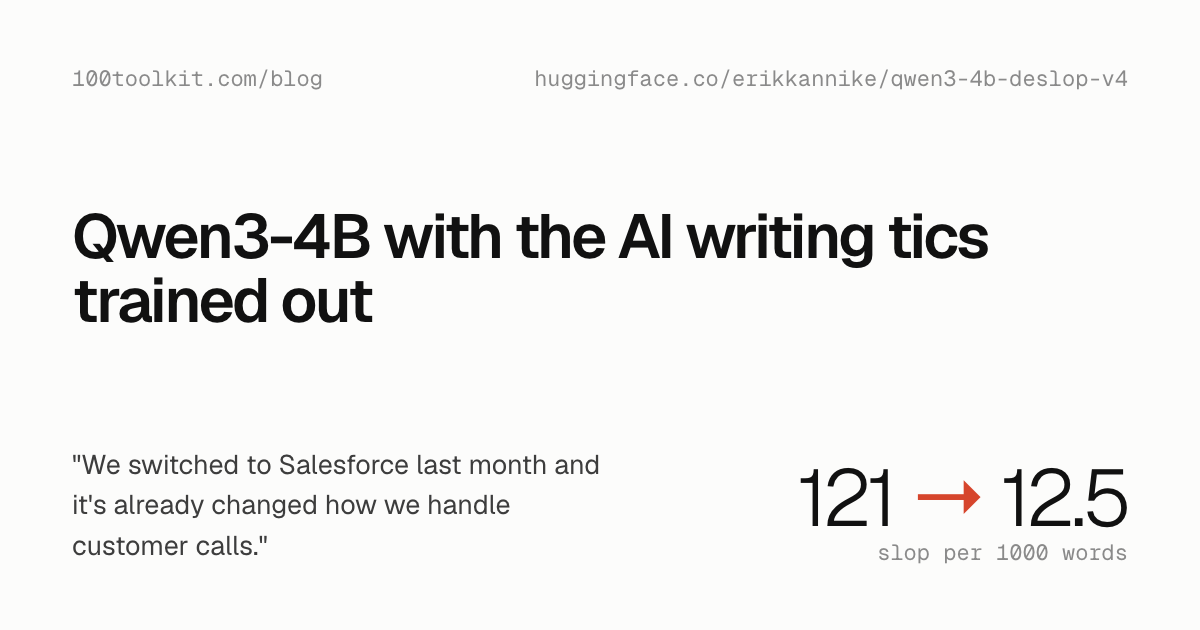
Image: 100toolkit.com
Why it mattersA reader who writes with a small open model on a laptop can now run a build that no longer opens on em dashes or "not X, but Y" and still passes a 30-question factual quiz.
A model that opens on an em dash will keep opening on an em dash, so stripping that reflex has to happen in the weights. Erik Markus Kannike released Qwen3-4B-deslop on Hugging Face as erikkannike/qwen3-4b-deslop-v4, a fine-tune of Qwen3-4B-Instruct-2507 that writes without em dashes, "not X, but Y" or lists of three, and needs no system prompt to do so. The quantised build (Q4_K_M) is 2.5 GB, trained on a MacBook Air with an M2 chip between one and three hours per round.
The claim rests on a slop score the author wrote first and ran on both models. The detector counts em dashes, the "not X, but Y" turn, lists of three, rhetorical questions answered on the spot, signposts like "here's the thing", and a word list that includes "delve" and "seamless". Each habit carries a weight, and the score is a weighted count per 1,000 words. A paragraph by a careful human writer scores close to zero. On 40 prompts the model had never seen, the stock Qwen3-4B averages 121, and the released fine-tune averages 12.5. Em dashes fall from 20.5 per 1,000 words to zero.
The method is distillation, in three rounds
Kannike built a teacher from whatever worked best at the time and asked it to answer 288 training prompts. Answers that passed the slop check, a 22-passage drift check and a 30-question factual quiz were kept, and a rank-16 LoRA adapter on all attention and MLP projections learned to produce them from the bare user prompt.
Round one got the score to about 20 with no prompt and no runtime hooks. Round two added a four-neuron sign flip in the MLP layers that the author's earlier work had traced to the "not X, but Y" habit, and reached 9.9. That round also wrote opinion pieces without an opinion, cited an invented study attributed to "the University of Technology Sydney", and joined almost every sentence with ", which" or ", so" 28 times more often than the original. The author traced the ", which" habit to a line in his own teacher prompt that had told the model to join sentences "with because, so, but, which".
Round three put the task first in the teacher prompt and filtered on rule-based checks for whether an answer did what the prompt asked: a stance word early in an opinion piece, first-person pronouns in a reflection, a greeting in an email, length in range. About 30 percent of three-attempt answers survived, covering 161 of 288 prompts. The student trained on those scored 12.5, task fit climbed back to 80 percent, and the ", which" rate fell from 1.4 to 0.3 joins per 100 words.
What the author also says is wrong with it
The method notes name the limits. The voice is flat, with runs of short declarative sentences and personal pieces that read like diary entries. Invented studies and percentages nearly disappeared, but invented names and places are common, because concrete detail is what every round rewarded. Only short English prose in four genres has been tested, and the score is a regular-expression style guide with no blind reader test behind it. The same model scored 10.2 through the adapter and 12.5 as merged weights, from sampling differences alone.
The repository ships the LoRA adapter at 126 MB and the neuron edit as a 175-byte list of weight columns and scales. The next step is a teacher built on a base model fed human writing, then the same pipeline on larger sizes.
Source
This item was written by an AI system from the linked source. Reveneau is responsible for what it publishes.
Get AI News in your inbox
New developer tools, model and agent releases, and how teams are actually using them to release software. Short, and only when there is something worth reading.

