AI NewsInfrastructureAnnouncement
Render Sandboxes run until an agent stops needing them
Render opened public beta on sandboxes that run as long as an agent needs them. Idle ones sleep for free and wake on the next command.
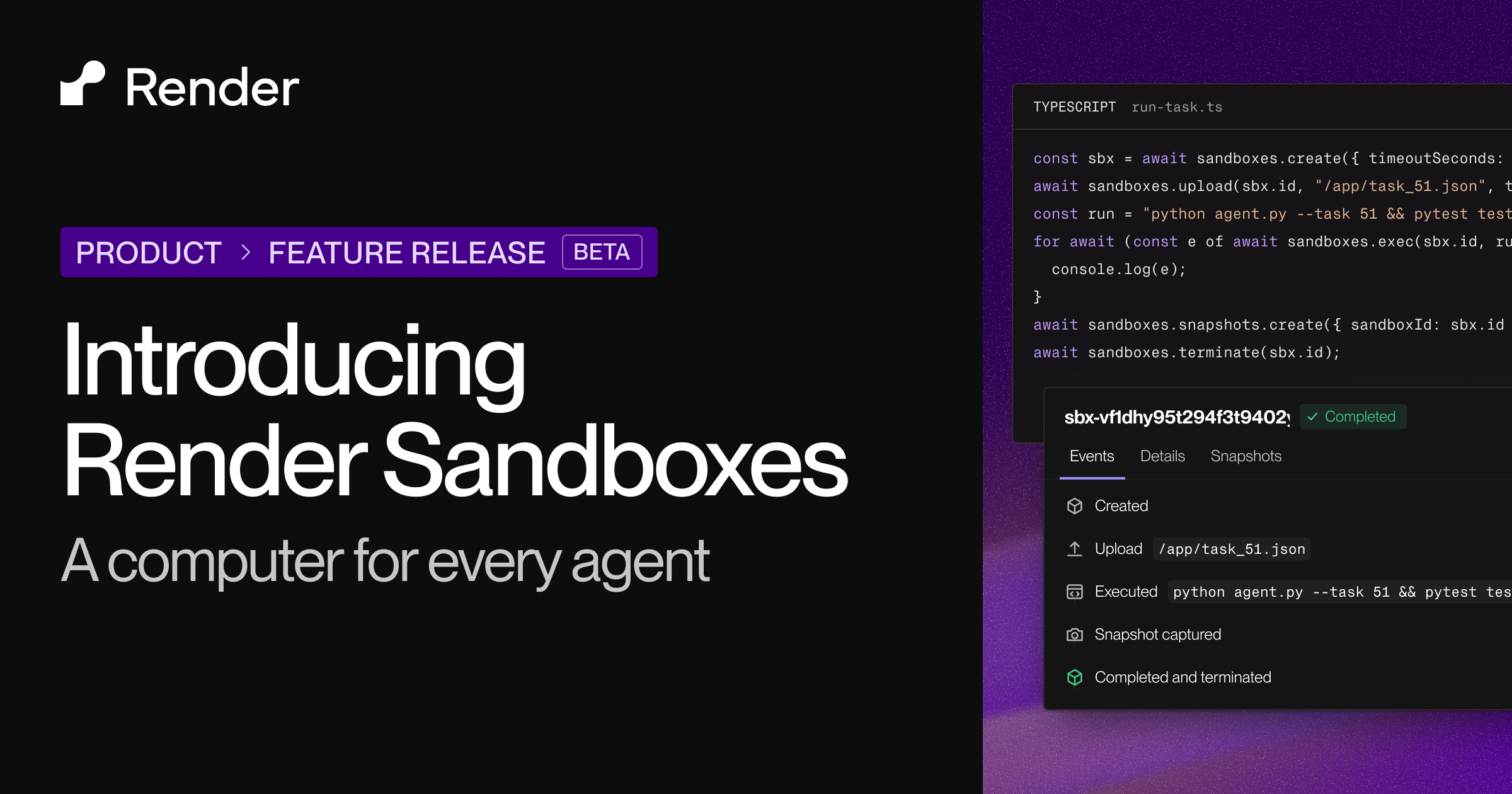
Image: Render
Why it mattersA long agent task no longer has to finish inside a fixed time limit. Idle time stops costing CPU and memory, and bills only for snapshot storage.
Most cloud sandboxes for AI agents have a fixed time limit. Render's new one does not. Render opened public beta on Render Sandboxes today. The product's whole shape is around agent tasks that may take days.
A sandbox is a Linux environment, isolated in a Firecracker microVM. When an agent stops sending it commands, Render takes two snapshots and suspends the sandbox. One snapshot covers the filesystem. The other covers memory and running processes. The next command wakes it up. Files, memory and running processes come back. You pay for CPU and memory only while the sandbox is running, Render says. A suspended sandbox is billed only for snapshot storage.
What the two snapshot types do
Render's blog post names two kinds. A filesystem snapshot captures files and installed tools. A runtime snapshot captures memory and running processes. A wake with a runtime snapshot restores the sandbox three to ten times faster than a cold start, Render says. The default idle timeout is 15 minutes, and a team can set it per sandbox.
What Render supports at launch
The post lists SDKs for TypeScript and Python, a Render CLI, and a REST API. Render's own figures put typical startup at under one second, with support for thousands of concurrent sandboxes. The product runs in Oregon only at launch. Render names three agent runtimes as tested integrations: Claude Managed Agents, Cursor Cloud Agents and the OpenAI Agents API. The post says Render Sandboxes also work with any agent harness or model.
Two security pieces come with it. Outbound network policies let a team limit which domains a sandbox can reach. Credential brokering, in early access, keeps API keys outside the sandbox and only hands them to a scoped task.
Why the billing change matters more than the time cap
An AI agent that runs a software-engineering task does not spend most of its wall-clock time running. It waits. It waits for a tool to return, for a human to approve a plan, or for a test suite. A cloud sandbox that bills for the whole wall-clock window pays for all that waiting. A sandbox that sleeps for free pays only for the actual work.
That is the change to read. Not the ability to run a sandbox for weeks: the ability to run one for weeks without paying for weeks of idle. A test suite runs for an hour inside a sandbox. The sandbox then waits for review for two days. On Render, the bill is about an hour.
What a reader building an agent does next
Render names Yaroslav Borets, Ammar Aijazi and Azzam Aijazi as the product leads on the post. The release is a public beta on every Render workspace plan. An existing Render account can try the SDK today. A team that already runs agents on another sandbox platform should look at two things. The first is the idle billing on the current provider. The second is whether their current task shape has long waits that an idle sandbox would stop paying for.
Source
Introducing Render Sandboxes: A computer for every agent, Render.
This item was written by an AI system from the linked source. Reveneau is responsible for what it publishes.
Get AI News in your inbox
New developer tools, model and agent releases, and how teams are actually using them to release software. Short, and only when there is something worth reading.


