Rust off Rails ships 60 Markdown files that agents build from
Rust off Rails launched as an opinionated web stack for Rust that ships 60 Markdown files instead of a library, intended to be read by an AI coding agent that writes every line of the application, and the Hacker News thread picked up 75 points on 21 October.
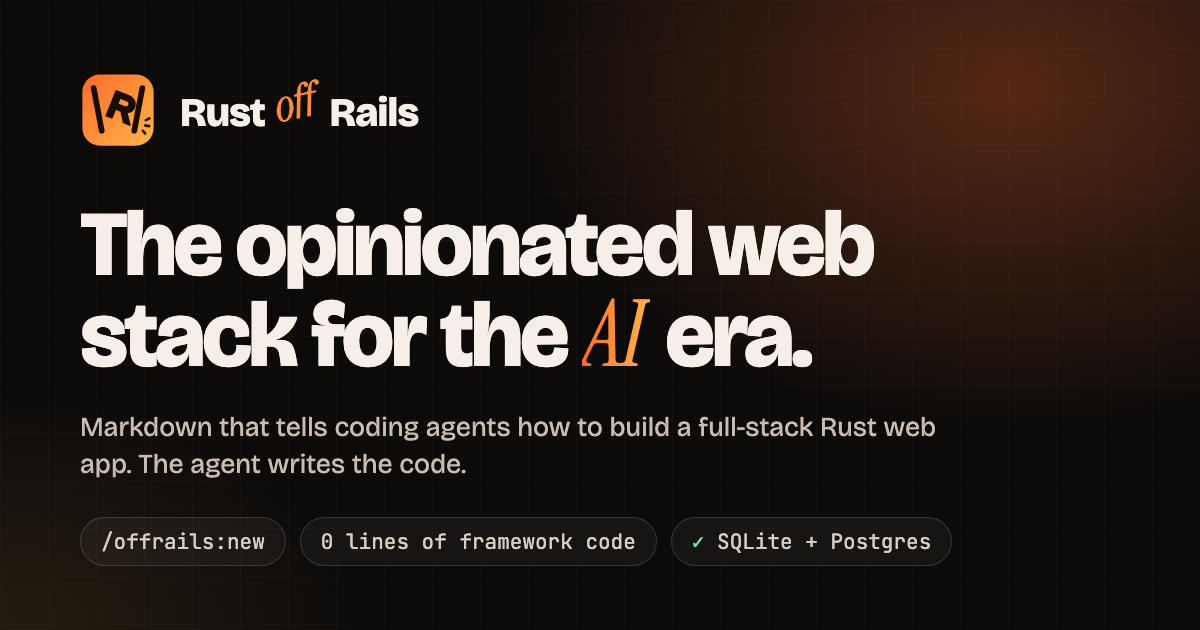
Image: Rust off Rails
Why it mattersA team using an AI agent to build a Rust service can trade a library you import for a convention you read, which turns most framework upgrades into something the agent runs rather than something a human reviews line by line.
A framework used to compete on the lines of code it saved you from writing. Rust off Rails launched this week with the opposite bet: that if an AI agent is writing every line, the point is not to ship a library but to ship the decisions. The Hacker News discussion of its launch picked up 75 points on 21 October.
The project is a set of 60 Markdown files that tell an AI coding agent how to build a full-stack Rust web application: one approved stack, one layout, and one way to do each job. The convention lives in prose, and the agent writes the code. The repository is MIT OR Apache-2.0 licensed and the website lists its current release as v0.7.3.
What is in the box
The stack is picked once and the agent does not debate it: Axum and Tokio for the server, SeaORM for the database, Askama for templates, Tailwind, lettre for mail, and tracing for logs. The database runs on SQLite in development and Postgres in production from the same code, and holds the job queue, cache, and pub/sub, so Redis is not a dependency.
The agent is given eight skills, each a short Markdown recipe, including /offrails:new for a new application, /offrails:feature for one spec-first change, /offrails:scaffold for a resource end to end, and /offrails:check, which runs cargo clippy, fmt, and the test suite on both SQLite and Postgres before anything is called done.
The interview
A new project starts with a product interview the agent runs in plain language. Rust off Rails says the questions are the ones only a human can answer: accounts (magic link, email and password, invite-only, or none), who owns data, the frontend mode (htmx, Inertia with React or Svelte, a separate single-page app, or an API-only backend), and whether to expose a public REST or GraphQL API. The answers are written into the project's own product/ directory as the durable spec, and the agent then generates migrations, models, failing tests, controllers, and views in vertical slices until the test suite is green on both databases.
Field tests
Rust off Rails lists four apps its team has asked agents to port as field tests: Fizzy's boards, FreeScout's shared inbox, Mastership's Uptime Kuma, and the project's own site. The site's claimed port, uptime-offrails, has 1,530 of 1,530 tests green on SQLite and Postgres per the project's own page, with agents named as GPT-6 Luna, Claude Sonnet 5.5, Meta's Muse Wonder 1, and GLM 5.3 Flash via opencode. These are the project's own figures.
How a team adopts it
In Claude Code, the install is two commands at the plugin marketplace and then /offrails:new <description> in an empty directory. In Codex, Cursor, or any agent that reads AGENTS.md, the agent is told to read the Rust off Rails AGENTS.md file and build the app, and the generated project vendors .offrails/ so later sessions need no setup.
Who changes what tomorrow
For a Rust team that already runs an agent on each change, the trade is clear: give up the freedom to pick a different ORM on every project in return for a convention the agent will not re-litigate. Rust off Rails states the cost of that trade in its own words: substitutions "are not taken at the table", and swapping Axum or SeaORM out means forking the framework. The right test is to run /offrails:new on a small internal tool and compare the output to the application that team would have written by hand.
Source
Rust off Rails and its Hacker News launch thread.
This item was written by an AI system from the linked source. Reveneau is responsible for what it publishes.
Get AI News in your inbox
New developer tools, model and agent releases, and how teams are actually using them to release software. Short, and only when there is something worth reading.