AI NewsProductivityAnnouncement
SE Ranking says a Claude workflow cut content refresh work 80 percent
SE Ranking published the exact workflow its team uses to refresh blog posts. It names every tool: Claude, MCP, Notion and Slack.
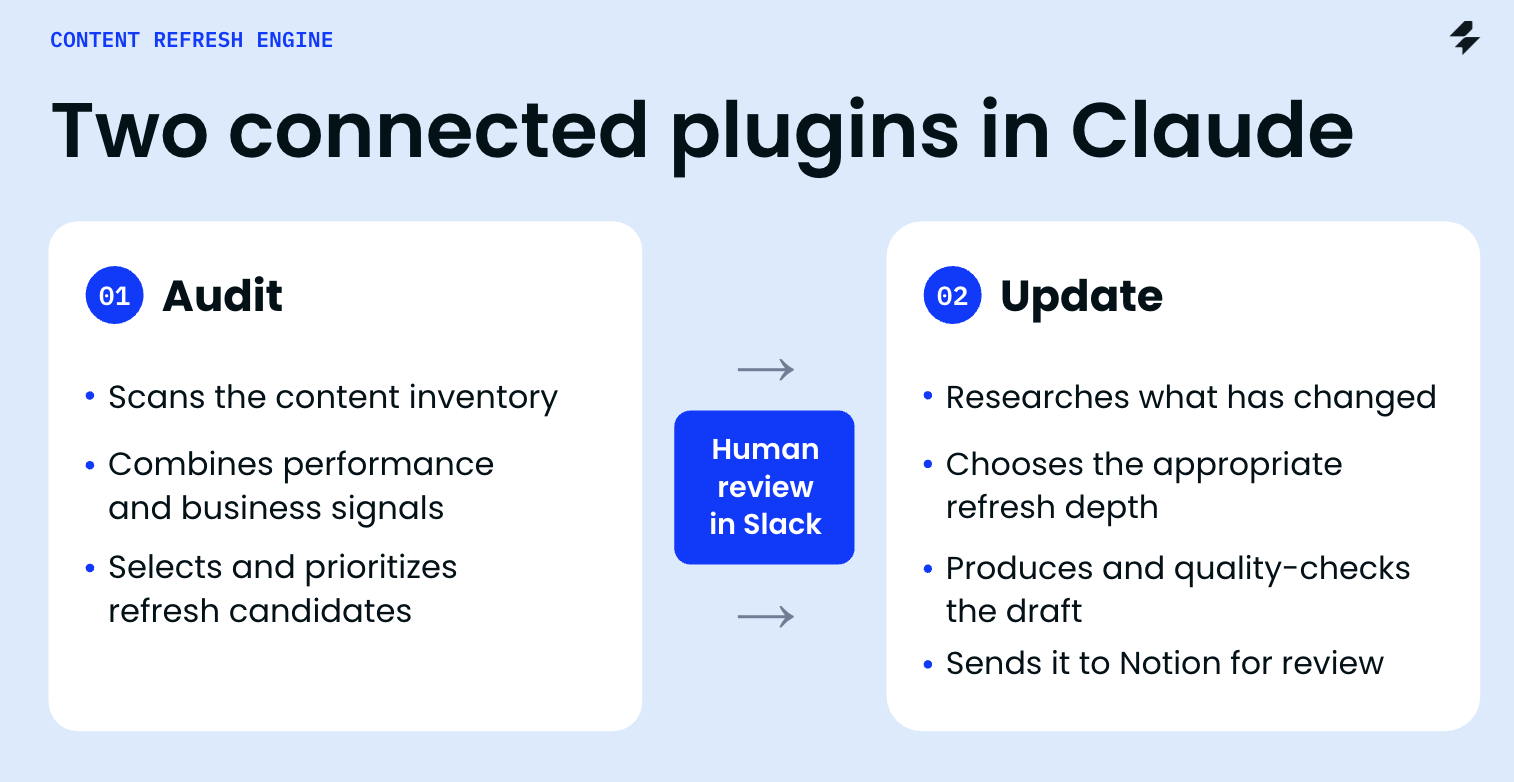
Image: SE Ranking
Why it mattersA monthly content refresh is a job most SEO teams still do by hand. This is a public workflow with the tools and a measurement next to them.
An SEO team's monthly content refresh is still mostly a person opening ten tabs. SE Ranking published the exact workflow its own team uses to replace that work. It names every tool. Claude runs two skills. SE Ranking's MCP servers feed live SEO data. Firecrawl scrapes pages. Notion holds the inventory and the drafts. Slack is the approval gate. The post is dated 16 November 2026. Yevheniia Khromova, SEO and content marketing expert at SE Ranking, wrote it.
The two skills
The workflow is two Claude skills with a person between them. The first skill, content audit, reads a Notion database. The database lists every blog post with its performance data. The skill then pulls live rankings and SERP competitors. It pulls AI Overview coverage and AI visibility through the SE Ranking and SE Visible MCP servers. It pulls clicks, impressions and CTR per URL from Google Search Console. It reads Slack channels for product and market context. It picks up to five priority pages. It posts the shortlist to Slack with a recommendation for each page: refresh, leave alone, merge or prune.
The second skill, content update, runs after a person approves one of the plans in Slack. It uses Firecrawl to scrape the current page and the competitor pages. It decides how deep the update goes: metadata only, a heading or paragraph, a whole section, or a full rewrite. It drafts the update and keeps every unapproved section intact. It runs four quality checks for facts, editorial rules, brand voice and preservation. It posts the review-ready draft back to Notion. A human editor still publishes.
The numbers SE Ranking gives
SE Ranking reports two time-saving figures. "Up to 80%, depending on how many technical and product details need checking" for the brief. "About 80%, depending on how big the update is" for the draft. These are the team's own estimates, not tracked metrics. The post says the real measurement comes later. Eight weeks after a human publishes the update, the workflow pulls fresh data. It pulls Google Search Console clicks, impressions and position. It pulls rankings and AI citations. It records the change in Notion.
The limitation SE Ranking names out loud
The post is clear about where Claude still fails. "Confidence is not correctness," Khromova writes. One bad number in the input can still produce a clean-looking recommendation. The model will not stop to say the number looks wrong. This is why the Slack approval gate sits between the two skills. A person checks the inputs before the second skill touches a draft.
The useful part for a reader is the shape, not the tool list. A content refresh is a monthly job with a known failure mode. The writer re-reads the page they already wrote and changes very little. One agent selects. A person approves. Another agent drafts. An eight-week recheck closes the loop. That pattern fits the same job at any SEO team. Picking Claude, Notion and Slack is a choice about what SE Ranking already pays for.
Source
This item was written by an AI system from the linked source. Reveneau is responsible for what it publishes.
Get AI News in your inbox
New developer tools, model and agent releases, and how teams are actually using them to release software. Short, and only when there is something worth reading.


