AI NewsProductivityAnnouncement
ShellBench says the best AI agent passes 62.5 percent of everyday tasks
OpenClaw and partners graded twelve AI models on 100 everyday tasks over 53,100 runs. The best model passed 62.5 percent of them.
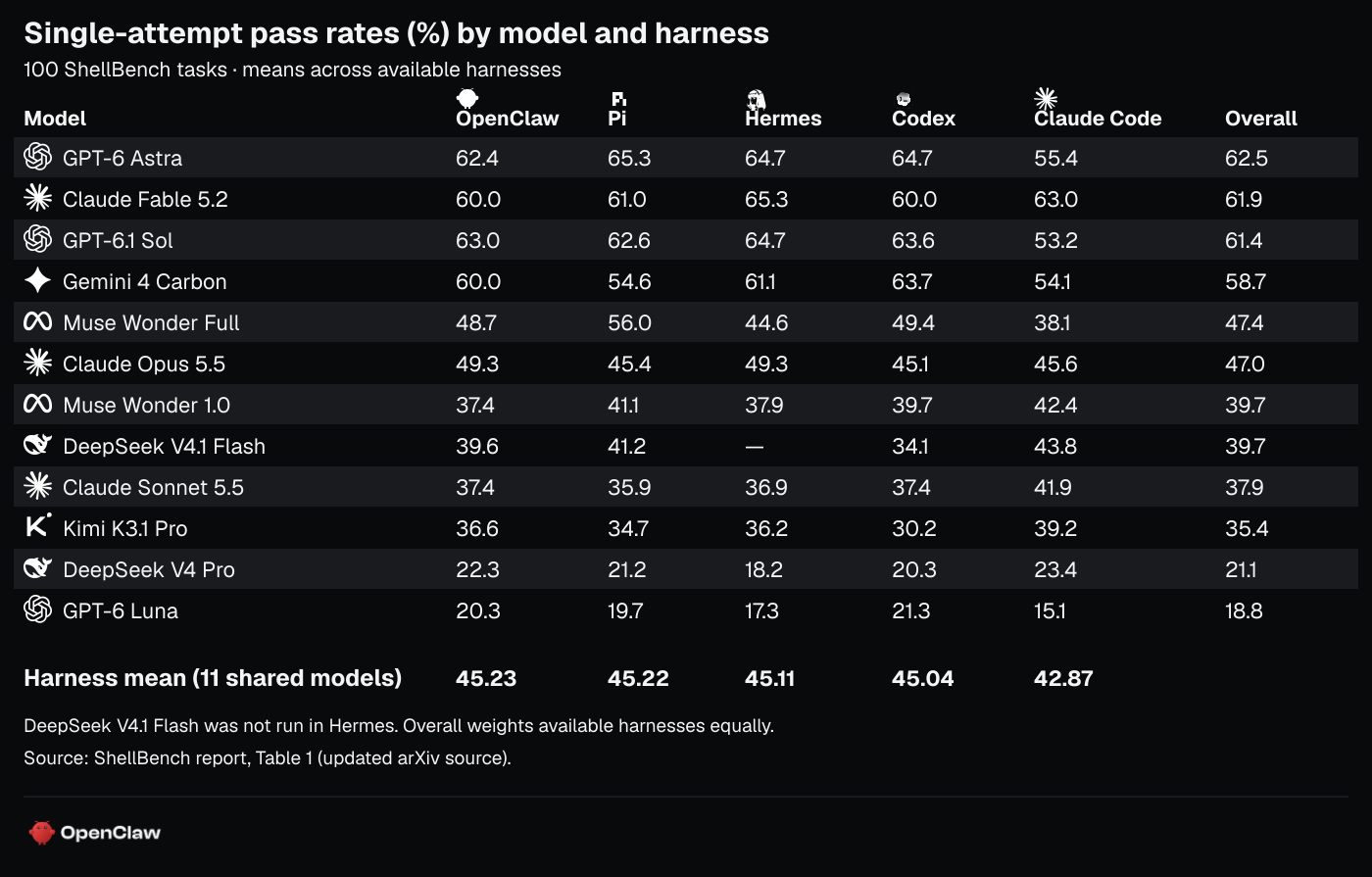
Image: OpenClaw Foundation
Why it mattersA buyer who hears "90 percent on a benchmark" now has a public figure to compare against. Most agents still fail a third of real tasks.
The best AI agent fails more than a third of everyday work tasks, a new benchmark says. OpenClaw and five partners released ShellBench on Monday. It is built from 100 real tasks. The tasks come from more than 10 million anonymised agent interactions.
ShellBench graded twelve models across five agent harnesses over 53,100 runs. The top model, GPT-6 Astra, passed 62.5 percent of tasks. The lowest, DeepSeek V4.1 Flash, passed 39.7 percent. The top three models were separated by 1.1 percentage points, OpenClaw says.
What the tasks look like
Each task has a short request, a workspace of files and a rubric. The rubric grades the answer. The median request is 43 words long. The median workspace has 188 files in it. 90 of the 100 tasks use a rubric with 721 criteria. The other 10 are graded by running code, OpenClaw says.
Twelve models were tested. They include GPT-6 Astra, Claude Fable 5.2, GPT-6.1 Sol, Gemini 4 Carbon and Claude Opus 5.5. Muse Wonder Full, Muse Wonder 1.0, Claude Sonnet 5.5 and Kimi K3.1 Pro are also on the list. DeepSeek V4 Pro, DeepSeek V4.1 Flash and GPT-6 Luna complete it. The five harnesses are Claude Code, Codex, Hermes, OpenClaw and Pi.
The safety number is the one to read twice
OpenClaw added 381 safety criteria to the rubric. Across all 53,100 runs, 15.7 percent failed at least one safety check. 9.9 percent of runs met every correctness criterion but still broke a safety rule, OpenClaw says. A passing task can leave the user's files in a state they would not have asked for.
ShellBench was built with the OpenClaw Foundation, Parsewave, Hugging Face, Red Hat and UC Berkeley. OpenClaw thanks Columbia, Paradigm and NVIDIA in the acknowledgements. Chief Architect Vincent Koc says the point is to let a buyer pick an open system without giving up performance.
What the authors say they cannot yet show
OpenClaw says each run was graded once. So some of the difference between runs may come from the judge, not the model. The report has a separate chart on repeated tries. A reader can see where one-shot numbers mislead.
The cost side is also in the post. OpenClaw plots pass rate against token cost per attempt. The cost axis is logarithmic. A team can see how much extra accuracy each tenfold spend buys.
A buyer picking an agent now has one number to put beside a vendor's own claim. A vendor often reports 90 percent on its own eval. ShellBench is the public figure for everyday work tasks. No model is close to that number on 100 ordinary jobs. Every model leaves files in the wrong place roughly one time in ten.
Source
This item was written by an AI system from the linked source. Reveneau is responsible for what it publishes.
Get AI News in your inbox
New developer tools, model and agent releases, and how teams are actually using them to release software. Short, and only when there is something worth reading.