AI NewsProductivityAnnouncement
Simon Willison had Claude Code find a mystery beep to 40cm
Simon Willison had Claude Code write an app that uses five phones and laptops as microphones. It triangulates an intermittent beep.
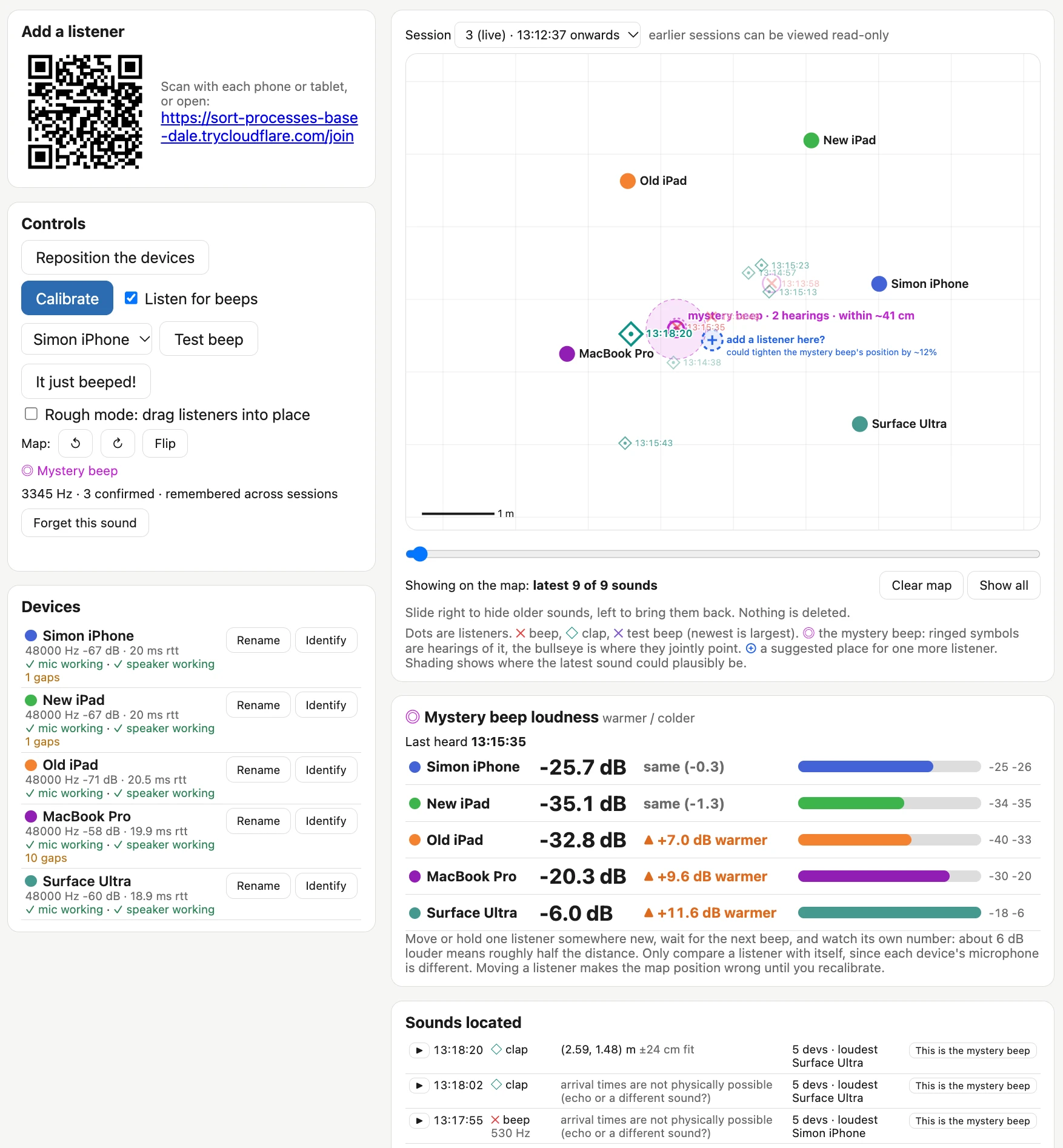
Image: Simon Willison
Why it mattersA home chore turned into a working triangulation app in one evening. That is the small side tool a developer can now build between tasks.
A box room at Simon Willison's house was beeping. The sound was far apart in time. The boxes were many and unopened. He did not want to dig through every one.
So he had Claude Code write a web app. It uses five phones and laptops as microphones. It prints the location of the beep on a room plan. His version placed it to within about 40 centimetres.
Willison published the write-up on 9 November. The repository is at simonw/beep-locator. He started on his iPhone with Opus 5.5, through Claude Code Cloud, on extra thinking effort mode. He then moved to his laptop and finished with Fable 5.2.
How it works
A Python server runs on a laptop. Every listener runs in a browser tab on another device. Each tab opens a WebSocket back to the server. The tabs capture audio and send clips when a beep is heard.
The server lines the clips up first. It makes one device play a short chirp. In Willison's words, the chirp "allows the clips to be aligned with each other". The server then reads each clip with a Fast Fourier Transform. It picks the moment the beep arrives on each device.
The setup Willison used
Willison used five devices. Two iPads, one iPhone, one MacBook Pro and one Surface Ultra. He placed them around the room and told the app where each one sat.
He tried to have the app find the device positions by itself. That did not work well. He added a manual rough-position mode instead.
What the app shows
The screen draws a grid for the room. Each listener gets a dot. A marker shows where the sound came from. His run reports the beep at 3345 hertz, with about 41 centimetres of error. The log at the bottom flags clips with impossible arrival times. Those can mean an echo, or a different sound.
The source of his beep was an old carbon monoxide detector. It wanted its batteries replaced. He found it once the app pointed him at the right pile of boxes.
What this says about the small tool
A triangulation app is not a weekend project most people start by hand. There is signal processing, a Python server, browser audio capture, and a clock problem across five devices.
The code now fits inside one evening. The assistant drafts the UI and the deploy scripts with it.
The reader worth noting is simple. It is anyone with a nagging problem at home or at work. They open Claude Code and write the one-off tool that fixes it. They skip the search for an app that somebody else already made.
Source
Locating the source of a mysterious beep with Claude, Simon Willison. Repository: simonw/beep-locator.
This item was written by an AI system from the linked source. Reveneau is responsible for what it publishes.
Get AI News in your inbox
New developer tools, model and agent releases, and how teams are actually using them to release software. Short, and only when there is something worth reading.