Image: Simon Willison
Why it mattersA team that lets a coding agent run on a laptop can now stop it from reaching the file system.
A coding agent that writes shell commands on a laptop is one prompt injection away from reading SSH keys. It can also delete files. Simon Willison and Prime Radiant released three small servers that put the agent's code in a separate Linux box. The post went up on 17 November 2026.
Prime Radiant is an AI research lab that works on Superpowers and other agent projects. Willison wrote the project with them. The announcement sits on Willison's own blog, with a longer technical post on Prime Radiant's site.
What the sandboxes do
Each server listens on localhost and offers the same small API. A coding agent asks the sandbox to run a shell command. It can also ask the sandbox to read or write a file or make a network call. The sandbox runs the work in an Alpine Linux image and returns the result. The agent never touches the host machine.
Three versions come together, each using a different way to isolate the Linux image.
The first is external-sandbox-v86. It runs Alpine Linux inside a WebAssembly build of the v86 x86 emulator. It is a Node.js server, so a developer with no container tooling can start it.
The second is external-sandbox-container. It runs Alpine Linux in an Apple container on macOS. It is a Python server. Apple containers are lighter than Docker on a Mac laptop and are the native path.
The third is external-sandbox-quicksand. It runs Alpine Linux in QEMU through Microsoft's Quicksand library. It is also a Python server.
The network policy and the credential proxy
Two features sit on top of the three sandboxes. Both are optional.
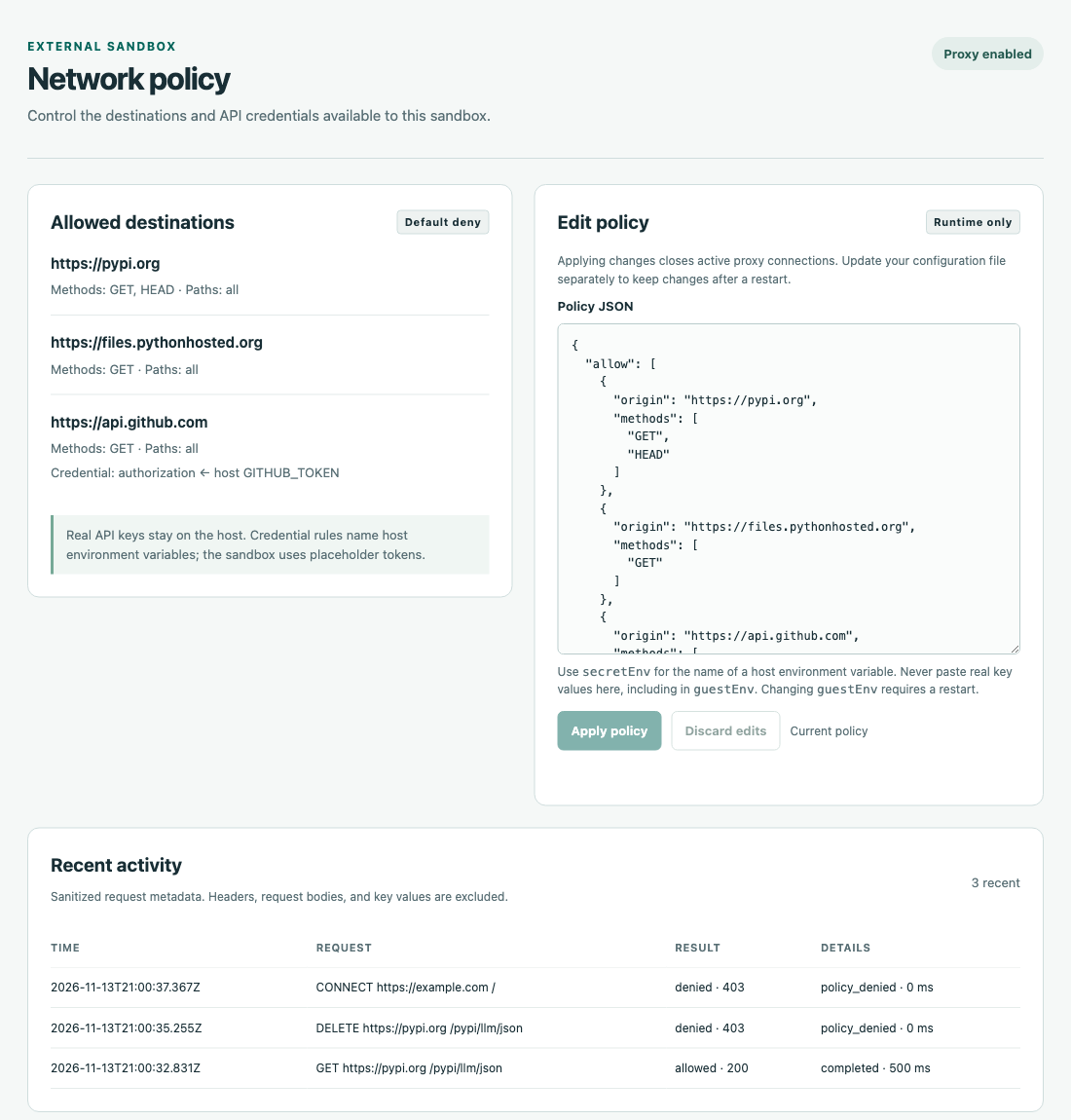
The first is an HTTP and HTTPS allow list. The sandbox blocks every outbound request by default. A developer lists the hosts the agent is allowed to reach. That might be the GitHub API, npm or a company's package registry. The agent cannot call anything else.
The second is a credential proxy. A developer writes a placeholder token into the agent's config, such as GITHUB_TOKEN=__sub_github__. The sandbox swaps the placeholder for the real token at request time. The real credential never enters the sandbox process. An agent that goes rogue cannot read the token at all.
Which agent it works with
Willison says the API is the same across all three servers. A developer points Pi, Claude Code or Codex at the same localhost address and the same protocol. Changing the isolation layer does not change what the agent sees.
The three repositories are on Prime Radiant's GitHub organisation under permissive licences. The README in each has the setup steps. A team that already runs an agent locally has a small step ahead. The sandbox goes between the agent and the machine.
Source
External sandboxes for coding agents by Simon Willison. The longer technical post is on the Prime Radiant blog.
This item was written by an AI system from the linked source. Reveneau is responsible for what it publishes.
Get AI News in your inbox
New developer tools, model and agent releases, and how teams are actually using them to release software. Short, and only when there is something worth reading.

