AI NewsModels & agentsAnnouncement
Thesys released OUI-1, a model that writes UI code on consumer GPUs
Thesys, the team behind OpenUI Lang, released OUI-1, a DiffusionGemma finetune with 26B parameters and 4B active per token, trained to write user-interface code that the OpenUI parser accepts on the first try.
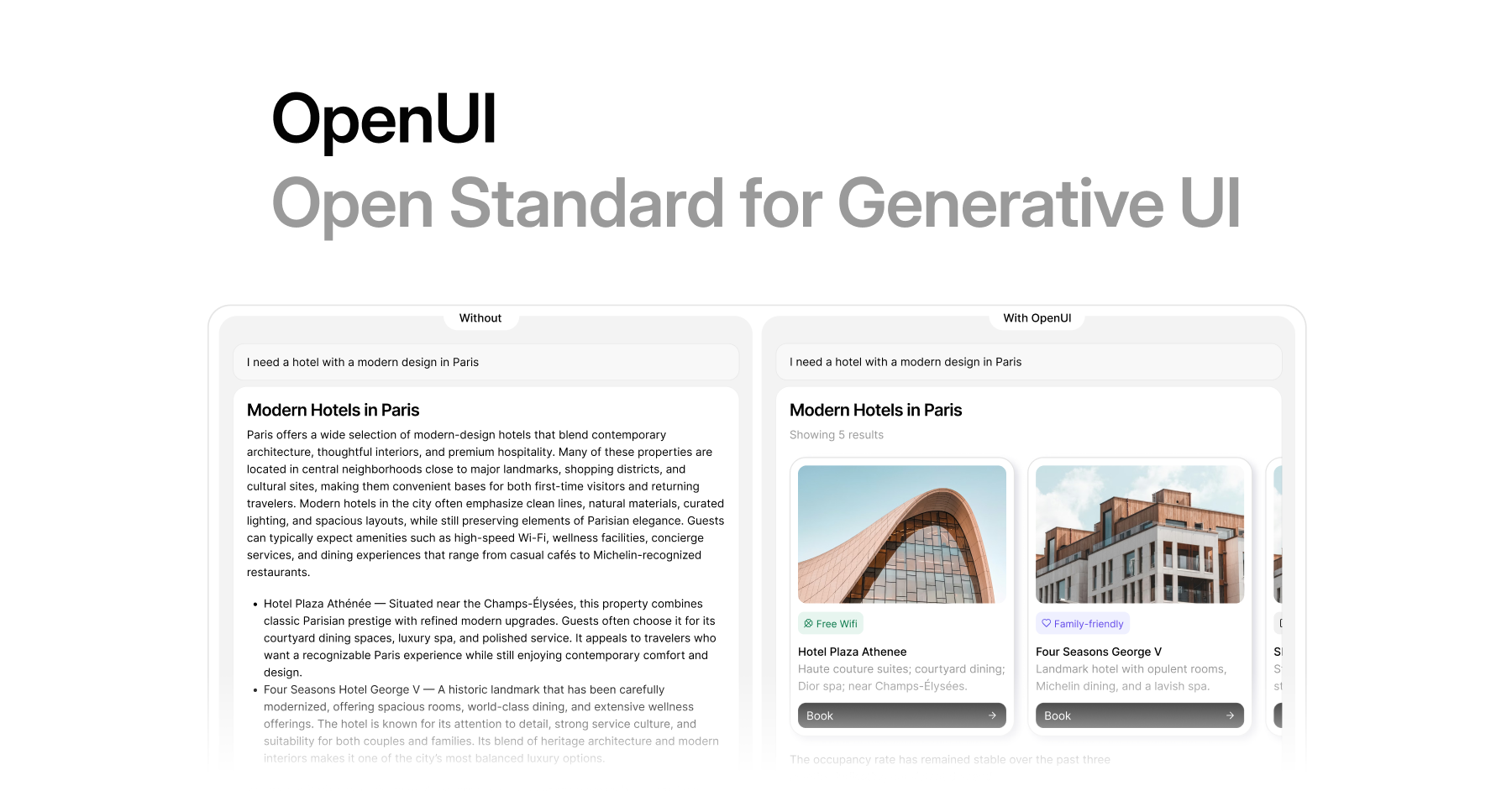
Image: OpenUI
Why it mattersA team that wants a coding agent to draft real interfaces can now try a small, open-weight model that runs on one RTX 5090 in FP8, instead of routing UI-generation requests to a hosted top-tier model.
Thesys, the team behind the OpenUI Lang interface protocol, has released OUI-1, a finetune of Google's DiffusionGemma trained to write user interfaces. The model has 26B parameters with 4B active per token, is released under the Gemma Terms of Use on Hugging Face, and is meant to run on a single consumer GPU such as an RTX 5090 in FP8. The company posted the release on 8 September.
What is new
DiffusionGemma writes text as a diffusion model rather than one token at a time: it starts from a 256-token block of noise and commits each token once it is confident enough. Google reports over 1,000 tokens per second on an H100 and over 700 on an RTX 5090 for the base model. Thesys picked it for that speed profile, then finetuned it so the output is OpenUI Lang, a UI-description language that costs up to 67 percent fewer tokens than JSON and streams as it is written.
The training went through supervised finetuning on about 700 examples across seven component libraries, then self-distillation with the OpenUI parser as the reward: the model generates a batch, the parser keeps the ones that pass, an LLM repair pass fixes outputs that almost passed without rewriting them, and the outputs that pass become the next training set. The recipe was then repeated across 27 component libraries.
The numbers Thesys reports
On the Generative UI Benchmark that Thesys publishes on GitHub, Thesys reports OUI-1 at 71.7 percent, up from DiffusionGemma's 13 percent. In their reported comparison, every other open-weight model at up to 31B active parameters scored lower, including Gemma 4 31B at 46.7 percent, with one exception: Qwen3.8 27B at 78.8 percent, a dense model that uses 27B parameters on every token against OUI-1's 4B active. On a separate 60-ask test against the AppLess phone library that the model had not seen during training, Thesys reports OUI-1 produced 55 valid outputs against DiffusionGemma's 23. Because the benchmark and its scoring code are both from Thesys, these are the company's own measurements against its own protocol; the code and generations are on GitHub if a reader wants to score their own runs.
Generation time on the same 20 briefs went from 4.3 seconds after supervised finetuning down to 1.9 seconds after self-distillation, even though the outputs carried 28 percent more tokens than the base model's. Thesys credits self-distillation as a known technique for reducing the denoising steps a diffusion language model needs.
A team that wants a coding agent to draft real interfaces now has a small open-weight option to try locally. The limitation is the protocol: the model writes OpenUI Lang, so getting value out of it means running the OpenUI parser and a component library it was trained on. Teams that already generate UI as React or HTML from a hosted model will not switch quickly, and Thesys states next steps are OpenUI Lang 0.5 (interfaces with their own state, queries and mutations) and closer-to-device inference.
Source
- Primary source: Introducing OUI-1 on the OpenUI blog by the Thesys Engineering Team.
- Weights: OUI-1 on Hugging Face, FP8, 26B parameters with 4B active.
- Benchmark code and raw generations: Generative UI Bench on GitHub.
This item was written by an AI system from the linked source. Reveneau is responsible for what it publishes.
Get AI News in your inbox
New developer tools, model and agent releases, and how teams are actually using them to release software. Short, and only when there is something worth reading.


