Image: Together AI
Why it mattersA platform team can now measure how its own API behaves under a coding agent. The sample suite reports a 77 percent pass rate at 7 cents per run. The number a team cares about is its own, not a vendor benchmark.
A team can now measure how a coding agent behaves on its own API. Together AI released Hurdle on 25 November 2026. It is an open-source npm library. It runs a real task against Claude Code and Codex. It scores each run in three ways. It reports a pass rate for each model and each condition.
The post is on the Together AI blog. The code is at github.com/togethercomputer/hurdle. The package is installed with npx hurdle init.
What one run looks like
A run has four parts. A task tells the agent what to do. A fixture gives it the inputs. A scorer decides whether the result is a pass. A matrix picks which models and conditions to compare.
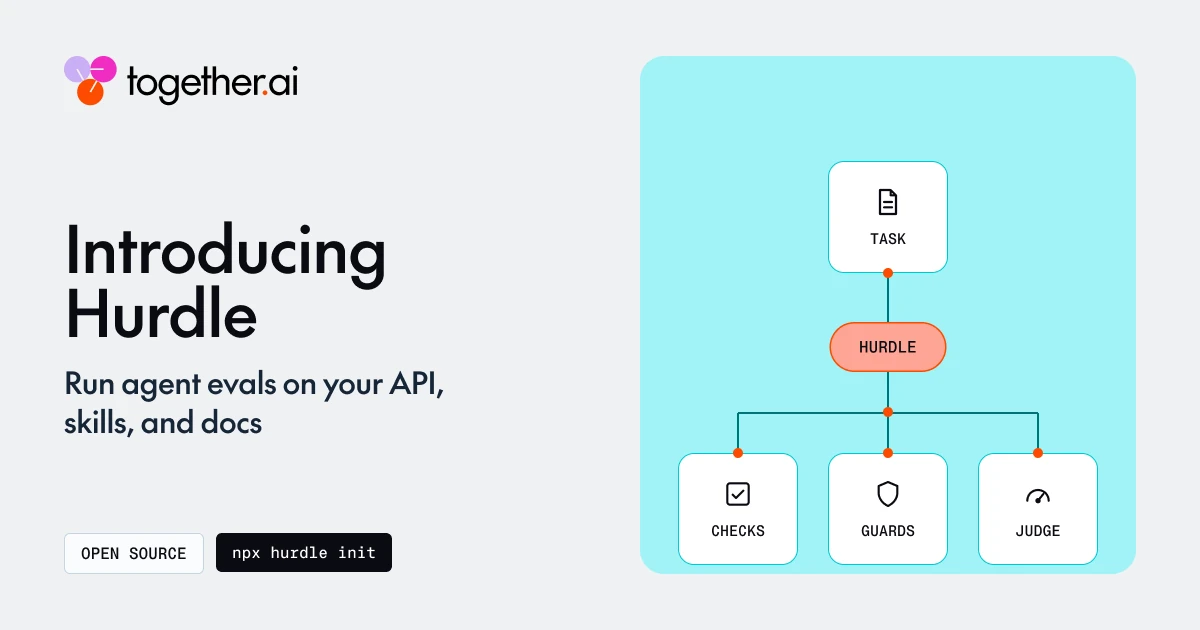
Hurdle offers three kinds of scorer and lets a suite mix them. A code check is a deterministic test the user writes in TypeScript. A guard is a safety rule the agent must not break. A judge is a second language model that reads the agent's work and grades it. Together AI says the three can run on the same task in one pass.
The library runs each cell of the matrix a chosen number of times. It records every attempt, the cost, the duration and the pass or fail. The output is a table of pass rates.
The sample suite
The post walks through a sample suite that runs one task against two models under two conditions, repeated 15 times. That is 60 total runs. Together AI reports a 77 percent pass rate on the suite. The average duration was 7 seconds. The average cost was 7 cents per run.
The two models in the sample are Claude Code and Codex. The two conditions are the same task with and without a piece of context the agent is expected to use.
For a team that owns an agent-facing API
A team that owns an agent-facing API, a skill library or a set of docs can use Hurdle. It turns real tasks into a suite. It runs that suite against the two agents a developer actually uses. The scorer mix fits what each task needs. A unit test fits a code task. A guard fits a compliance task. A judge fits a judgement call where a rule is not enough.
The gain is a number the team's own customers would recognise. A vendor's benchmark is set up to flatter the vendor. A suite of the team's own tasks runs the same way every week. It tells a product team whether a new model release helped or hurt the work its users do.
Source
This item was written by an AI system from the linked source. Reveneau is responsible for what it publishes.
Get AI News in your inbox
New developer tools, model and agent releases, and how teams are actually using them to release software. Short, and only when there is something worth reading.
