AI NewsGo-to-marketAnnouncement
Only 40 percent of stats AI tools quote reach a real study
Trakkr traced 1,285 statistics that five AI tools quoted. Only 40 percent reached a study that said the same thing.
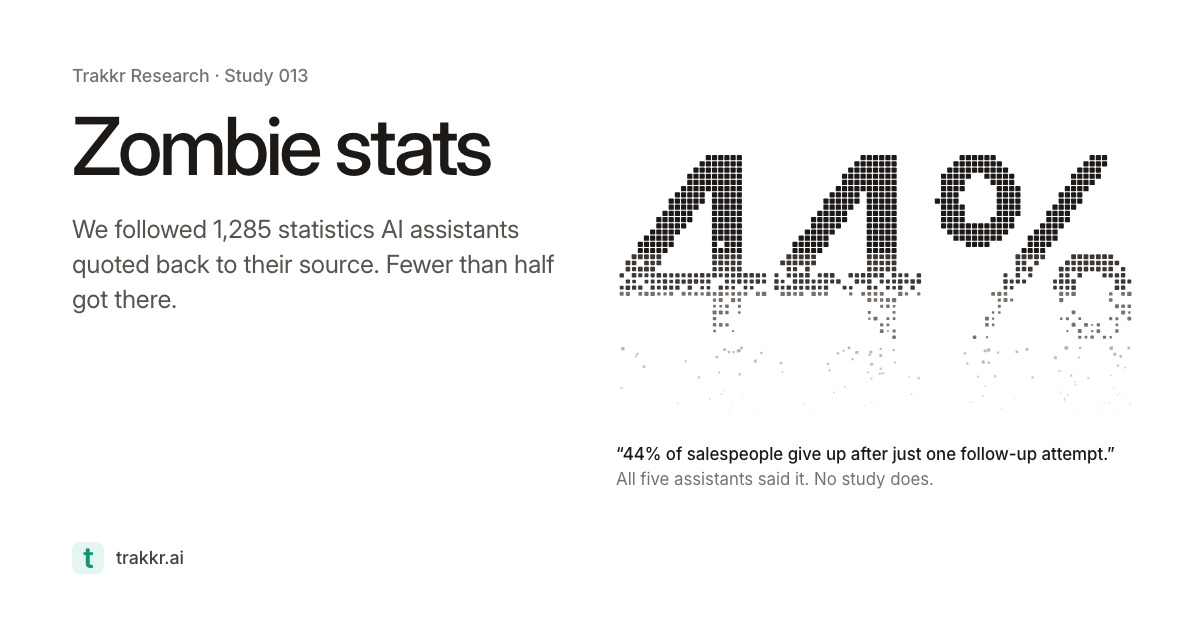
Image: Trakkr
Why it mattersA number quoted by every answer engine is not a safe number. A team that cites what an AI tool quoted is inheriting a source nobody checked.
Every answer engine will quote a number if asked. Most of the numbers do not lead back to a study. Trakkr is an AI visibility research group. It says it traced 1,285 statistics quoted by five AI tools. Only 40 percent matched what the original study said. The rest stopped at a locked page, a dead link, a company blog, or nothing at all.
Mack Grenfell published the research on 28 October 2026. His team asked five AI tools the same 200 questions. The tools were ChatGPT, Perplexity, Gemini, Claude, and Google AI Overviews. The questions needed numerical answers. The tools quoted 3,167 statistics across the answers. The team then followed each citation up to five pages deep. An AI model read every trail. The team hand-checked 150 of them.
What they found
Only 40 percent of the 1,285 traced claims matched the number in the original study. Another 8 percent reached a study, but the number or the context had changed on the way. 40 percent of trails ended at a page the team could not check, locked, deleted, or silent. 11 percent led to no source at all.
ChatGPT quoted the fewest numbers, 1.3 per answer, and had the best sourcing rate at 57 percent. Perplexity sourced 46 percent of its 2.2 per answer. Google AI Overviews sourced 39 percent of 4.8 per answer. Gemini sourced 38 percent of 6.2 per answer. Claude quoted the most, 6.8 per answer, and also sourced 38 percent. Trakkr says the pattern is that quoting more stats does not mean sourcing more.
The zombie stats
Four claims appeared in every one of the five tools. Trakkr says none of the four reached a real study. The one its post leads with: "44 percent of salespeople give up after one follow-up." The trail ends at a freelance writer's sample article. The others: 90 percent of social media users follow brands. 75 percent of searchers never scroll past page one. It costs 5 to 25 times more to win a customer than to retain one.
By source type, 54 percent of citations went to a company blog. Only 37 percent of those matched the study. 13 percent went to a research firm (62 percent matched). 7 percent to a government source (61 percent matched).
An AI tool is not a shortcut to a trustworthy citation. A team pastes a number from an answer into a sales deck or a blog post. The team is now the authority for that number. The source list in Trakkr's own post is open: the questions, the tools, the trails. The quiet lesson sits in the agreement. When every engine quotes the same figure, that is often where the mistake lives. The trail hit the same unchecked article a few years ago. Nobody audited it after.
Source
Zombie Stats: Where the Numbers AI Quotes Come From, Mack Grenfell for Trakkr.
This item was written by an AI system from the linked source. Reveneau is responsible for what it publishes.
Get AI News in your inbox
New developer tools, model and agent releases, and how teams are actually using them to release software. Short, and only when there is something worth reading.