AI NewsGo-to-marketAnnouncement
Verno launches on YC with AI that edits plant engineering drawings
Verno launched on Y Combinator with an AI that edits piping diagrams for industrial plants.
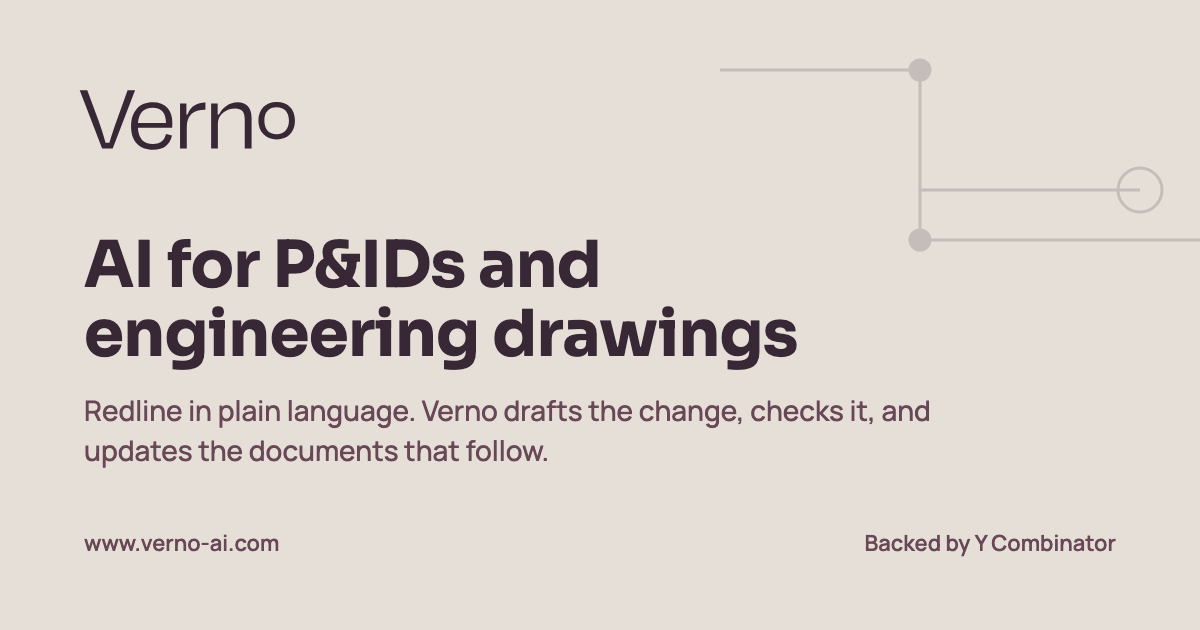
Image: Verno
Why it mattersThe pitch is a narrow job in a slow industry. Building for process plants means every change has to be signed off by a licensed engineer.
An engineer at a chemical plant marks up a drawing with a red pen. A drafter opens the file and makes the change. Then the downstream documents get updated by hand, one at a time. Miss one, and the error shows up in the field. Verno says it is the AI that can do that loop in minutes. The company launched on Y Combinator today in the Fall 2026 batch.
Verno's pitch, in its own words, is "AI for how the physical world gets built". The launch page says it starts with the P&ID, the piping and instrumentation diagram. This is the master drawing of every tank, pump, pipe, valve and sensor in a plant.
What the product does
Verno says an engineer can describe a change in plain words. The page gives the example "add a bypass valve here". Verno then edits the native CAD file. The company says downstream documents follow: line lists, spec sheets and other files across CAD, Excel, PDF and Word.
The launch post says every change is checked against engineering rules. Its examples: a pump needs suction and discharge, a control valve needs its instrument loop, a spec change needs a break. It says the system catches errors across documents too. One example is a relief valve set higher than the pipe below it can handle.
Verno says engineers stay in control. They approve every change and stamp the drawings.
Who it is built for
The launch names six fields for the first pilot. They are oil and gas, chemicals, semiconductors, pharma, food and beverage, and plastics. Verno says it will add water and power next. The company wants to expand to other drawing types later. Those include process flow diagrams, utility flow diagrams, single-line diagrams and loop diagrams.
The launch calls process EPCs the first customer. EPC stands for engineering, procurement and construction. These are the firms that design and build plants. Verno says engineering design is "a $130B+ industry in the US alone". That figure is the company's own.
Who built it
The YC page names two founders. CEO Oliver Wesche, by his own account, was an ML engineer at Blue Origin. He says he built an AI there that decided what to make next across the factories. He also says he built Asurion's generative AI for call centre agents. He puts the scale at more than 5,000 agents and $6 million saved a year. These are his own figures. CTO Ujjawal Madan says he was an AI engineer at Promise, a YC W18 company. He says he is now a Principal at Asurion.
The company raised no amount on the launch page. The YC launch has 7 votes at the time of publishing.
Why it is hard
A process plant is a safety-critical environment. A piping change has to be signed off by a licensed engineer. The Verno page says this is why the product keeps the engineer in the approval seat. The system edits the drawing, and the engineer stamps it. That is the pattern for every regulated industry.
The second hard part is the file format. P&IDs live in CAD tools that a general-purpose AI model does not read. The launch says Verno edits "the native CAD file". It does not name the tools. A pilot customer will care which ones: AutoCAD Plant 3D, SmartPlant P&ID and Bentley OpenPlant are the three most common in the fields Verno names. The launch page does not say which of them are supported today.
Source
Verno: AI that edits and checks the engineering documents behind every industrial plant, Y Combinator.
This item was written by an AI system from the linked source. Reveneau is responsible for what it publishes.
Get AI News in your inbox
New developer tools, model and agent releases, and how teams are actually using them to release software. Short, and only when there is something worth reading.