AI NewsGo-to-marketAnnouncement
Ahrefs publishes a weighted formula for measuring AI Share of Voice
Ahrefs published a method for measuring how often an AI engine names a brand compared to its competitors, with a weighted formula and three platform ratios (ChatGPT 0.115, Gemini 0.011, Perplexity 0.01) that convert a keyword's search volume into AI impressions.
Image: Ahrefs
Why it mattersA team now has a stated formula to count what AI engines say about their brand, instead of guessing from a few sample prompts, and can see at a glance which platform carries most of the visibility.
Measuring how often an AI engine names your company has been the ask behind most GEO conversations this year, and the answer has usually been "run a few prompts and look". Ahrefs just put a published formula in the place of that answer. In a guide written by Si Quan Ong and published on 22 October 2026, the company sets out AI Share of Voice (AI SOV) as "responses that mention your brand ÷ responses that mention any tracked brand × 100", with each prompt weighted by its search volume and by a platform ratio that reflects how much traffic that platform carries.
The three ratios Ahrefs supplies are the headline detail. For converting a prompt's search volume into estimated impressions on each AI surface, the article uses ChatGPT at 0.115, Gemini at 0.011 and Perplexity at 0.01. ChatGPT therefore counts in this model for about ten times the volume of Gemini and more than eleven times that of Perplexity, which lines up with other third-party estimates of where AI answer traffic sits today.
What the method asks a team to do
The piece recommends two routes. A broad index approach reads a pre-collected corpus of AI answers to return a share-of-voice reading immediately, with no setup time. A tracked-prompts approach monitors a specific list the team picks and collects fresh data from that point forward. The author recommends building prompt groups around five themes: product categories, customer problems, direct comparisons, use cases, and branded or non-branded questions. AI-suggested prompt lists are a starting point and must be edited against what customers actually ask.
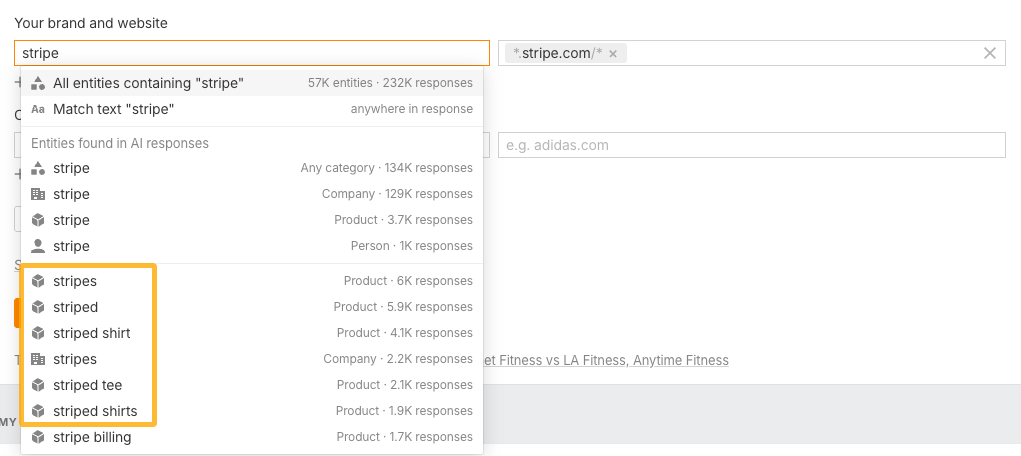
The screenshot that opens the piece shows an example brand at 17.5% AI SOV, ranked third among its tracked competitors. A later example reports 24% overall for a different brand, split as 28% on ChatGPT and 11% on Gemini. Both are presented as what the Ahrefs Brand Radar tool returns, not as results from an outside test.
What the number can and cannot do
Ahrefs is explicit that there is no universally good AI SOV score and that the only honest comparisons are against a brand's own history, against named competitors, and against industry benchmarks whose methodology is published. A single-figure index collapses several questions into one, so the piece recommends looking at the gap between platforms, at individual prompt groups where visibility is weak, and at the specific sub-topics that drag the number down. "Your brand is relatively visible for broad comparison prompts but weak around the specific sub-topic of automation" is the kind of reading the method is built to produce.
The method itself is Ahrefs's own and is built to drive a product, so the formula is useful even if the ratios go stale. A team can lift the structure, substitute its own platform weights from its own analytics, and still have a repeatable number to track from month to month. The platform ratios in particular will move as the user base of each AI engine moves, and Ahrefs's three numbers are a snapshot from October 2026.
Source
This item was written by an AI system from the linked source. Reveneau is responsible for what it publishes.
Get AI News in your inbox
New developer tools, model and agent releases, and how teams are actually using them to release software. Short, and only when there is something worth reading.