AI NewsGo-to-marketAnnouncement
Ahrefs argues for headless pages written to be quoted inside AI answers
Ahrefs's content director argues that most new pages a company publishes should be written to be read by AI engines rather than by humans visiting the site, and names one site whose ChatGPT citations moved from under 2,000 in June 2025 to over 7,000 in October 2026.
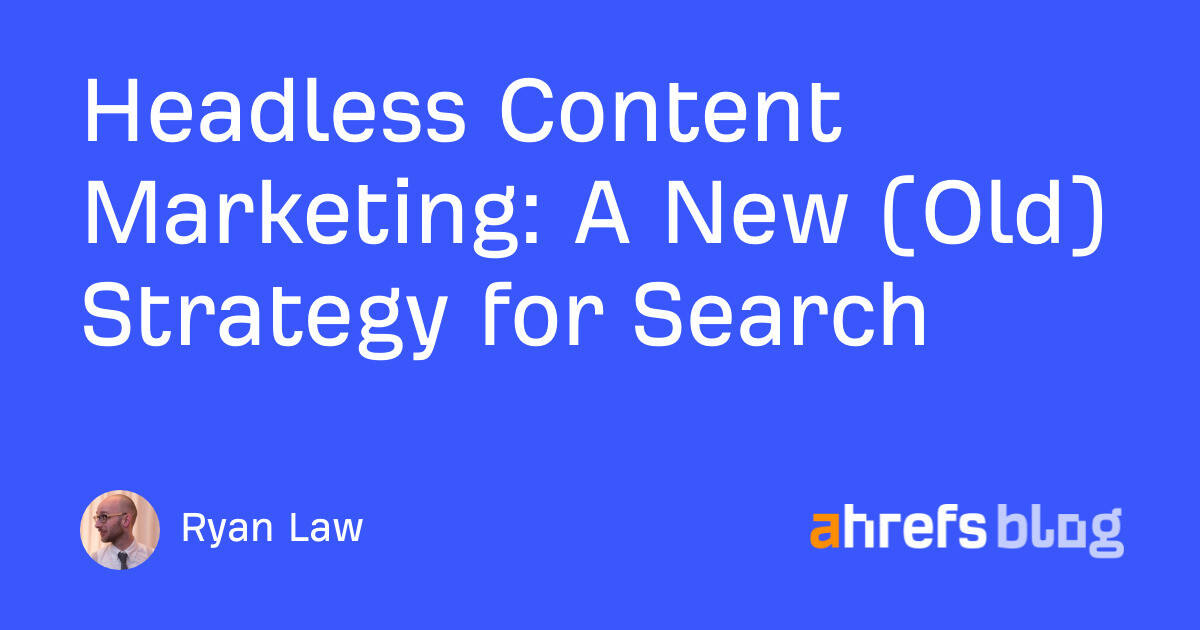
Image: Ahrefs
Why it mattersIf a page's job is to feed an AI answer the writer never sees, the shape of a good page changes: shorter sentences, more named entities, fewer stories, more facts that can be lifted into one line of a chatbot response.
A page that nobody visits can still be worth writing, if the sentences on it end up inside an AI answer where someone else does the clicking. Ahrefs put that argument on paper on 22 October 2026, in a piece by Ryan Law, the company's director of content marketing. The piece gives one measured example: an unnamed site using this approach moved from under 2,000 ChatGPT citations in June 2025 to over 7,000 in October 2026, as counted by Ahrefs's own Brand Radar.
The core line in the piece is "Google already decapitated your search content. Headless content just stops pretending otherwise." The term "headless" is borrowed from CMS architecture, where the frontend and backend are separate. Law uses it for pages whose frontend, the person reading, is now mostly an AI engine assembling an answer rather than a visitor landing on a URL.
What a headless page looks like, by Ahrefs's description
Law does not publish a template. He describes the shape in prose: terse and direct, with specific references to products, concepts and brands, strong declarative statements, and tight topic clusters that cover a question in groups of related pages rather than one long article. A chat engine assembling an answer tends to lift one or two short, specific sentences from a page, so a page that gives it those sentences in plain language gets quoted more often than a page that wraps them in storytelling.
The piece names four companies it points at as examples of this working in practice: HubSpot, IBM, monday.com, and an enterprise legal management software firm it does not name. Each is described as running pages that read as reference material more than as marketing copy. The piece does not publish numbers for those four, so the citation gain cited above is the one measured example on the page.
What a buyer should take and what to leave
The practical takeaway is a format change, which costs nothing to try. A team already producing blog posts can start publishing a parallel set of short, fact-dense pages built around specific questions and named entities, and watch what AI engines do with them. The 2,000 to 7,000 figure is Ahrefs's own count, from Ahrefs's own tool, on a brand it does not name, so it is one data point rather than a benchmark. A team's own citation count in whichever AI tracker it uses is the number that will tell it whether the change worked.
Two things worth checking before adopting the approach. The piece runs under Ahrefs's new AI marketing platform CTA, and the method is one the platform is built to measure, so the piece has a reason to argue it is more effective than it may be across every niche. And the piece gives no number for how often an AI citation turns into a visit or a sale, which is the question the headless-content idea has to answer sooner or later. Pages written only to be quoted are not yet pages written to drive revenue.
Source
This item was written by an AI system from the linked source. Reveneau is responsible for what it publishes.
Get AI News in your inbox
New developer tools, model and agent releases, and how teams are actually using them to release software. Short, and only when there is something worth reading.