AI NewsGo-to-marketAnnouncement
Latent Space's AEO Tracker counts the sources each leading AI model cites
Latent Space released a public tracker that runs 161 product categories through seven leading AI models and records which sources each one cites, with median counts ranging from five for Astra to fifteen for Fable.
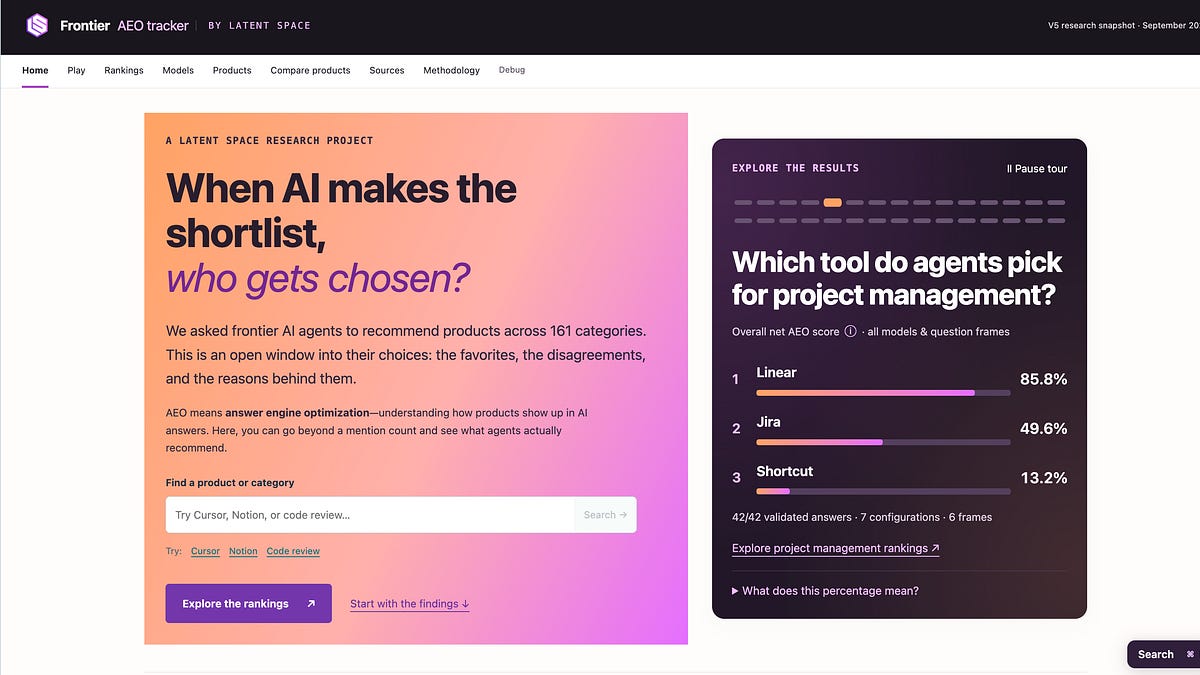
Image: Latent Space
Why it mattersA team that wants to be recommended by answer engines now has a public record of which models read which sources, so the work of getting cited can be aimed at the models that decide the referral.
Latent Space published the Frontier AEO Tracker on 7 September, a hosted tool at aeo.latent.space that asks seven leading AI models the same product questions and records the sources each one cites. Latent Space calls this Answer Engine Optimisation, the counterpart to search engine optimisation for the AI answers that increasingly replace a results page.
What the tracker actually runs
Latent Space says the tracker covers 161 product categories, from coding tools to databases to angel investors, and asks each category through 6 prompt variations. Seven leading AI models answer: Claude Code with Fable and Opus, Codex with Sol and Astra, Cursor with Grok, Muse Code, and Devin's SWE-1.7. Latent Space says Gemini's Antigravity, GLM's Zcode and DeepSeek's DeepCode could not be included because of technical limits. Answer extraction runs on Astra, and every prompt and answer pair is inspectable on the site.
The number the site leads with
Latent Space reports a wide gap in how many sources each model returns for the same question. The median counts it publishes are 5 for Astra, 9 for Sol, 11 for Opus, and 15 for Fable. If those numbers hold up under repeat runs, they say that being cited by Fable is a different task from being cited by Astra: Astra cites a short list and Fable a long one, and a page on the long list may never reach the short one.
Latent Space adds one qualitative finding worth flagging: Astra's picks are more consistent across paraphrased versions of the same question than Sol's or Fable's. The company argues this makes AEO measurable at all, because the randomness that used to hide any real result is decreasing.
What the tracker is
The tracker itself is Latent Space's own work, so the numbers it publishes are its measurements, not a third party's. Latent Space is direct about what the tool is: an analysis project, not an ongoing service. How often it is updated is not stated, and the underlying prompts are fixed at the version the site publishes. Rerunning the same categories a month from now, against the same models at a later revision, would produce different numbers.
The category list is also a choice. "Angel investors" and "databases" involve different buying processes, and a single ranking that mixes them will hide the variation inside each category. The value of the tool is in the per-category breakdowns and the inspectable prompts, more than in any headline ranking.
A team that sells a developer tool now has something to check when it asks why it is not cited. Fable read fifteen pages to answer this question; if this team was not on any of the fifteen, that is what to fix. Astra read five, so it is harder to be cited by Astra.
Source
The Frontier AEO Tracker: What Astra Chooses (and every other frontier model, and what you can do about it), Latent Space, 7 September 2026.
This item was written by an AI system from the linked source. Reveneau is responsible for what it publishes.
Get AI News in your inbox
New developer tools, model and agent releases, and how teams are actually using them to release software. Short, and only when there is something worth reading.