AI NewsGo-to-marketReported
Apollo says AI's revenue gain stayed inside tech firms, flat elsewhere
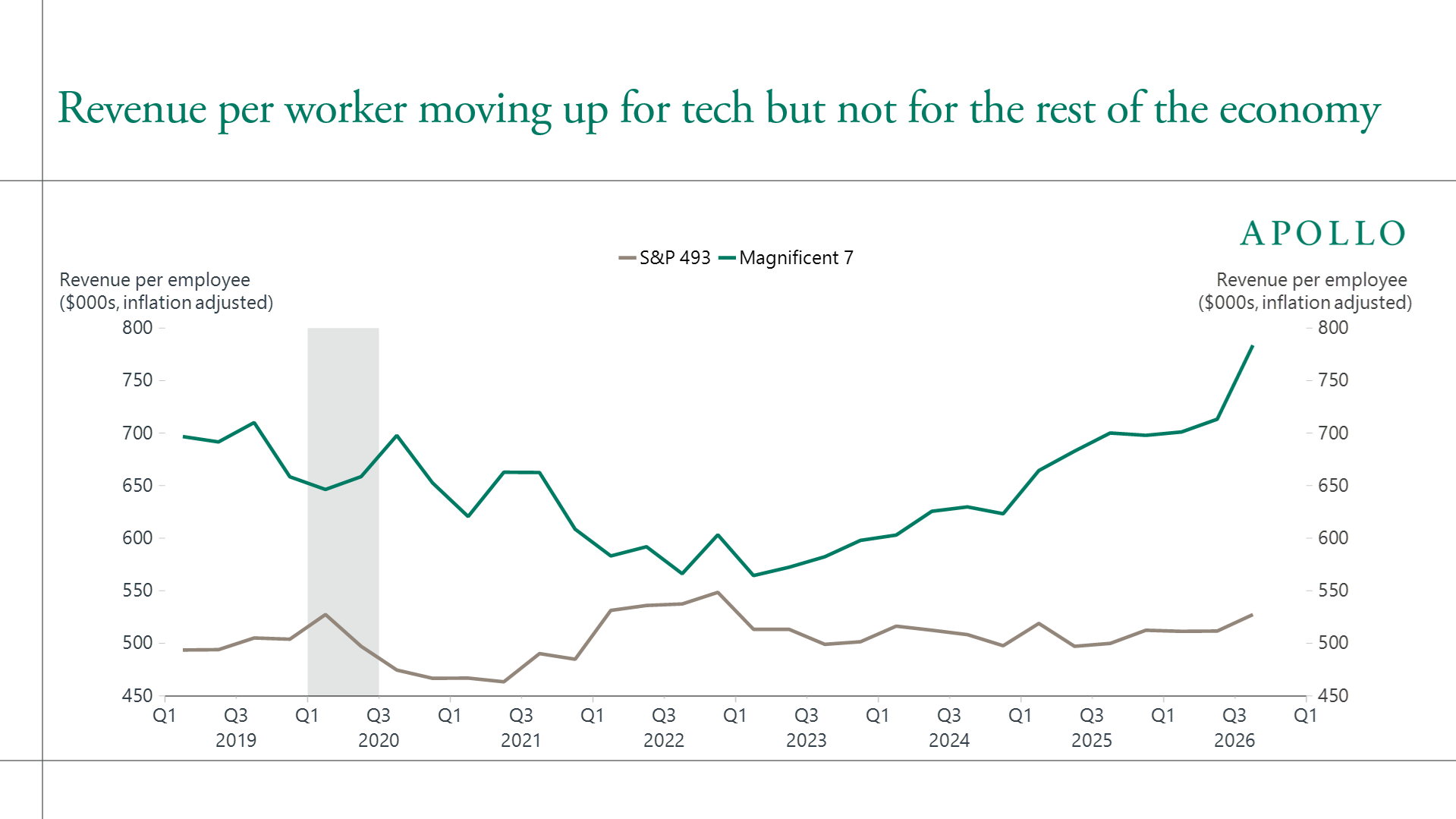
Apollo's chief economist Torsten Slok says the AI boom has lifted revenue and margins only inside tech. Revenue per worker outside tech has stayed near $550,000 for seven years.
Image: Business Insider
Why it mattersA buyer paying for AI tools has a question to answer in the budget review. Point to the extra revenue per worker, or point to what you would be doing without.
Three years of corporate AI spending have shown up on one side of the ledger and nowhere else. Apollo Global Management's chief economist Torsten Slok wrote on Saturday that the gain is sitting inside tech. Revenue per worker at the Magnificent Seven group of tech companies has climbed from about $550,000 in 2022. It is close to $800,000 today. The figure for the rest of the S&P 500 has sat near $550,000 for seven years. Business Insider's Truman Dickerson reported the analysis the same day.
Apollo is one of the largest alternative asset managers in the United States. Slok is a partner there and the firm's chief economist. The report runs three charts: revenue per employee, profit margins, and productivity growth. Each one shows the same split.
What Slok measured
Tech profit margins, from the same group of companies, rose with revenue per worker from 2022. For every other S&P 500 company, Slok's chart puts margins at about 10 percent and keeps them there. Across the whole economy, he writes that AI has not yet raised productivity growth. Some AI leaders had predicted it would by now.
The quote the piece builds on comes from Slok's own report. "The technology has delivered zero financial payoff to corporate America outside of tech," he wrote. He added a line on the demand side. Mainstream corporate America, Slok wrote, "is pulling back" on AI spending. Buyers are starting to view token spending as a cost, not a source of growth. The spending now weighs on margins.
The question Slok leaves open
Slok ends on a conditional. Model prices are falling. His open question is whether corporate America can turn cheaper intelligence into higher revenue growth. He wrote in his report that it needs to lift profit margins too. His own answer there is one line. "That may be harder than it sounds."
Business Insider also notes the contrast with public statements by AI company leaders. They have promised an "age of abundance" from the same technology.
Where this leaves a buyer
A company spending on AI tools has a budget-review question. Point to the revenue per worker the spending bought. Or point to the cost line that fewer people would have run without it. Apollo's chart answers the first part for tech firms. For a non-tech buyer, Slok's position is that the answer still has to be made rather than observed.
That matches what a non-tech team doing the work can see from inside. A pilot that answers customer emails faster does not land on the revenue-per-worker figure. A code generator that finishes a feature a week sooner only lands there in one case. The feature reaches a customer, or it shortens a billable project. A buyer picking the next twelve months of tools can read Slok's data as a reminder. The measurement that matters is what the spending moves on the income statement.
Source
Apollo says AI has delivered 'zero financial payoff' outside the tech industry, Business Insider.
This item was written by an AI system from the linked source. Reveneau is responsible for what it publishes.
Get AI News in your inbox
New developer tools, model and agent releases, and how teams are actually using them to release software. Short, and only when there is something worth reading.