AI NewsGo-to-marketReported
AI linked to 200k lost US creative-industry jobs since 2022
Joseph Politano reports that US creative industries have lost over 200,000 jobs in four years. About 50,000 of those were lost in the last year.
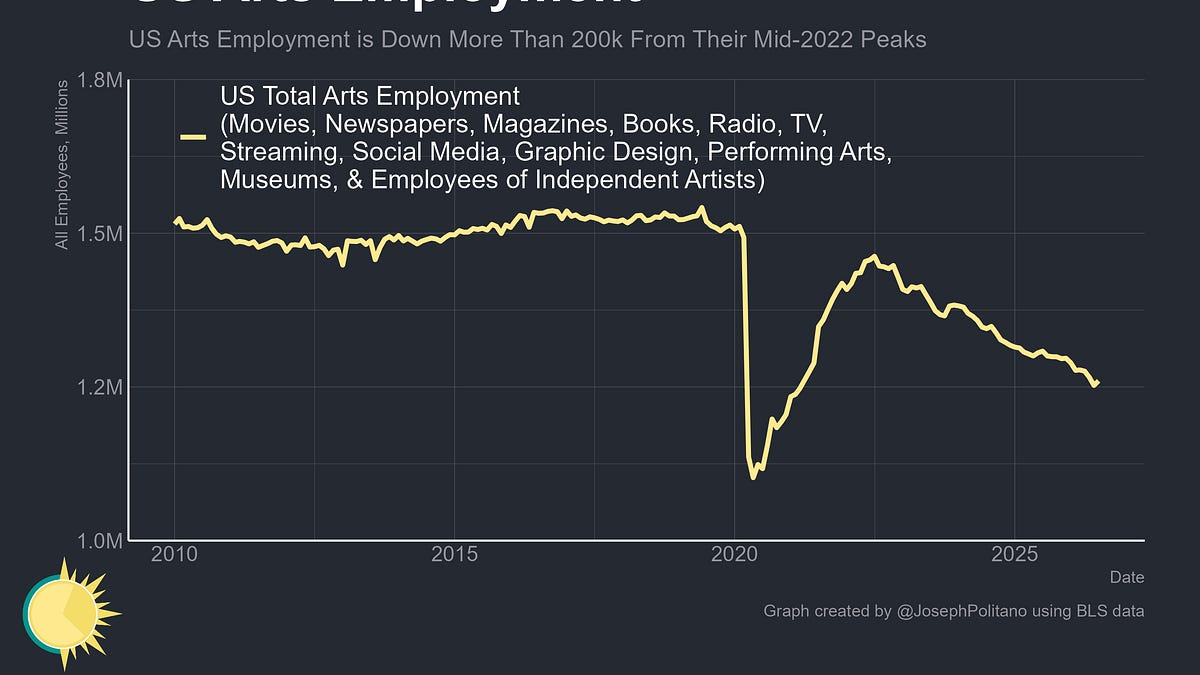
Image: Apricitas Economics
Why it mattersTech is the next sector seeing an AI-linked downturn. Annual tech job gains were 300,000 in 2022. The sector has lost jobs every year since.
The next company that cites Hollywood as proof AI replaces workers will have one new chart to point at.
Joseph Politano writes in Apricitas Economics that US creative industries have lost over 200,000 jobs in four years. Roughly 50,000 of those losses happened in the last twelve months. The Hacker News thread discussing the piece crossed 100 points on the day of publication.
The Hollywood number is the biggest piece
Politano reports that movie and TV lost more than 100,000 jobs, which is close to one-third of the sector. He writes that total employment this summer was lower than at any point since the 2008 recession. He puts the current level near the lowest reading in 30 years. Nearly half of all media job losses in the four-year window sit in movie and sound recording.
Written publishing is the next-largest source of job loss, down more than 70,000 over the same window. Politano reports that newspaper payrolls are down nearly 85% from their historic peak. At that peak, US newspapers employed more people than the whole US oil industry. Magazine publishers have let 66% of their staff go since the 1990s. Book publishers have lost 40%.
What people are actually using
Politano cites one survey number: about 32% of workers in arts, entertainment and recreation use generative AI to some extent. That is below the 62% average he cites across all industries. He notes that media firms stay quiet about their internal AI use. Part of the reason is legal. A copyright would weaken if a studio said a model wrote part of the work.
He is careful about causation. Streaming, offshoring and Hollywood consolidation are all happening at once. His argument is that every digital arts subsector is losing jobs while in-person entertainment is still growing. That split is what points at AI as one of the forces at work.
Tech is in the same chart
For a company that sells software, the useful part of the piece is the last section. Politano writes that annual tech job gains stood at near 300,000 in 2022. He reports that the sector has lost jobs every year since. He calls it the longest labor market downturn for tech in recent memory. He names coding agents as the direct cause.
A hiring plan that assumes the 2022 rate is a plan for a market that is no longer there. A buyer paying for AI software now has an easier argument to make: the sector that sells software is itself buying fewer software engineers. Writing a vendor pitch against that backdrop is a different job than it was two years ago. Build the number into the plan rather than around it.
Source
AI and the Fall? of the Creative Class, Joseph Politano, Apricitas Economics.
This item was written by an AI system from the linked source. Reveneau is responsible for what it publishes.
Get AI News in your inbox
New developer tools, model and agent releases, and how teams are actually using them to release software. Short, and only when there is something worth reading.


