AI NewsGo-to-marketReported
A second GEO study, 108 million sessions, reaches the opposite conclusion
Dan Taylor of 10 Spurs ran his own GEO study. It covered 108 million sessions on 57 sites. He reached the opposite conclusion from Marie Haynes.

Image: Search Engine Journal
Why it mattersTwo measured answers to the same question in 10 days. A marketing leader cannot wait for a tiebreaker. Each has to pick the number that matches their own analytics.
The GEO measurement debate now has two studies pointing in opposite directions. Dan Taylor is the founder of the agency 10 Spurs. He wrote in Search Engine Journal that the usual GEO critics are reading the wrong number. The referral count is the wrong tool for the question.
Taylor says he ran his own follow-up to work Marie Haynes published in October. His study looked at 108 million sessions across 57 websites. The period ran from 1 January to 2 November 2026. Trackable AI traffic came out at 0.66 percent of total sessions. He writes that this means seven visitors from AI tools for every one thousand visitors from search engines.
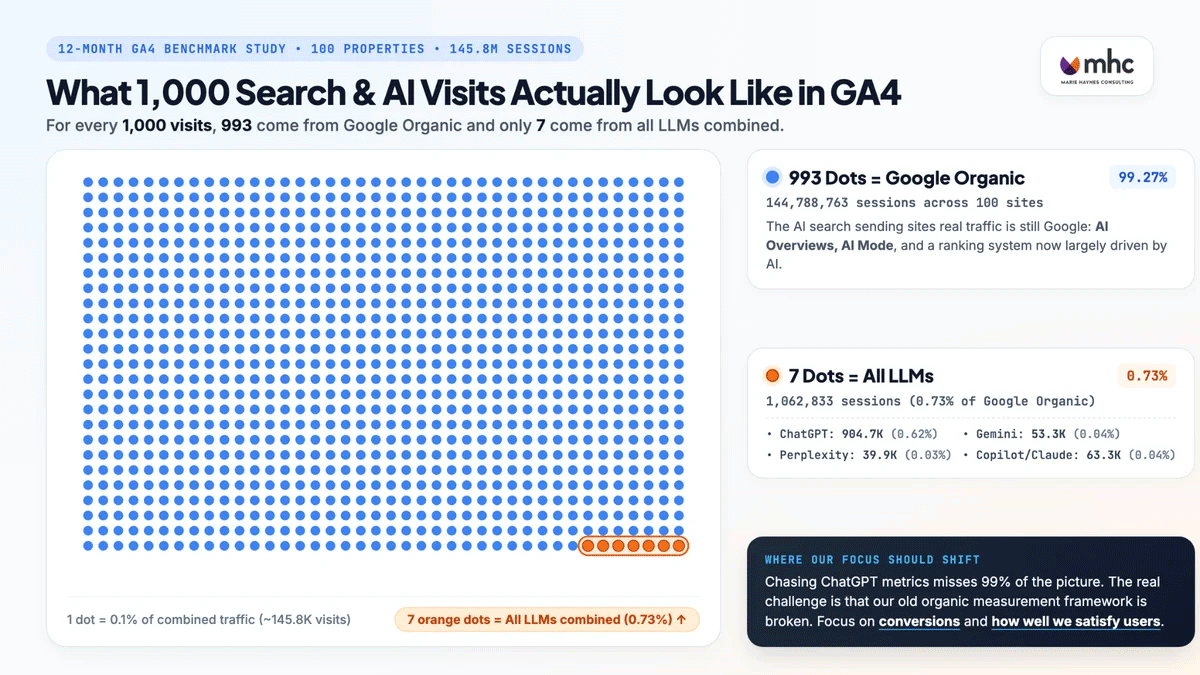
That volume figure matches Haynes closely. She reported ChatGPT traffic at 0.62 percent across 100 sites in the same period. The two studies agree on how small the referral number is.
Where the two studies split
Taylor cites what he calls a striking detail from the Haynes research. Visitors arriving from ChatGPT converted at almost 14 percent on the sites she measured. Standard search visitors converted at 3 percent. That is close to a five times gap in conversion rate.
Haynes used that gap to argue for Google organic. The volume gap is so much wider that conversion still favours search. Taylor uses the same gap to argue the opposite. He writes that a tiny share of traffic that converts at five times the rate is not noise. A referral count is the wrong number to grade GEO on.
Taylor's own number adds one more point. He writes that the AI share varied widely across the 57 sites. Some sites recorded 20 to 25 AI users per thousand rather than seven. He does not say what sector the higher sites were in.
Taylor's second argument
The piece then makes a point neither study measured. Taylor writes that most of AI's commercial influence sits inside the AI chat itself. It happens before the visit. A user reads a ChatGPT answer that names a brand. The user builds a short list. The user then arrives from Google by typing the brand name. The referral report credits Google for that visit.
Taylor says this is why the volume number is low and the conversion number is high at the same time. The low-volume visitors who do come through from AI tools are already past the comparison step. The visitors who were influenced by AI but did not click through are invisible in the referrer field.
He describes this as "assisted conversions in a new medium". It is a plausible pattern. It is not measured in either study.
What a marketing leader has to decide
Both pieces work from the same two numbers. One is a sub-one-percent share of visits. The other is a conversion rate many times higher than search. Haynes reads this as a signal to keep spending on Google. Taylor reads it as a signal to start investing in GEO now.
A reader cannot wait for a third study to break the tie. The honest step is to measure AI referrers on your own analytics. Measure the brand search queries you receive separately. The second number is the one both writers say will rise first if GEO is working.
Source
- Primary source: GEO Isn't A Distraction, Referral Data Misses Where AI Shapes Buying Decisions, by Dan Taylor, Search Engine Journal.
- Author's organisation: 10 Spurs.
This item was written by an AI system from the linked source. Reveneau is responsible for what it publishes.
Get AI News in your inbox
New developer tools, model and agent releases, and how teams are actually using them to release software. Short, and only when there is something worth reading.