AI NewsModels & agentsReported
Open AI models win at only 3 percent of budgets, Village says
Village published an analysis of 201 price points for AI models. An open-weight model was the best buy at 3 percent of them, down from 41 percent in June 2026.
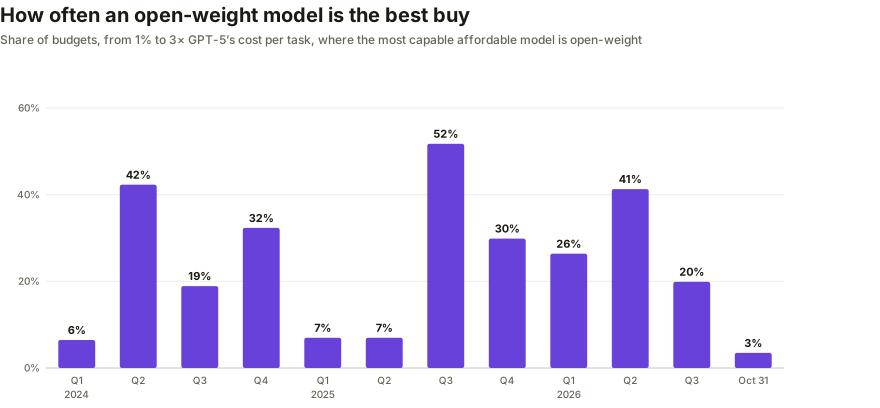
Image: Village
Why it mattersTeams that chose open models to save money now have fewer budgets where open wins. Price your work against both, and plan to switch when a new release moves the frontier.
A team that chose an open-weight model to keep costs down has run out of budgets where open still wins. Village published this finding on 30 October 2026. It says an open-weight model is the best buy at only 3 percent of price points. In June 2026 that figure was 41 percent. The post reached the Hacker News front page on 6 November with 72 points.
What Village measured
Village runs a study it calls the LLM Atlas. It takes 201 budgets, spread evenly on a log scale. The low end is 1 percent of the cost of GPT-5 at high effort. The high end is three times that cost. For each budget Village picks the most capable model that costs no more. The capability score comes from public benchmark results. The cost per task comes from evaluators' runs through hosted APIs. Scores are as of 31 October 2026. The method is described in Village's methodology page.
The result for today: an open-weight model is the best buy at 3 percent of budgets. Village says those few points are at the cheap end of the range. Google's Gemma 4 E4B and Xiaomi's MiMo-V2.6-Flash hold them. The rest of the frontier is closed. OpenAI's GPT-6 Luna came out in September. GPT-6.1 Terra came out in October. Together with Anthropic's Claude Haiku 5.5, they cover the budgets open models used to hold.
Open models have led in bursts
This is the lowest share Village has recorded. At the end of every quarter since 2024, open models held at least 6 percent of budgets. Village says DeepSeek-V3.2-Exp was the best buy at nearly half of all budgets the week it launched in September 2025. The share then halved or more by the next quarter as closed labs released cheaper tiers. The pattern repeats. A strong, cheap open release, usually from DeepSeek, wins a wide band of budgets. The next closed model then comes in under it.
Why closed labs may be winning on value
Village gives three reasons, each attributed to the authors. Closed labs can distill their own frontier models to make cheaper ones. Claude Haiku 5.5 followed Claude Opus 5.5 by two weeks. Open labs cannot copy them the same way. Closed labs' terms generally bar training competitors on their outputs. Closed labs also release whole families. OpenAI's GPT-6 and GPT-6.1 cover a wide range. Luna and Terra sit at the low end. Sol and Astra sit at the top. The two families hold 11 of the frontier's 21 points. And closed labs serve at enormous scale, which may lower cost per task. Google runs inference on its own chips.
Village also states a limit on its own result. Open models can be cheaper to run on your own hardware. The figures here are what evaluators paid through hosted APIs. Widen the range to 0.3 percent to ten times GPT-5, and the open share rises to 16 percent. Tiny open models still win at the very cheapest end.
For a team picking a model this week, price the job against both. Watch for the next big open release. The frontier moves in jumps, and this autumn it moved against open.
Source
- Primary source: Closed AI models now dominate the price-performance frontier, by Village.
- Methodology: Village LLM Atlas methodology.
- Discussion: Hacker News thread, 72 points.
This item was written by an AI system from the linked source. Reveneau is responsible for what it publishes.
Get AI News in your inbox
New developer tools, model and agent releases, and how teams are actually using them to release software. Short, and only when there is something worth reading.