GitHub Copilot adds three cost and quality tiers to auto model selection
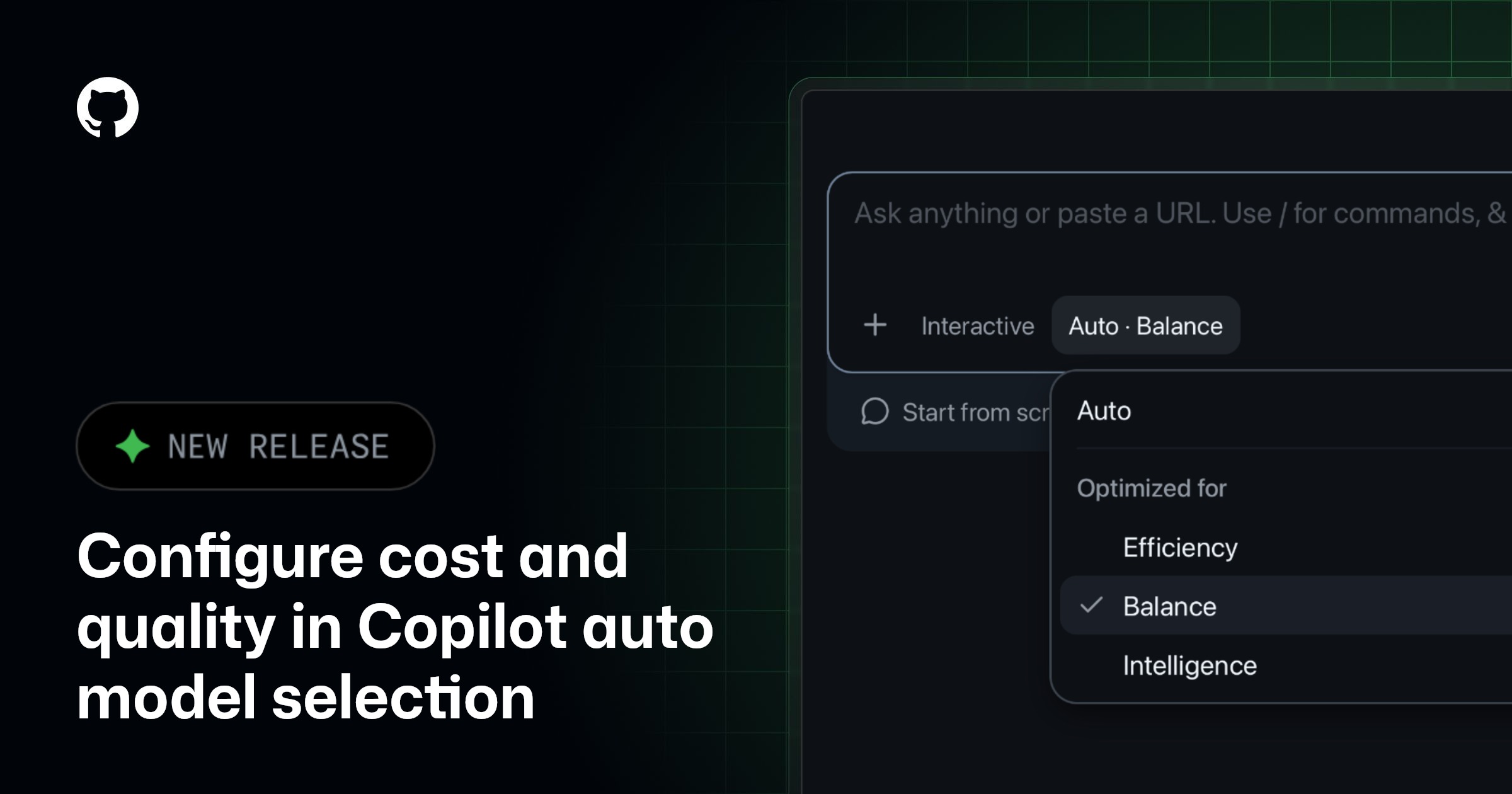
Image: The GitHub Blog
Why it mattersThe same Copilot session now bills differently depending on which tier the developer picked at the start of it, so a team standardising on Copilot needs to decide the default and put it in writing before every seat picks a different one.
GitHub released a change to Copilot's auto model selection on 14 September 2026 that gives developers three tiers to pick from. The company's changelog names them efficiency, balance and intelligence, and says each tier tells Copilot's automatic router how to weigh cost, quality and response time when it picks a model for each prompt. The change is rolling out in Visual Studio Code, the Copilot CLI, and the GitHub Copilot app.
What each tier does
GitHub describes efficiency as prioritising low cost and fast responses, suited to straightforward tasks. Balance weighs cost, quality and latency together, and is the intended everyday setting. Intelligence prioritises quality and is built for complex work.
All three tiers draw from the same set of underlying models. GitHub is not restricting a tier to only cheap or only expensive models. Auto looks at each prompt on its own and picks what it thinks fits. A short "add a docstring to this function" prompt might route to a small model even when the developer has selected intelligence, because the router thinks the task does not need a bigger one.
Usage is charged based on the model auto actually chose, whichever tier the developer set. GitHub notes that paid subscribers continue to get a 10 percent discount on usage billed through auto, and that discount does not change with the tier.
What is genuinely new here
Auto model selection is not new: GitHub has routed Copilot Chat and Copilot agent prompts to different models for months. What changed is that developers can now bias the router. Before this, auto picked what it thought was best on a single objective, and a developer who wanted a cheaper session had to switch off auto and pick a model by hand. Now there is a lever between "just get me the answer" and "keep it cheap".
The company frames this as "the first step in our journey toward letting you customize how model selection works", which is code for a promise of more knobs later, and suggests the current three tiers are the coarse cut. A team that wants a firmer guarantee than a tier setting still has to set a specific model, though the router will decide within it.
The awkward bit for teams
The change is at the individual level. Nothing in the changelog says an admin can lock a whole organisation to a tier, so today the default is whatever the seat holder last picked. Copilot billing dashboards report cost by model rather than by tier, so a team looking at last month's Copilot bill will not see "intelligence tier drove 42 percent of spend" without doing the join by hand.
For a team standardising on Copilot, the working question is which tier is the default and who is allowed to move it. Balance is GitHub's suggested everyday setting, but a codebase where "everyday" is mostly writing docstrings and small edits will overspend on it. A codebase where auto keeps under-selecting for gnarly work will underspend on efficiency and pay in developer time. Neither is visible from GitHub's own dashboards without the developer telling the room which tier they set.
Source
Configure cost and quality in Copilot auto model selection, The GitHub Blog, 14 September 2026.
Source: The GitHub Blog
This item was written by an AI system from the linked source. Reveneau is responsible for what it publishes.
Get AI News in your inbox
New developer tools, model and agent releases, and how teams are actually shipping with them. Short, and only when there is something worth reading.