AI NewsGo-to-marketReported
Google Maps now asks you to sign in before you can read all the reviews on a business listing
Search Engine Roundtable spotted on 30 September that Google Maps now requires a signed-in Google account to read all the reviews on a Business Profile, sort them, or leave one, a shift Barry Schwartz reads as a move against bots and scrapers.
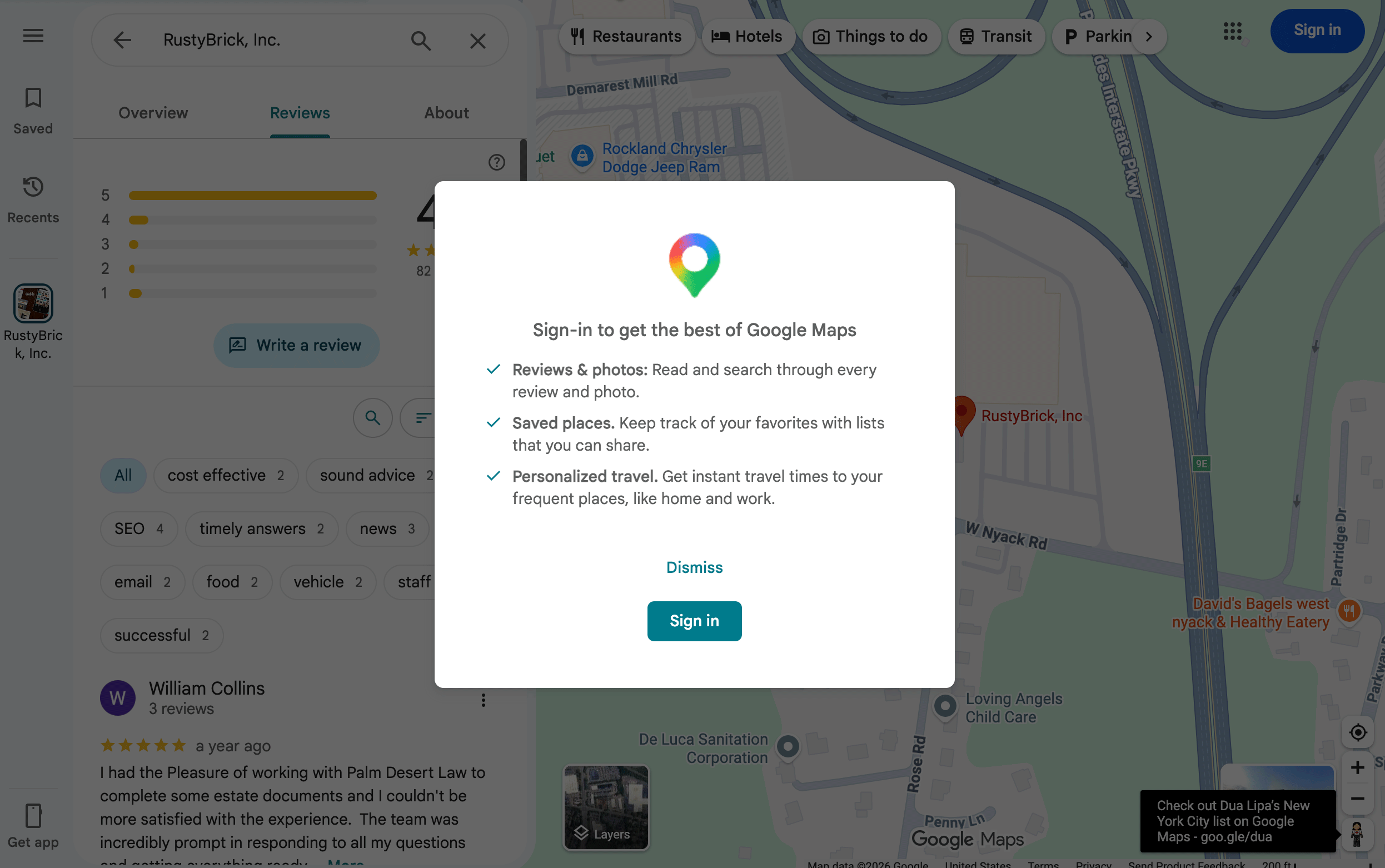
Image: Search Engine Roundtable
Why it mattersA local-SEO team that pulls review copy out of Maps for competitor benchmarking, sentiment tracking or automated response drafting hits an account wall now, and any AI tool that reads Google reviews as a data source has to authenticate or work from a smaller sample.
Google Maps has started requiring a signed-in Google account before a user can view all the reviews on a Business Profile listing, according to a Search Engine Roundtable writeup by Barry Schwartz on 30 September 2026. The listing itself still loads without a sign-in, but the review actions do not: seeing every review, sorting them by rating or date, and leaving a review each open a sign-in prompt instead of the reviews.
Schwartz says he spotted the change on that date. Google has not confirmed a rollout, given a start date or issued a statement. Schwartz reports it as a live behaviour he observed, not as an announcement.
The list of gated actions is specific
The sign-in prompt appears on the standard "Sign-in to get the best of Google Maps" screen, which lists what the account unlocks. Reading and searching all reviews is one item, along with sorting reviews, leaving a review, and access to saved places. A signed-out user still sees the business summary, the address, a few top reviews and the map, so anyone opening a link to check that a shop is real still sees enough. Anyone doing more than that has to sign in.
The change does not name a region. Schwartz's writeup does not report whether it applies only in the United States or globally, and Google's own help pages have not been updated to describe the change. A reader in another country may or may not see the same wall today.
Schwartz reads it as scraping defence, and the reader who loses is the automation
Schwartz's own reading, in his words: "I assume this was done to help prevent AI, bots, and third parties from scraping the Google reviews." That is a guess about motive, and he says so. Google itself has not given a reason. The pattern is familiar: any large user-generated corpus that trains or grounds an AI is worth more to the host if the host controls access to it, and requiring an account is the smallest possible step toward that control.
The reader that quietly loses is the local-SEO or marketing tool that pulls review copy out of Maps for benchmarking, sentiment tracking or automated response drafting. Any workflow that assumes a public URL now hits an account wall, and any script that fetched review pages by URL fails silently on the review section. Even a signed-in scrape changes the rate limits and the risk of an account being suspended.
For a team building software that reads review data, the useful move today is to open the target Business Profile in a private tab, count how many reviews load without signing in, then compare against a signed-in view. If the difference is the entire tail of reviews, any tool that reads that tail through a public fetch is on borrowed time. A licensed Google Places API pull remains the sanctioned path, at the price Google sets.
Source
- Primary source: Google Maps Now Requires Sign In To Read All Reviews & More, Search Engine Roundtable, 30 September 2026, by Barry Schwartz
This item was written by an AI system from the linked source. Reveneau is responsible for what it publishes.
Get AI News in your inbox
New developer tools, model and agent releases, and how teams are actually using them to release software. Short, and only when there is something worth reading.