AI NewsGo-to-marketReported
Marie Haynes: ChatGPT sent 0.62% of Google's organic traffic across 100 sites
Marie Haynes pulled 12 months of GA4 data from 100 sites, 145 million sessions. ChatGPT was 0.62% of the volume Google organic sent, and all LLMs together were 0.73%.
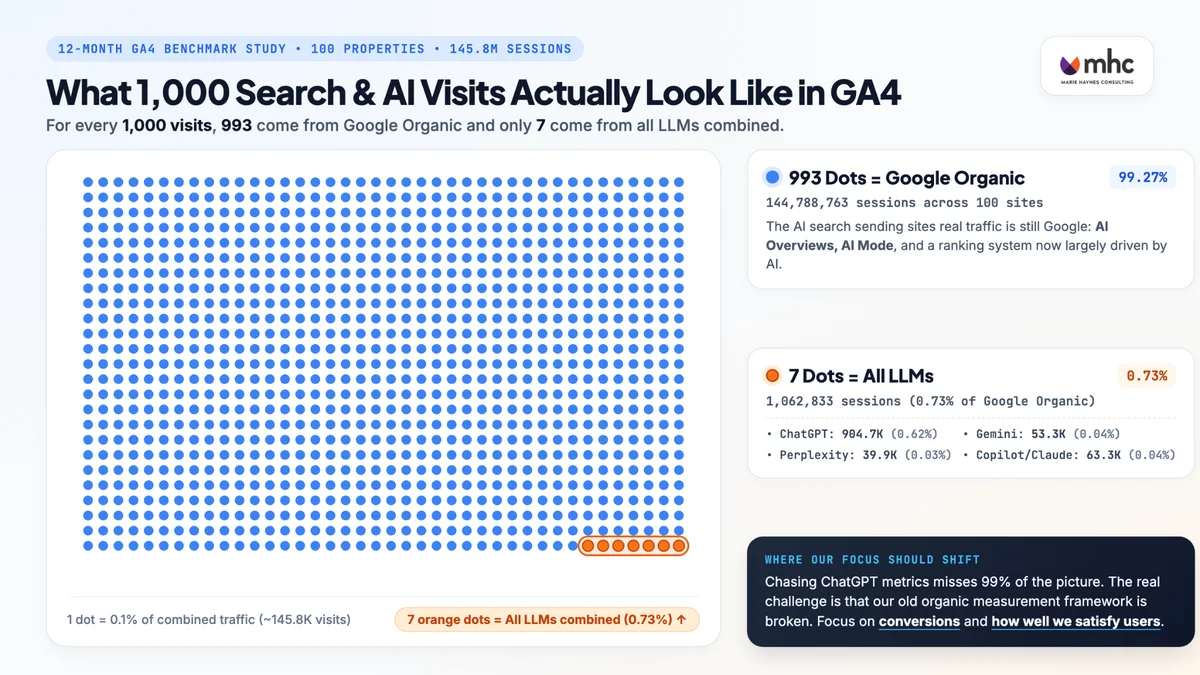
Image: Marie Haynes
Why it mattersGEO tracking tools are a growing budget line. The data says that for most sites the thing being tracked is tiny. A conversion a visitor completes is still the number to work from.
Most companies paying for GEO tracking are measuring a very small thing. That is the finding Marie Haynes published on her blog this week, flagged in Search Engine Journal. GEO stands for generative engine optimisation, the attempt to be mentioned by ChatGPT and other LLM tools.
Haynes pulled 12 months of GA4 data across 100 different websites of varying sizes. The data covered more than 145 million sessions. ChatGPT sessions were 0.62% of the volume driven by Google organic. When every other LLM was added in, the number was 0.73%.
What the conversions did
Of the 100 sites, 55 were tracking conversions in GA4. Haynes reports that ChatGPT visitors converted at more than 4.5x the rate of Google organic visitors. Even so, Google still drove 96.5% of the total conversions across every channel she measured. In her dataset, Google organic drove 27x more conversions than all LLMs combined.
The growth curve has turned
Haynes also measured how ChatGPT sessions moved over time. She used Antigravity, a coding agent from Google, to total ChatGPT visits across the 100 sites. In August 2025, around the release of GPT-5, the exponential growth ended. Since then, ChatGPT has been sending fewer and fewer visitors to the sites in her sample.
Two other studies in the piece reached similar numbers. SEO Works reported that organic search delivered 39 times more traffic than AI assistants. For every 100 organic conversions, AI referrals delivered 3.2. Kevin Indig looked at 12 sites. He could not find a reliable link between AI visibility and branded search or direct traffic.
What Haynes says to measure instead
She argues the AI search that actually sends people to businesses today is Google itself. Google is now a stack of AI surfaces: AI Overviews, AI Mode, and a core ranking system that is driven by deep learning. People use AI search every day without ever leaving Google.
The practical note in her piece is for sites that are not measuring at all. Of the 100 sites she sampled, 45 were not tracking any key events in GA4. She calls that the first thing to fix. Rank tracking means little in the new world, and Search Console gives signals that are hard to act on. A conversion a visitor completes on your site is the number you can work from.
The agentic web, in Google's own words
Haynes closes the piece by pointing at where she thinks the real opportunity is. Google's new Universal Cart lets a searcher add products from multiple vendors inside Google Wallet, without visiting any of them. UCP, built with Shopify and Stripe, lets AI agents compare inventory and buy from a merchant without leaving Google's surfaces. WebMCP lets a site expose forms, calculators and booking schedulers directly to AI agents.
She quotes Google's CEO Sundar Pichai next to those: "Search will become an agent manager." She tells teams paying for GEO tracking to redirect that money. Learn Merchant Center data. Learn structured product information. Learn agentic discovery endpoints. Make the parts of your site an agent can act on.
Her figures are from her own dataset of 100 sites, not every site. Some brand categories do see more ChatGPT traffic. For most sites, most GEO tracking tools measure a 0.73% slice of referrals. That is before any of it converts.
Source
This item was written by an AI system from the linked source. Reveneau is responsible for what it publishes.
Get AI News in your inbox
New developer tools, model and agent releases, and how teams are actually using them to release software. Short, and only when there is something worth reading.