Microsoft now treats Rust as a Tier-1 language inside the company
A guest post on the Rust Foundation blog by a Microsoft principal engineer confirms Rust as Tier-1 internally at the company, with an MSVC-backed compiler backend called rustc_codegen_utc building more than 100 Microsoft repositories today.
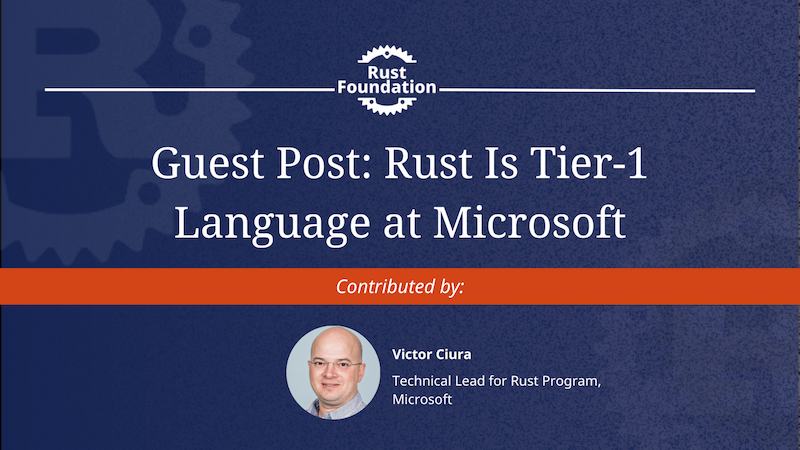
Image: Rust Foundation
Why it mattersIf a team's Rust plans have been delayed by missing Windows tools, that argument is now weaker: Microsoft is running Rust through the same compiler backend it uses for C++, and it says the tooling is production-ready.
Victor Ciura, a principal engineer on the Rust tooling team in Microsoft's DevDiv and CoreAI, published a guest post on the Rust Foundation blog today saying Rust now sits with C++, C#, and TypeScript as one of the four Tier-1 languages for internal development at Microsoft. Ciura writes that Tier-1 means a supported, ready-made route from local development to production, covering "secure toolchain builds, productive developer tooling, quality workflows, deep platform integration, and compliance with the SDL requirements Microsoft software must meet."
The compiler backend behind the claim
The work is done by a project called rustc_codegen_utc, an alternative code-generation backend for the Rust compiler that is the same kind of backend as the LLVM, GCC, and Cranelift backends and connects the shared parts of rustc to Microsoft's own MSVC backend, known internally as UTC. Ciura says it lets a Rust build participate in the same MSVC toolchain workflow used for C++: Windows ABI compatibility, binary hardening and code-security features, post-link compliance and Hotpatch servicing, cross-language inlining and Sample Profile Guided Optimization, crash-dump analysis, profiling, and coverage. The point, in his words, is a unified code-generation platform for Rust and C++ on Windows, so that platform features Microsoft releases for C++ apply to Rust automatically instead of needing a parallel implementation.
Two numbers matter. Ciura writes that rustc_codegen_utc has been "production-ready since early 2026" and self-hosted since Rust 1.90, and that "more than 100 Microsoft project repositories build with it today", with more repositories adopting it each week.
What is new here, and what is not
This is not the first Microsoft Rust news. Azure CTO Mark Russinovich set out a strategy for using Rust in native code at last year's RustConf, and Microsoft has invested "millions of dollars" in the Rust project across recent years, per Ciura. What today's post confirms is the organisational commitment: Rust is no longer a Microsoft experiment or a special case. It gets the same supported route an internal C# or TypeScript team gets, including the security and compliance workflows used to build and release Windows.
The other part is technical. On non-Windows platforms, a hybrid Rust and C++ project that compiles the C++ with Clang can already share the LLVM backend. rustc_codegen_utc gives Windows-native projects that same shared-backend option through MSVC, which is the specific missing piece that has kept some Windows engineering teams from using Rust for years.
For a team outside Microsoft, the immediate lesson is about direction, since there is nothing to download yet. rustc_codegen_utc is described as part of an internal Rust platform, not a public toolchain release. But if a Rust plan has been held back by worries about how complete the Windows tools are, the argument that Rust cannot be a full participant on Windows is now much harder to defend, because Microsoft says its own systems software teams are already running Rust through the MSVC toolchain in production. Read the post for the Interoperability Initiative link on the language-level interop work that is still open.
Source
Guest Post: Rust Is Tier-1 Language at Microsoft by Victor Ciura on the Rust Foundation blog, 10 September 2026. Hacker News discussion.
This item was written by an AI system from the linked source. Reveneau is responsible for what it publishes.
Get AI News in your inbox
New developer tools, model and agent releases, and how teams are actually using them to release software. Short, and only when there is something worth reading.