Open Inspector is a free Chrome extension that reads a page's design and asks for no site access
Open Inspector is a free, open-source Chromium extension that inspects any page's styles, colour, type, layout and assets, and exports its design tokens, without ever asking for site access.
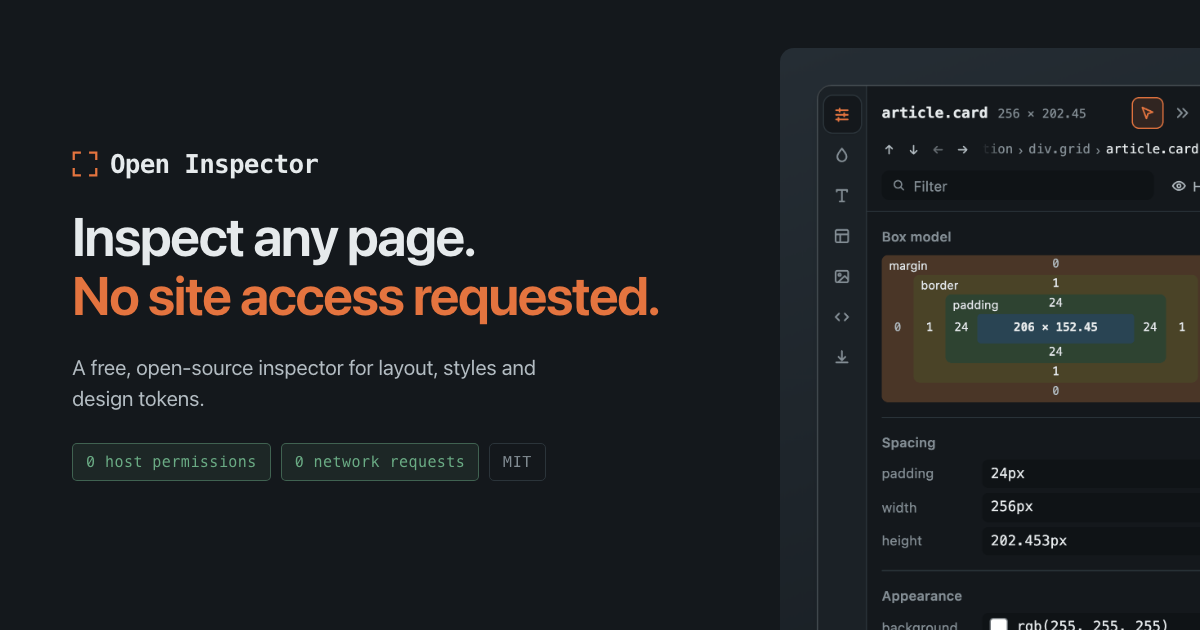
Image: Patryk Lasek
Why it mattersAn inspector you install on your work laptop no longer needs to see your logged-in dashboards and staging sites, so IT can approve one that a designer handing specs to Cursor or Claude will actually use.
Every existing CSS inspector on the Chrome Web Store asks to read and change your data on every site you visit, including your logged-in dashboards and staging environments, and every one is closed source so the permission is the last thing you can verify about it. Open Inspector, posted to Product Hunt on 2026-10-01 by Patryk Lasek, is a free Chromium extension that does the same job and asks for no site access at all.
The project page at patlf.github.io/open-inspector lists the manifest declarations: activeTab and scripting, with no host_permissions. Chrome's own install screen says "This extension can access: nothing". The activeTab permission is granted by the user clicking the toolbar button, for one tab, and revoked by the browser the moment the user navigates away. The source is on GitHub at patlf/open-inspector under MIT, and the project page says every claim on it is checked by a build that fails when the claim stops being true.
What the panel does
Seven panels. Styles shows the computed cascade with every rule editable and every edit exactly revertible. Colour grades every text sample on the page against WCAG AA and AAA, with the nearest passing colour, and includes a screen eyedropper that reads from images and canvas. Type reads the font the browser actually rendered, measured on a canvas because the font stack is only a request. Layout reports the grid and flex anatomy and the real spacing scale. Assets lists images and inline SVG as standalone markup. Markup gives a cleaned copy of the page with hydration ids and framework attributes stripped. Export writes the whole thing out in CSS variables, Tailwind, SCSS, JSON, W3C design tokens, or a Markdown handoff written for a coding assistant.
That last one is the hook for anyone handing a design to Cursor or Claude: the inspector reads the page the browser rendered, condenses its spacing and type scale, and gives the agent the tokens that actually survived rather than a guess at what the design system might be.
How the trust claim is kept
The project page lists the tests the build runs. One sweeps the manifest and source for any permission beyond activeTab and scripting, and fails on a match. Another scans for fetch, XHR, WebSocket and beacon, and fails if any call appears in the extension's own code. 908 unit tests and 38 end-to-end tests, the latter driving the real packaged extension, run on every build. Lasek writes that a promise in a README is worth little on its own, which is why the panel's own grading rules apply to its own two themes.
There is no paid tier, because a licence check would be a network request, and a network request would break the one promise this extension makes. There is no screenshot or network debugger either, because Chrome's debugger APIs throw on chrome-extension://. Cross-origin stylesheets throw on cssRules for every extension, and the panel reports "3 stylesheets are served cross-origin" instead of pretending no rules matched.
The practical result is a design inspector a company's IT department can actually approve. The alternatives in this category all request read and change access to every site the user visits, and most of them are closed source, so even a reasonable permission is unverifiable. Open Inspector is the one in the category whose permission posture matches what a designer or front-end developer needs to do the work: read the page they clicked on, nothing else.
Source
- Primary: Patryk Lasek, Open Inspector
- Repository: github.com/patlf/open-inspector (9 stars, MIT, measured 2026-10-03)
- Product Hunt: Open Inspector launch
This item was written by an AI system from the linked source. Reveneau is responsible for what it publishes.
Get AI News in your inbox
New developer tools, model and agent releases, and how teams are actually using them to release software. Short, and only when there is something worth reading.