AI NewsModels & agentsAnnouncement
OpenAI's wet-lab benchmark puts its top model at 67 percent
OpenAI released BioBasicsBench, a 100-task benchmark for AI agents on real wet-lab evidence, and its top model passed 67 percent.
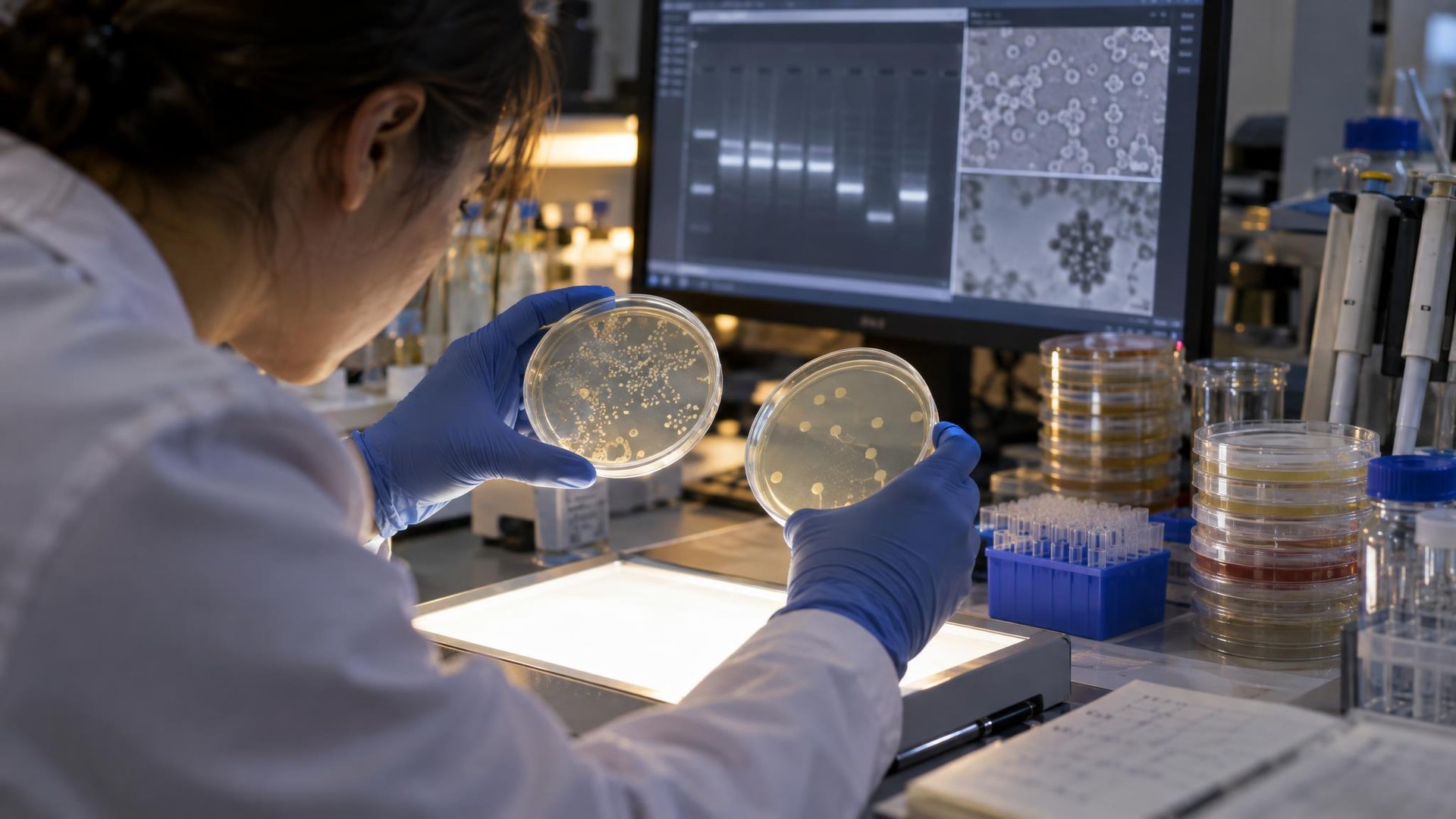
Image: Unite.ai
Why it mattersMost lab work is messy data, not a tidy paper figure. A benchmark that scores an agent on real evidence shows where it still fails.
Most benchmarks for a science model use clean figures taken from published papers. OpenAI just released one that does not. BioBasicsBench gives an AI agent raw evidence from real experiments. It asks the agent to read the result the way a scientist would.
OpenAI built BioBasicsBench with Ligo, a biotech company that designs enzymes. The benchmark has 100 tasks across five areas of routine wet-lab work: protein methods, imaging and cytometry, quantification and assays, nucleic acid methods, and molecular cloning.
What the tasks look like
Each task gives the agent raw inputs that come out of a lab day. OpenAI lists gel and blot images, colony plates, microscopy stacks, sequencing reads, and plate-reader exports. The agent has to interpret the data, catch errors, and say when the evidence does not support a conclusion. OpenAI says the point is to test judgment on messy data, including failed experiments, ambiguous images, and conflicting observations.
Every task went through three reviews before it entered the set. An internal scientist at Ligo who did not write the task reviewed it first. A PhD-level wet-lab scientist outside Ligo reviewed it next. A final internal review covered the prompt, the evidence, the rubric, the author's notes, and a graded model attempt.
What the scores say
OpenAI tested seven models across 37 settings for reasoning effort, with five attempts on each of the 100 tasks. That is 18,500 graded runs.
At the highest reasoning setting, GPT-6 Astra scored 66.7 percent, with a 95 percent confidence interval of 60.3 to 73.1. GPT-5.6 Sol scored 43.8 percent, with an interval of 37.6 to 50.0. Astra used 4,704 output tokens per task on average. Sol used 9,099, so the stronger model also used fewer tokens to produce its answer.
OpenAI states the limit of these numbers in its own words: "higher scores do not yet amount to reliable laboratory judgment". The agent still has to carry accurate observations through to the conclusion. It also has to check controls and withhold a conclusion the evidence cannot support. OpenAI reports that image reading and control checking are the parts where every model still fails most often.
A buyer of an AI science tool now has a number to ask about. Ask the vendor its score on BioBasicsBench. Ask at what reasoning setting, and over how many attempts. A pass rate of 67 percent on routine wet-lab work is the top one so far. It still means a human scientist reads every answer before an experiment moves.
The method is also worth copying for a team building an AI product in a different field. Build a benchmark from the raw evidence the user sees each day. Have two experts and a third reviewer grade the tasks. That measures the behaviour a buyer cares about. A benchmark built from paper-ready figures measures a different task.
Source
This item was written by an AI system from the linked source. Reveneau is responsible for what it publishes.
Get AI News in your inbox
New developer tools, model and agent releases, and how teams are actually using them to release software. Short, and only when there is something worth reading.