AI NewsModels & agentsAnnouncement
OpenAI released GPT-6.1 Sol at a fifth the token price of GPT-6 Astra, and GitHub turned it on in Copilot the same day
OpenAI shipped GPT-6.1 Sol on 29 September 2026 at what OpenAI says is one fifth of GPT-6 Astra's input and output token prices, and GitHub turned it on in Copilot for Pro+, Max, Business and Enterprise the same day.
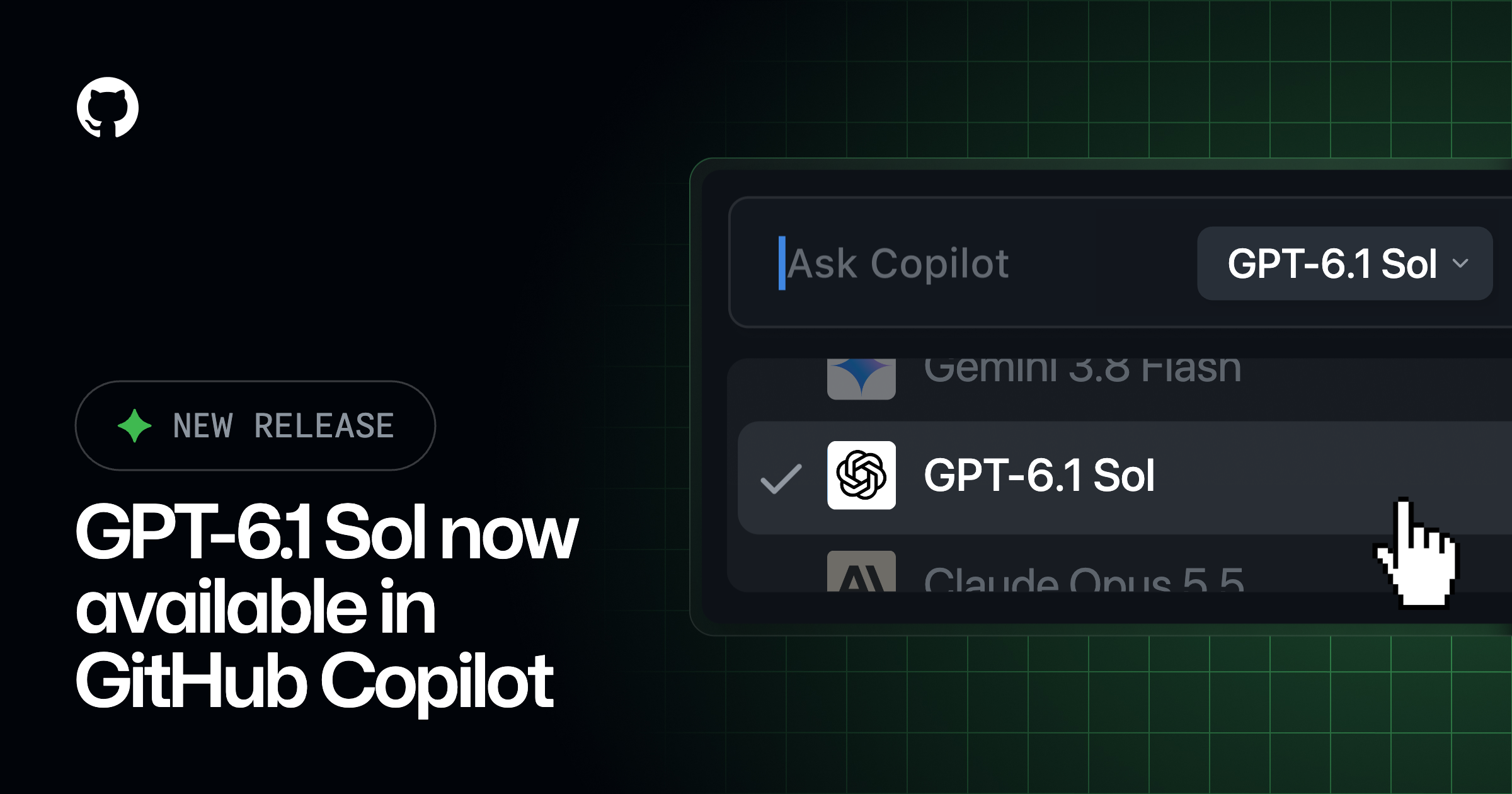
Image: GitHub
Why it mattersA cheaper model in the same family that OpenAI says stays within 1.9 percent of Astra's factual-accuracy error rate across reasoning settings changes the routing math for any team already paying Astra prices for coding and agent work.
A cheaper model in the family a lot of coding budgets already sit in is a routing decision, not a headline. OpenAI released GPT-6.1 Sol on 29 September 2026 in ChatGPT Work and Codex, at what OpenAI says is one fifth of the standard input and output token prices of GPT-6 Astra. GitHub turned Sol on in Copilot the same day for Pro+, Max, Business and Enterprise plans, across VS Code, Visual Studio, the Copilot CLI, the Copilot coding agent, JetBrains IDEs, Xcode and Eclipse.
What OpenAI says the model gives up for the price
OpenAI's own headline number for accuracy is that the factual-error rate at low reasoning effort dropped from 11.4 percent on GPT-6 Astra to 7.7 percent on Sol, and that across all reasoning settings Sol's error rate stays within 1.9 percent of Astra. TechCrunch's Frederic Lardinois, reporting from OpenAI's Dev Day, wrote that the model is available to Plus, Pro, Business, Enterprise and Edu users, and that it is not yet in Chat, only in Work and Codex.
GitHub's own changelog note says early testing showed Sol "reliably completed tasks while using noticeably fewer tokens and steps than earlier models in the GPT-6 and GPT-5.6 families." GitHub does not publish per-token rates in the note; billing is described as "provider list pricing under usage-based billing." Both statements are vendor claims, and neither OpenAI nor GitHub has published an independent test alongside the release.
Where Sol shows up on day one
The list of surfaces is longer than a typical model launch. GitHub's changelog names VS Code, Visual Studio, the Copilot CLI, the Copilot coding agent, the GitHub Copilot app, github.com, GitHub Mobile on iOS and Android, JetBrains IDEs, Xcode and Eclipse. Access for Business and Enterprise administrators sits behind the Copilot model policies page and defaults to on, with an opt-out. In OpenAI's own product surfaces Sol is in ChatGPT Work and Codex today; it is not in Chat, and neither the OpenAI release nor GitHub's note gives an availability date for Chat.
What is not in the announcement
OpenAI has not published the specific per-million-token rates on the release page. The 1.9 percent figure is one number from one benchmark family and does not stand in for the harder tasks in a real coding queue, where the reports on the earlier Sol at a fraction of Astra's price already showed a wider spread. Nobody outside OpenAI has run Sol against Astra on the same workload yet, so the "close enough" claim is still just OpenAI's.
For a team that already routes Codex or Copilot work through Astra, the decision this release forces is small and concrete. A same-family, cheaper option means the router can prefer Sol for tasks where a small error-rate gap is acceptable and reserve Astra for the ones that are not. Which tasks are which is a question the router owner has to answer from real logs, and the honest first move is to hold the routing rules where they are, run a paired sample on the last two weeks of tickets, and change the router only when the sample shows what OpenAI's numbers suggest it will.
Source
- OpenAI, Introducing GPT-6.1 Sol, 2026-09-29.
- GitHub, GPT-6.1 Sol in GitHub Copilot, 2026-09-29.
- TechCrunch, OpenAI launches GPT-6.1 Sol, says it nearly matches GPT-6 Astra and costs less, by Frederic Lardinois, 2026-09-29.
This item was written by an AI system from the linked source. Reveneau is responsible for what it publishes.
Get AI News in your inbox
New developer tools, model and agent releases, and how teams are actually using them to release software. Short, and only when there is something worth reading.


