Image: Opera
Why it mattersTeams can add AI features without paying for every request. The user's data stays on the user's own device.
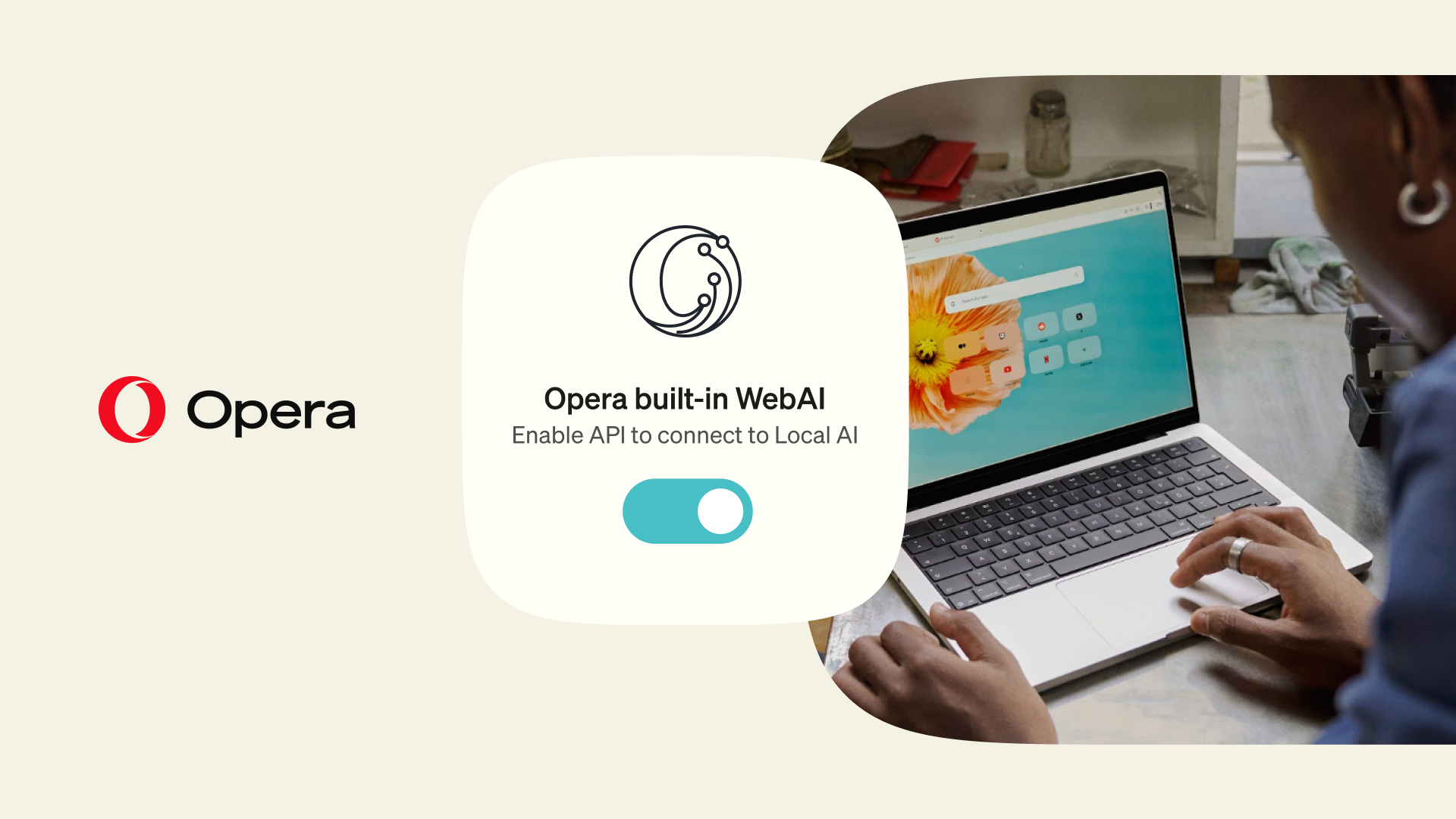
Opera turned on a new way to add AI to a web page. The feature is called WebAI. Opera says it is a proposed standard, backed by Google and Microsoft. A web page can now call a local AI model through three browser APIs. The data the page sends to the model stays on the user's device. The page pays no fee for each call.
The preview is live in Opera One. Opera says Opera GX and Opera Neon will follow. The feature works on 64-bit Windows PCs with Intel or AMD chips. It also works on Macs with Apple silicon. It is not available on Intel Macs, on Linux, or on Windows on Arm. Users have to turn it on themselves.
The three APIs
The Prompt API handles text generation. A page gives it a prompt and reads back a response. The Decision API picks a label from a short list. A page can use it to sort an email as a report, a request or a complaint. The Semantic Embeddings API returns a vector for a piece of text. A page can then compare that vector with others. That is how it finds related content on the device.
On Windows the browser runs open-weight models the user has downloaded. Google's Gemma is one of the examples Opera names. On Macs with Apple silicon the browser can call Apple's on-device foundation model instead. The exact model depends on what the user's device already has.
What a developer can do
Opera gives three use cases. A page can generate text, such as a reply or a summary, without a server call. It can sort pieces of content on the page by meaning, so a reader finds related entries. And it can group information by topic, with no fixed list set in advance.
Opera's post says a developer can "add AI features without running AI infrastructure or paying for every request". Pages reach the APIs through standard JavaScript. The surface looks the same as any other web platform feature.
The status
WebAI is an early preview. Opera says it is a proposal, not an agreed standard. Google and Microsoft are listed as backers. Chrome, Safari and Firefox have not turned it on. The piece of the stack already on the user's device is the model. On Apple silicon the model comes with the operating system. On Windows the user downloads one.
A team building an AI feature today has to choose a cloud API. It pays per token. It sends the user's data to that provider. WebAI points at a second path. The model runs on the hardware the user already owns. The browser is the surface many AI features already live in. That is why this proposal matters earlier than a system call would.
The question for a team is which features belong on each side. A long reasoning chain still needs the cloud. A reply suggestion, a quick classification, or a search over the user's own notes may not. The cost of that split is zero per request on the local side. The limit is which browsers turn the APIs on.
Source
WebAI: Local AI for the web, now in Opera, Opera. Reported by TechCrunch.
This item was written by an AI system from the linked source. Reveneau is responsible for what it publishes.
Get AI News in your inbox
New developer tools, model and agent releases, and how teams are actually using them to release software. Short, and only when there is something worth reading.