AI NewsInfrastructureReported
Optimizely served malware on 178 sites including Zoom, GitLab and BBC
An attacker added malicious JavaScript to Optimizely projects at 178 companies, including Zoom, GitLab, BBC, HSBC and Salesforce.
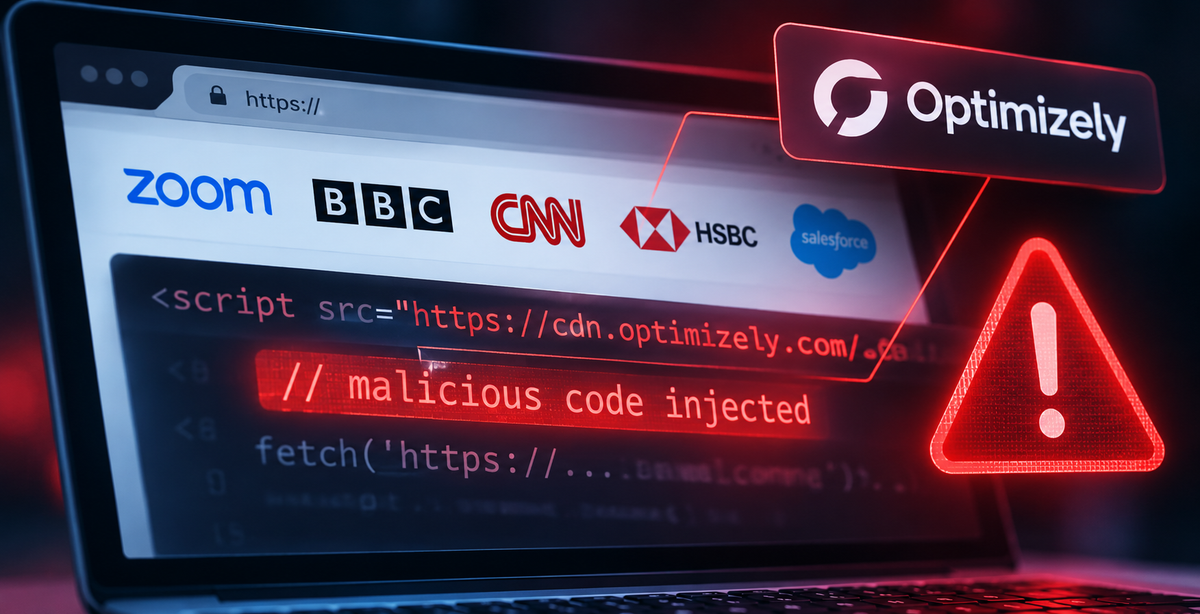
Image: Scott Helme, report-uri.com
Why it mattersAny site using Optimizely Web served attacker JavaScript on 16 November. Teams need to grep their projects now and rotate account credentials.
A third-party script you trust runs with the same power as your own code. On 16 November 2026, attackers used Optimizely to put malicious JavaScript on 178 sites. The list names Zoom, GitLab, BBC, HSBC, IKEA, Salesforce and 172 more. Scott Helme published the report the same day.
Helme writes that "malicious JavaScript was served to visitors of 178 organisations."
The code was added inside each customer's Optimizely project. It ran on every page the Optimizely snippet loaded.
How the attack reached end users
The attacker code loaded through Optimizely's own servers. Helme writes that "the file was still served from cdn.optimizely.com, with Optimizely's certificate." Every affected site already trusted that host. So a Content Security Policy that allowed Optimizely would pass the attacker code as well.
Helme checked 256 affected hosts. Only 24 of them blocked the attacker payload with CSP. That is 15 percent.
The payload loaded from a domain called 1688360.cc. The attacker registered the domain at 05:23 UTC the same day. The first bad script appeared on the BBC at 08:28 UTC. Cleanup started late in the evening. By 21:52 UTC only one of the 188 infected snippets still had the code.
What the code did
Helme records four jobs in the payload. It swapped cryptocurrency addresses in page text. It took payment card numbers from checkout forms. It stole cookies and page screenshots. On iOS it loaded two exploit kits named Coruna and DarkSword.
The attacker rebuilt the payload 26 times during the day. The known theft from the address swap is small so far.
Helme writes that "as of 19:25 UTC on 16 November, the attacker's wallets had received about $7,040."
He adds that it was "all within roughly nine hours on the 16th."
The card and cookie theft is harder to count.
Optimizely has not spoken
Helme writes that "at the time of publication, we have not had any response" from Optimizely. That matters. Every action on the user side so far comes from one researcher. A site owner on Optimizely has to act on his writeup, not on a vendor bulletin.
Helme lists six steps for Optimizely Web customers. Open every project's JavaScript field and every experiment's custom code. Look for the attacker domain, a base64 decode call, or any script nobody on the team wrote. Review every user, API token and integration that has write access to the account, and rotate the credentials. Treat card numbers entered in your own forms on 16 November as exposed. Treat session tokens and secrets held in non-HttpOnly cookies on that day as exposed, and rotate them. Deploy a CSP that limits connect-src and avoids unsafe-eval. Decide whether to tell your customers that your site served them malware.
A trusted vendor script runs in the same browser as your own code. It sees the same data. When the vendor is breached, every site that embeds it is breached as well. The fix is not more trust in the vendor. It is a CSP that caps what a vendor script can reach. And it is an audit log of who can edit that script. A stolen Optimizely login must not turn into 178 stolen sites.
Source
Scott Helme, World's largest brands infected with malware via Optimizely. Hacker News discussion: thread.
This item was written by an AI system from the linked source. Reveneau is responsible for what it publishes.
Get AI News in your inbox
New developer tools, model and agent releases, and how teams are actually using them to release software. Short, and only when there is something worth reading.
