AI NewsGo-to-marketReported
Peec AI tracked Google's first AI Overview link moving down the page
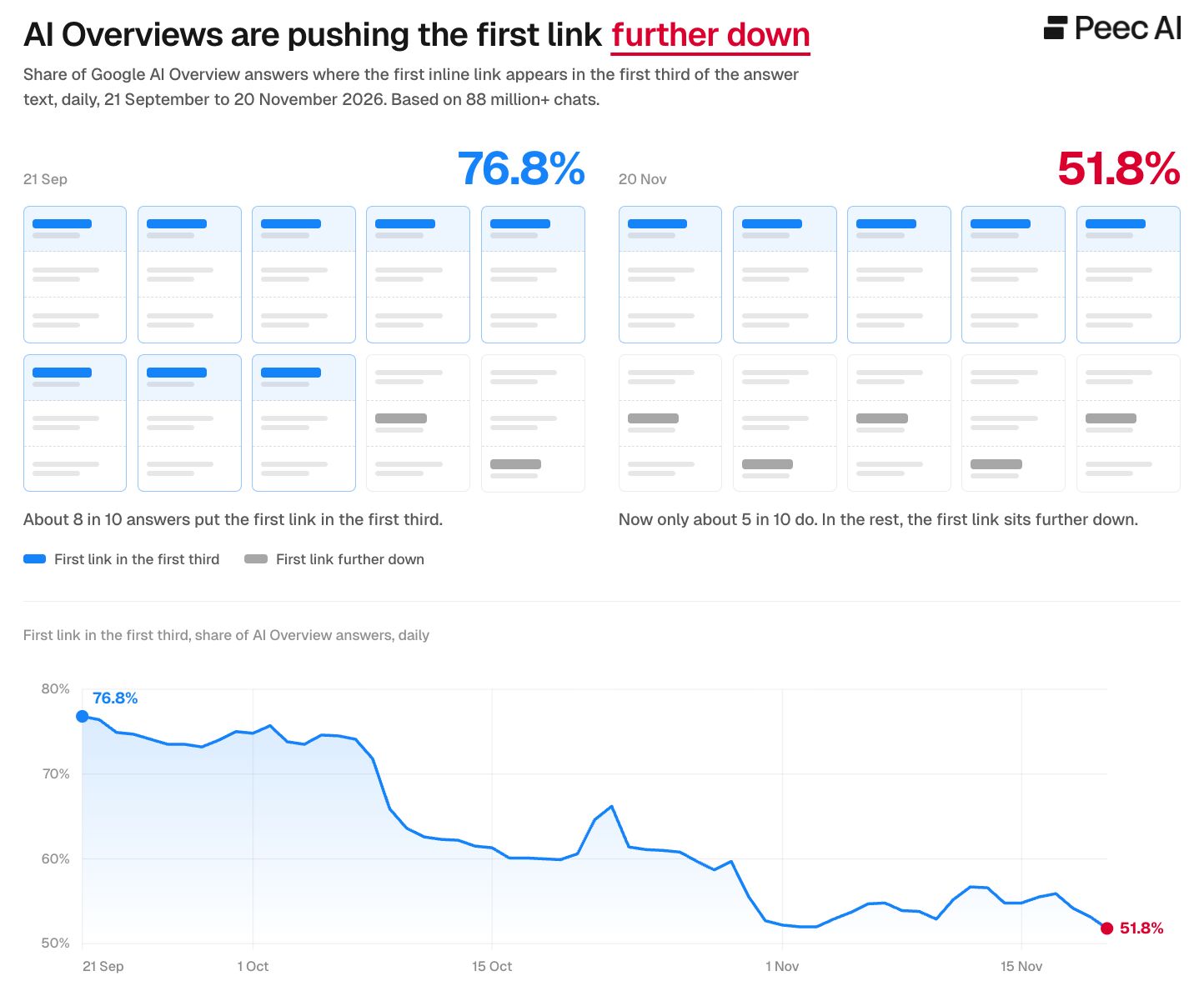
Peec AI's David Konitzny tracked 88 million AI Overviews. The share whose first link sits in the top third fell from 76.8 to 51.8 percent in two months.
Why it mattersA team that measured citation rate in AI Overviews now has a second number to watch. Where the link sits in the answer decides whether the reader ever sees it.
Google says AI Overviews send readers to the web. The data says the first link in a Google AI Overview just moved further down the answer.
David Konitzny at Peec AI tracked 88 million AI Overviews. On 21 September, 76.8 percent of them had their first inline link in the top third of the answer. On 20 November, that figure was 51.8 percent. The drop is 25 percentage points in two months. Konitzny shared the chart on LinkedIn on 23 November. Barry Schwartz wrote it up the next day on Search Engine Roundtable.
What Konitzny measured
Peec AI sells a tool that tracks how brands appear in AI answers. Konitzny's chart runs day by day since mid-September. Each day shows the share of Overviews whose first inline citation falls in the first third. Two step drops stand out: one near 9 October, one near 30 October. He does not point at a cause.
The sample is 88 million chats, which Konitzny quotes as his own count. Google has not said anything about moving the first link down.
What Konitzny also says
Konitzny adds a second finding in the same note. The total number of links Google shows per AI Overview went up over the same window. His framing is that more links do not mean more visibility: a reader who has to scroll past half the answer to reach any citation may not scroll at all.
That matches an earlier Peec AI note. On 20 November, the firm studied 10 million prompts. It reported that ChatGPT favours the first 1,000 characters of a cited page. The location of a link inside a page matters there. The location of a link inside an AI Overview matters here, for the same reason: what comes first is what gets read.
What Google has said
Google has repeated through the year that AI Overviews drive traffic to the broader web. The total citation count on the Peec AI chart is up. The reader-level reading is where the gap sits. A cited site is a seen site only when the link reaches the reader before the reader gives up.
A site that measured AI Overviews citation rate as a single number has tracked only half the problem. Whether the citation sits above the fold is a separate measurement. That is the one that moved.
A team that reports AI Overviews visibility each month needs a second number. The citation count alone is not enough. Where each citation sits in the answer is the number that tells you whether the reader ever reached the link. Three things follow from Konitzny's chart. Pull the same figures for your own cited pages, from a sample large enough to see weekly drift. Watch the two step drops Konitzny names, because they fall near known Google Search updates. And do not read an increase in total citations as an increase in clicks.
Source
This item was written by an AI system from the linked source. Reveneau is responsible for what it publishes.
Get AI News in your inbox
New developer tools, model and agent releases, and how teams are actually using them to release software. Short, and only when there is something worth reading.