AI NewsGo-to-marketReported
A site opted out of Google AI Overviews. The organic clicks dropped too.
Cyrus Shepard turned off Google's AI features on one site. Both AI impressions and regular web clicks fell.
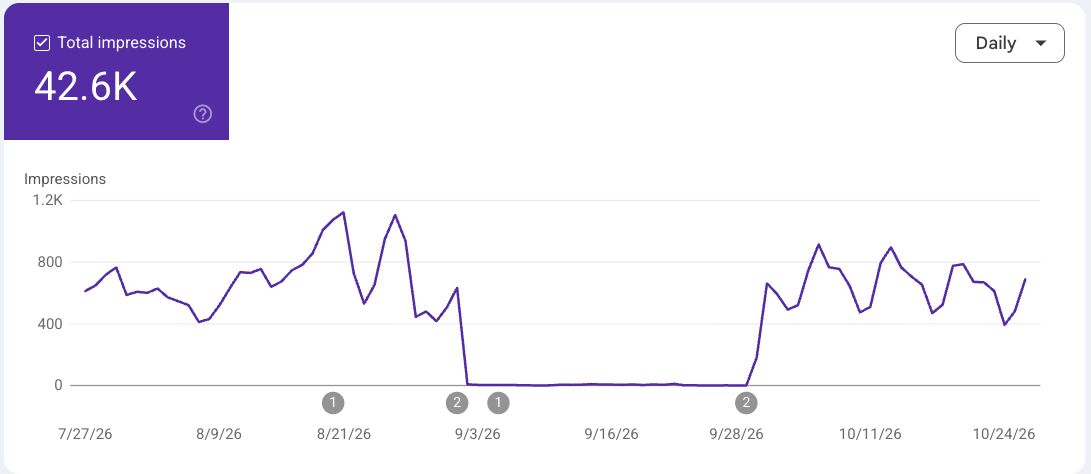
Image: Search Engine Roundtable
Why it mattersA citation in Google AI Overviews may lift clicks lower on the page. Opting out may cost web traffic as well as AI traffic.
Most teams building for search still assume AI Overviews either help or do nothing. A new case study by Cyrus Shepard says the second part is wrong. Shepard is the founder of Zyppy SEO. He blocked one site from Google AI Overviews and AI Mode on 28 October. He used Google's Search Console opt-out controls. He kept the opt-out in place long enough to compare the data before, during and after. He posted the case study on LinkedIn the same day. Search Engine Roundtable reported on it the next day. The study is one site. Shepard says so in his post.
The headline numbers
AI impressions dropped to zero as soon as the opt-out took effect. The estimated click-through rate on those AI impressions was about 0.9 percent. That rate is before and after the opt-out window. Shepard calculated it from the site's total impressions and clicks. He subtracted what the data showed during the opt-out. AI impressions were about 8 percent of total impressions.
The surprise
Regular organic clicks also dropped during the opt-out. The chart Shepard shared with Barry Schwartz shows the dip in web clicks. The dip tracks the dip in AI impressions. Shepard calls this a "Search SERP Halo Effect". His read: showing up in an AI Overview may push a user to click the same site lower on the page. Take the brand out of the AI answer, and the web result loses pull too.
Shepard tells Schwartz the site's average position rose overall during the test. New posts and brand searches lifted the sitewide average. But the pages with the most AI visibility dropped in position during the opt-out. They came back when AI visibility returned.
Greg Sterling, head of research at Near Media, told Schwartz his team has seen the same pattern. He said AI Overviews can give a brand lift that later shows up as more searches and more clicks. He added that his team sees this many times, though the result is irregular.
What the study does not say
AI Overviews still appeared on the search pages the site used to rank for. Only Shepard's site was absent from them. So the comparison runs this way. In the before and after, the site appears in the AI Overview. During the opt-out, the AI Overview still shows, with Shepard's site removed from it.
Shepard asks commenters not to generalise. "Results not guaranteed. Always test your own data." His LinkedIn post drew 108 comments and 443 reactions in a day. Readers asked about the opt-out method, the test length, and whether other crawlers were affected. Shepard has not published those details yet.
A team that measures AI visibility separately from organic rank now has a reason to count both as one line. A site listed in an AI Overview may pick up clicks on the web result below it. The AI citation then shows up in the organic column of the report. Teams reading only the AI column will understate the value of each AI citation. The reverse also holds. A page that loses AI citations may show a quiet dip in web clicks with no obvious cause.
The study is one site over one short window. Carry forward the pattern. Treat the 0.9 percent as one data point.
Source
Case study post by Cyrus Shepard on LinkedIn, reported by Barry Schwartz at Search Engine Roundtable.
This item was written by an AI system from the linked source. Reveneau is responsible for what it publishes.
Get AI News in your inbox
New developer tools, model and agent releases, and how teams are actually using them to release software. Short, and only when there is something worth reading.