Singularity is a free Mac app that runs coding agents on tickets and isolated git worktrees instead of a chat window
Singularity, a free macOS beta from the French team Meteor Factory, is a desktop app that drives Claude, Codex, Copilot and Gemini coding agents through atomic tickets and isolated git worktrees instead of a running chat.
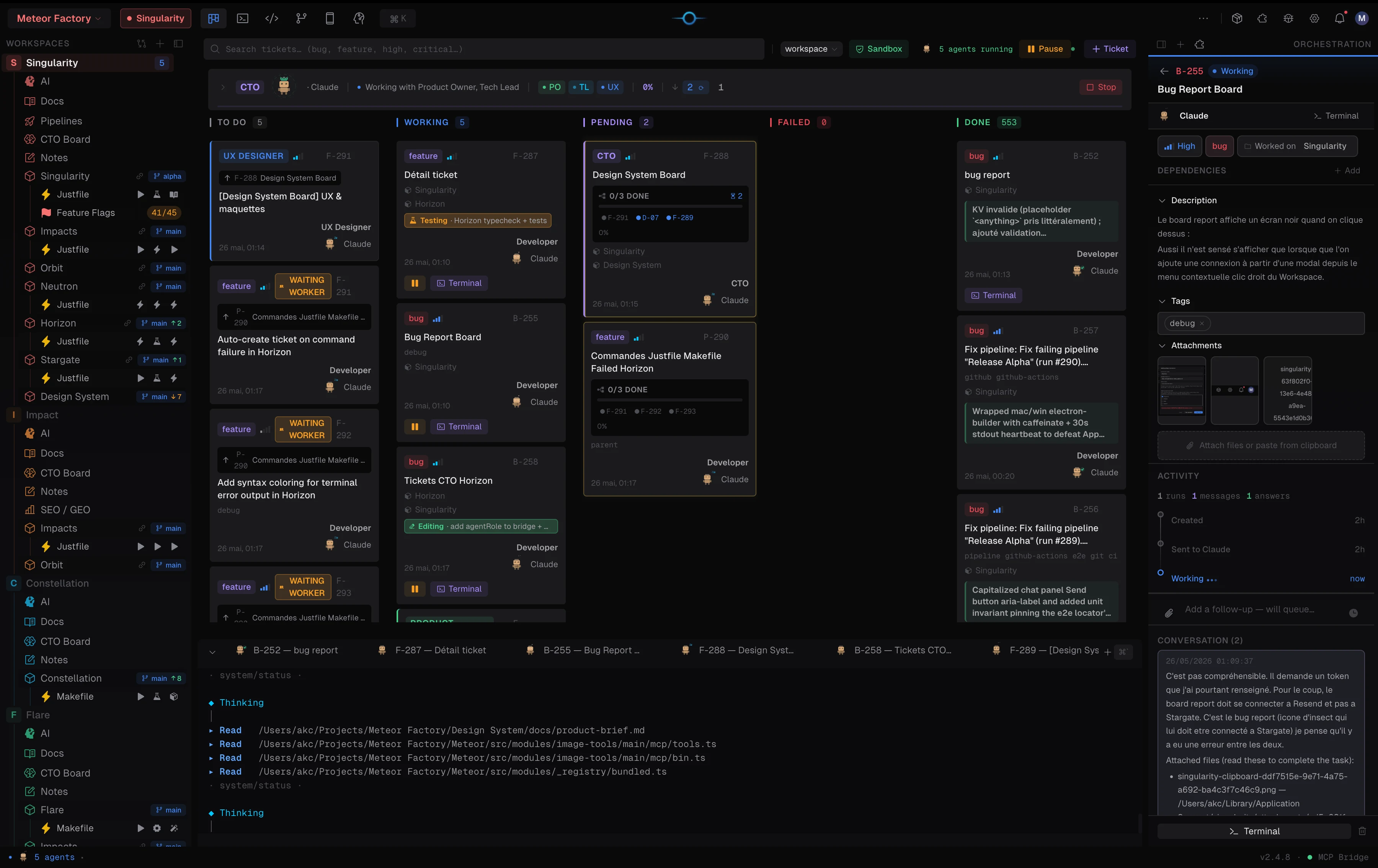
Image: Meteor Factory
Why it mattersA ticket board with one agent per worktree is a different unit of work from a chat with context at 97 percent, and swapping the two is a bigger change to how a team sits with an AI than any new model.
A coding agent conversation reaches the loop every developer who has used one knows: prompt, correction, re-prompt, hallucination, context at 97 percent and confidence at 3. Singularity, posted to Product Hunt on 2026-10-01 by the French team Meteor Factory, is a free macOS desktop app that replaces the chat with a kanban of atomic tickets, each one running an agent in its own isolated git worktree.
The product page at singularity.meteorfactory.dev lists version 2.18.5 for Apple Silicon and Intel, with Windows and Linux marked as coming before the public release. It supports Claude from Anthropic, Codex from OpenAI, GitHub Copilot and Gemini from Google, and the team says more providers will be added through the beta. It is bring-your-own-key, which means the user's own API key does the model call and the product itself charges nothing. Singularity Licence, a paid tier, is listed on the pricing page as an optional add-on; the base app is free and needs no card.
The ticket is the unit of work
The product page frames the design against Cursor, Devin, Orca and Superset by name, and asks for the comparison on the user's own projects. The point it keeps is one that the four it names handle differently: in Singularity, a feature, a bug fix or a refactor is a ticket; the ticket has one scope, one git worktree and one agent; the agent sees only the files it needs; the result is a diff the developer reviews before merging.
A workspace holds several projects. A single request can open sub-tickets across the projects it touches and collect the resulting commits in one review. macOS native notifications fire when an agent finishes or fails, which Meteor Factory writes about as the thing that stops a developer sitting at a terminal watching output.
The team calls the posture "privacy-first and self-hostable": the user's code, tickets and context stay on the machine. The product page says only the API calls to the chosen model provider leave, and only with the user's own key. Hosting is listed as France, with data encrypted.
Where it fits beside the chat-first tools
The pitch is a design choice, not a performance claim. Cursor, Devin and the agents in that category started from a chat and grew around it; Singularity starts from a ticket board and refuses the running chat. The honest consequence is that the user has to describe the work in a ticket before an agent sees it, which is more effort up front than typing in a prompt box. The payoff Meteor Factory argues for is a context that stays small on purpose, a worktree that cannot leak into another ticket, and a review step that happens on a diff instead of inside a running conversation. The product page gives a worked example at "une semaine réelle d'utilisation, 8 au 14 juin" (a real week of use, 8 to 14 June) showing how the workspace handled a week of tickets across projects.
A reader who has never shipped with a coding agent will not get the point from the screenshots; the point is for a team that has run into context saturation and merge races between parallel agent runs. The founders, listed on the page as Antony Kervazo Canut, Mehdi Chaabi and Marine Haziza, say the beta is on macOS only and Windows and Linux will land before the public release, so a Linux shop is paying attention rather than installing yet.
Source
- Primary: Meteor Factory, Singularity
- Product Hunt: Singularity launch
This item was written by an AI system from the linked source. Reveneau is responsible for what it publishes.
Get AI News in your inbox
New developer tools, model and agent releases, and how teams are actually using them to release software. Short, and only when there is something worth reading.