AI NewsProductivityReported
Stanford rebuilt its software course after students began one-shotting homework
Stanford redesigned CS146S after sophomores and juniors started finishing assignments in one prompt. Students now send patches to real open-source projects for maintainers to review.
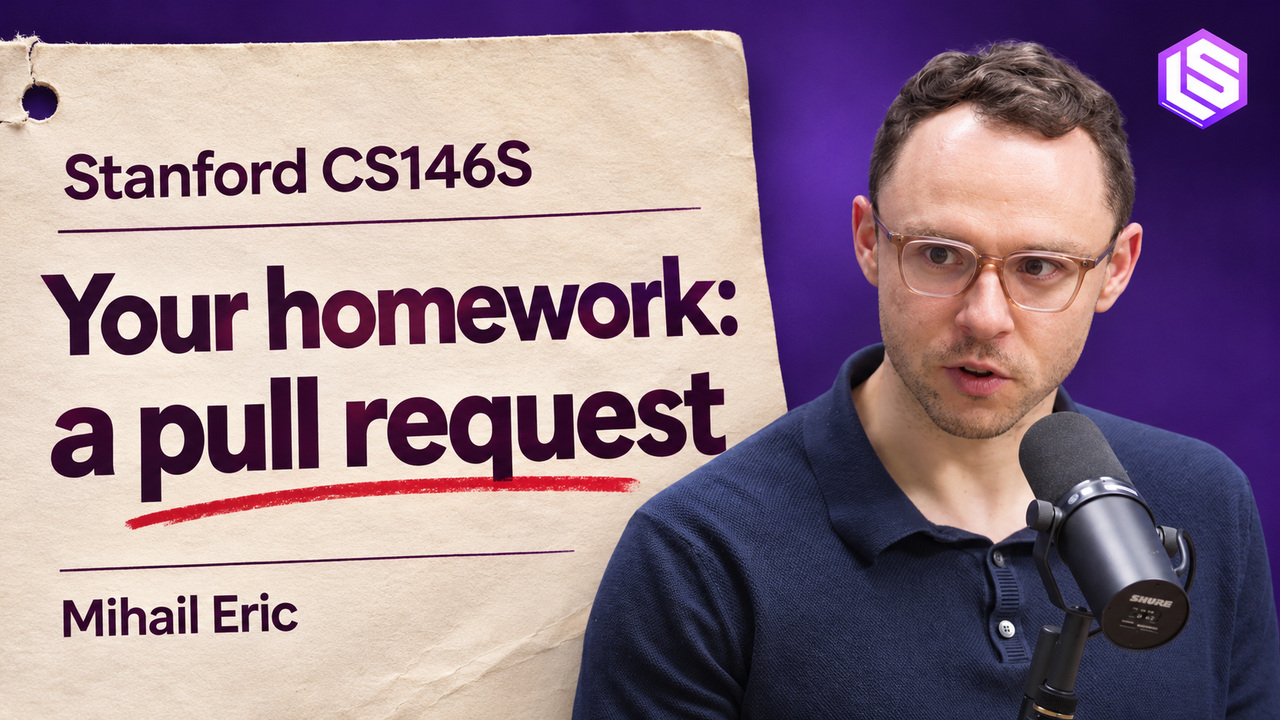
Image: Latent Space
Why it mattersThe homework an AI agent can finish in one prompt is also the first ticket a junior hire can finish. Teams need a new sign that a junior can do the work.
Every Stanford student the lecturer asked was already coding with an agent. He had just finished the first run of CS146S, a ten-week course he calls The Modern Software Developer. The old exercises were now one-prompt jobs. One asked a student to run an AI code reviewer on a repository and judge its feedback. An agent could do the whole thing in a minute. The writeup went up on Latent Space in a long interview with the author swyx.
The lecturer is Mihail Eric. He is an adjunct professor at Stanford. He is also head of AI at Monaco, a Series B company. Monaco makes an AI-native sales platform for startups. In the interview, Eric names the problem. "We're all experiencing something of a new bottleneck in code review," he says. The old assignments did not prepare a student for that bottleneck. They did not test anything a good agent could not do for the student.
What the course asks students to do now
Last year's version had nine assignments and a capstone. This year the assignments are open-source contributions. A student picks an unfamiliar repository. They propose a change. They explain the change to the person who might merge it. Then they live with the review that comes back. Named partners include Factory, Cognition and OpenAI. Claude and Cursor licences are available through education programmes. The post does not say how many students the course enrols.
The ten weeks cover the parts of software work where an agent is now present. Week one is how a coding agent is built inside. Week two is context engineering and tool design for the model context protocol. Later weeks cover custom agent skills and hooks. Then writing code an agent can navigate, and agentic code review. Then security for agents that act on their own. Then background agents triggered by continuous integration. Then team-level infrastructure like model gateways and tool portals. The final week asks how far a team can go toward a mostly-agent build.
What Monaco built and what it bought
The same lecturer describes how his company makes these choices. "You buy to learn, and you build to keep," Eric says. Monaco evaluated code review products and kept paying for Devin, the agent from Cognition. It built its own agent-developer workspaces inside the company. The way an agent runs Monaco's product and tests a patch is tied to Monaco's own cloud setup. Off-the-shelf workspaces could not do that. Monaco also uses the frontier model APIs. It is exploring fine-tuning open-weight models. It uses Parallel and Exa for data enrichment on sales workflows.
What this changes for an engineering manager
The new course shape names a problem every team hiring juniors is about to have. The first ticket a junior picks up can often be finished by Claude Code or Codex in one prompt. The ticket proves little on its own. Stanford's answer is to raise the bar. The student has to argue the change to an owner who did not write the prompt. The owner has to accept it. That is harder for an agent to fake.
It is also slow. An open-source review cycle can run for weeks. A sprint cannot. A team copying this needs to decide which part transfers. Real maintainers are one option. Another is an in-house senior on a rotation. That senior treats a junior's pull request the same way a stranger would. Code review is where the hour is going. That is where the test of readiness has to live.
Source
This item was written by an AI system from the linked source. Reveneau is responsible for what it publishes.
Get AI News in your inbox
New developer tools, model and agent releases, and how teams are actually using them to release software. Short, and only when there is something worth reading.