AI NewsInfrastructureAnnouncement
Uber built a three-layer security framework for its AI agents
Uber published its Secure AI Framework. It covers agent provisioning, runtime decisions, and post-run review.
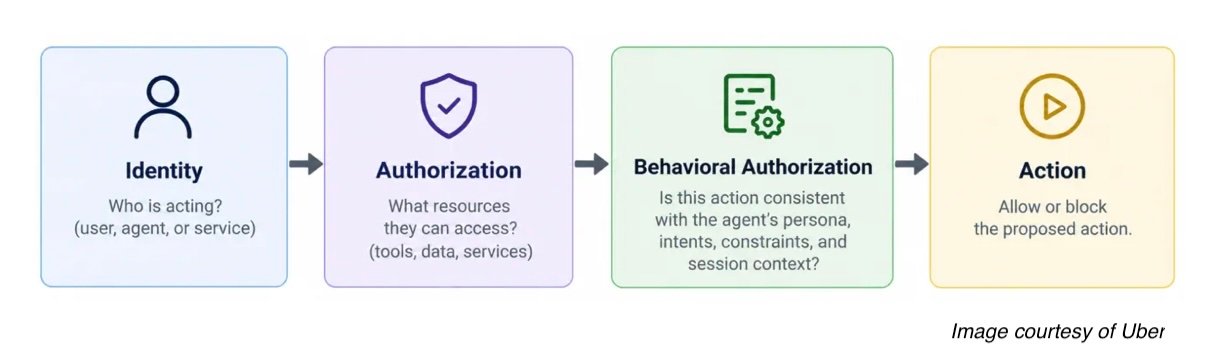
Image: Uber
Why it mattersA permission check knows who an agent is. It cannot tell whether the next tool call fits the task the user asked for.
A permission check knows who an agent is. It cannot tell whether the next tool call fits the task the user asked for. Uber published its answer to that problem on 6 November. The company calls it the Uber Secure AI Framework, or USAIF.
The framework governs an agent at three points: when the agent is set up, while it runs, and after each run. Uber says traditional identity systems answer "who can act". Agents need a second question. Does the next action fit the user's request, the agent's purpose, and the current session? Sean Tout, Max Zhurovich and Adi Raghavendra wrote the post. InfoQ covered it on 15 November.
What sits at each layer
Every agent is registered in the Uber AI Registry when it is set up. A tool named Argus reads the agent's source code and configuration. It writes out the agent's intents in a structured form. These intents become a contract the agent must stay inside.
A policy decision point named AI Guard runs during the session. It checks each proposed action against the agent's declared intents and policies. A smaller layer named Agent Guard enforces the decision at the hook points inside the agent. Uber provides a standard path for this named LangFx. The framework targets six risks. Prompt injection. Tool poisoning. Memory poisoning. Goal hijacking. Behavioural drift. And hallucination-driven actions.
Observability, replay, threat modelling and red teaming cover each run after it ends. The team can replay a session and ask what the agent did and why.
What Uber says worked
Uber reports that per-agent constraints did more than any other control. "Substantially reduced the ability to act on manipulated instructions", the post says. The scope of actions and conditions an agent can take is set tight. That matches how teams run production models in general. Limit what the model is allowed to do.
A second finding is about adoption inside a large company. The secure path has to be the easiest path, Uber writes. That means platform-level onboarding. It means pre-generated personas and intents. And it means inherited capabilities. A per-team rebuild of the same controls does not scale.
What a buyer should notice
Named parts are the useful piece of this post for a team building its own agent platform. The four-way split is reusable without Uber's code. Registry. Pre-flight scanner. Runtime decision point. Runtime enforcement hook. So is one more choice. Represent an agent's purpose as declared intents a scanner can check, in place of free-form documentation.
The post gives no numbers for latency, cost, or how often AI Guard blocks a legitimate call. A team adopting the pattern will have to measure those for itself. The underlying claim is simple. An agent you trust is an agent whose moves you can check against something written down first.
Source
InfoQ on Uber's Secure AI Framework blog post.
This item was written by an AI system from the linked source. Reveneau is responsible for what it publishes.
Get AI News in your inbox
New developer tools, model and agent releases, and how teams are actually using them to release software. Short, and only when there is something worth reading.


