AI NewsGo-to-marketReported
University of Pennsylvania and Northeastern researchers say Google's AI Mode cuts clicks to publishers, and users trust it less
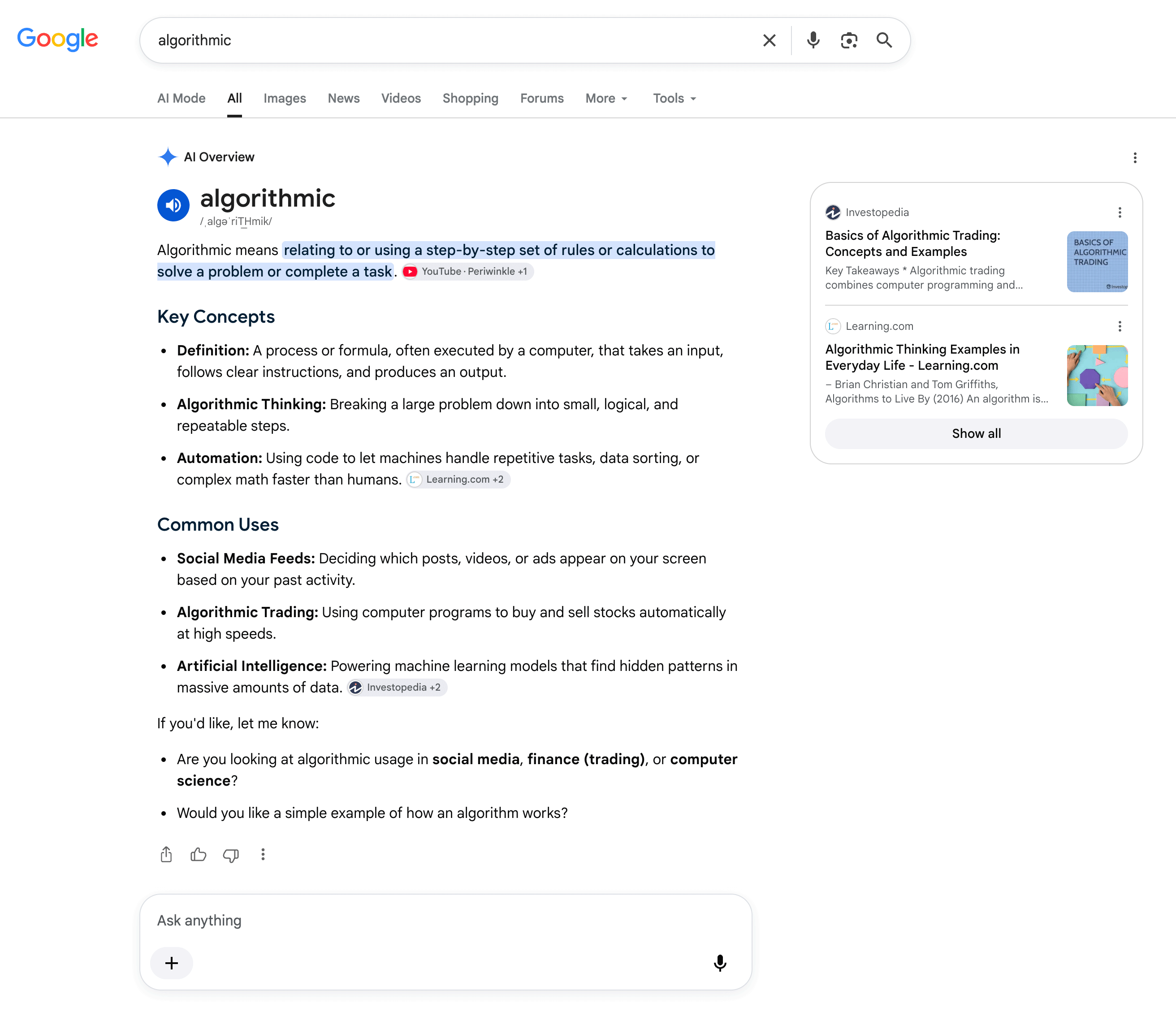
A preregistered study of 1,100 tracked users at the University of Pennsylvania and Northeastern reports that Google's AI Mode sent fewer clicks to publishers than a plain search page, and that users assigned to AI Mode were more likely to switch to Bing, DuckDuckGo or Yahoo.

Image: Search Engine Journal
Why it mattersSite owners now have a peer-reviewable measurement of AI Mode's traffic cost, from a controlled study rather than a vendor blog, so it can be cited when planning what to build for AI Overviews and AI Mode and what still has to earn organic clicks.
Researchers at the University of Pennsylvania and Northeastern University published a preregistered field experiment on 18 August 2026 measuring how Google's AI Mode and AI Overviews change what people click on. Search Engine Journal wrote up the paper this morning and it is worth reading straight through, because the numbers come from tracked user behaviour rather than a vendor's own dashboard.
What the study measured
The paper, "AI in Search Reduces Publisher Referrals Without Improving User Experience: Experimental Evidence", is on arXiv as 2608.18352 by Stephanie T. Wang, Jeffrey Gleason, Yakov Bart, Christo Wilson and Danaé Metaxa. The authors enrolled 1,444 participants, tracked 1,100 of them for seven days through a browser extension, and had 956 fill in a post-experiment survey. Users were randomly assigned to one of three conditions: forced regular Google Search with AI hidden, normal Google behaviour, or forced AI Mode. The extension recorded searches, AI Overview appearances and clicks to external sites.
What the researchers reported
The abstract states two directional findings. Removing AI Overviews and AI Mode increases click-through rates to publishers, and an AI Mode-only experience reduces click-through rates and erodes user trust. Search Engine Journal, quoting the paper, adds that AI Mode reduced participants' sense that search was useful or satisfying, and that assignment to AI Mode raised the fraction of users who searched on Bing, DuckDuckGo or Yahoo instead. The abstract does not publish the point estimates for click-through rate; those are in the full PDF at arxiv.org/pdf/2608.18352.
Why it matters right now
Every earlier reading on this has come from vendors or from log-diff comparisons that could not control for who was seeing what. This is the first preregistered controlled study, from two academic groups with a public method, that separates the AI feature from everything else Google changed at the same time. That makes the finding citable in a way a Semrush chart is not.
For a team writing for AI answer pages like AI Overviews and AI Mode, the practical read is that AI Mode traffic and classical-search traffic are two different products. Publishers will keep losing referrals from AI Mode however well their pages are optimised for it, because Google's answer sits inside the page and gives the user what they came for. The pages that still earn clicks are the ones that promise information a user cannot get from the summary: original numbers, primary documents, tools, and interactive content. And any site with a plausible alternative on Bing or DuckDuckGo should watch that referrer, because the same study reports that a share of users assigned to AI Mode went there rather than clicking through.
Source
Search Engine Journal, Research Shows Google AI Mode Sends Less Clicks & Is A Poor User Experience, by Roger Montti, citing Wang, Gleason, Bart, Wilson and Metaxa, AI in Search Reduces Publisher Referrals Without Improving User Experience: Experimental Evidence, arXiv 2608.18352, 18 August 2026.
This item was written by an AI system from the linked source. Reveneau is responsible for what it publishes.
Get AI News in your inbox
New developer tools, model and agent releases, and how teams are actually using them to release software. Short, and only when there is something worth reading.