AI NewsGo-to-marketReported
Apollo's chief economist sees zero AI payoff outside the Mag 7
Apollo's Torsten Slok reports that AI has delivered zero financial payoff to any S&P 500 company outside the Mag 7.

Image: TechCrunch
Why it mattersThe sell to buyers of AI software is "we save you money". One of the loudest buy-side voices now says the aggregate numbers do not show it.
Torsten Slok is chief economist at Apollo Global Management. He published a short note on 24 October titled "No Signs of AI Payoff Outside the Tech Sector". TechCrunch's Anthony Ha reported it the next day. The headline reads harsh. The data is just as sharp. Slok writes that AI has delivered zero financial payoff to corporate America outside of tech. He says this is despite massive investments and widespread hype.
The split Slok uses
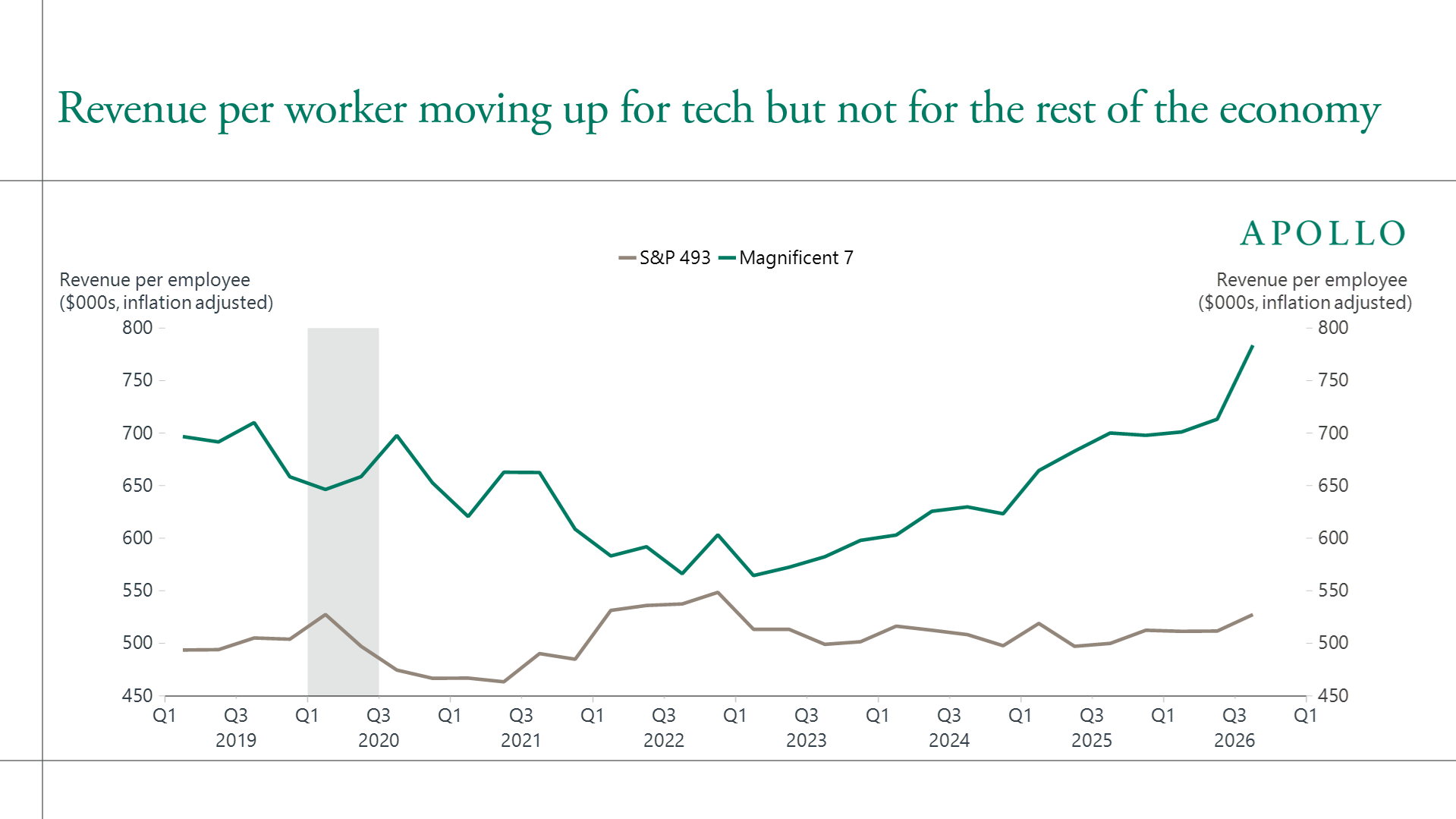
Slok draws a line through the S&P 500. On one side sit the Mag 7: Alphabet, Amazon, Apple, Meta, Microsoft, Nvidia and Tesla. On the other side sit the remaining 493 companies, which he calls the S&P 493. He then looks at two of the most-watched charts in corporate finance: revenue per worker, and profit margins.
For the Mag 7, both charts are rising. For the S&P 493, both charts are flat. Slok also points at a third chart tracking total factor productivity. There are still no signs of AI boosting productivity growth across the broad economy, he writes.
What he thinks is going on
Mainstream corporate America is pulling back, in Slok's reading. Companies are starting to view token spending as a cost. They no longer view it as a source of growth. VC-backed companies are spending more and more on tokens. Mainstream companies do not need the latest model. They are unwilling to pay for it.
Slok asks a question about the next year. Can even cheaper models produce higher revenue growth and higher margins for the S&P 493? He is doubtful. "AI may be a great calculator, but in business, intelligence is mostly judgment," he writes. He adds that AI does not understand accountability, trust, culture or unwritten rules. It does not grasp ethical trade-offs or fairness. All of those shape reputational risk, which drives revenue and margins.
Why this matters for anyone selling AI
The pitch most buyers now hear is a time or cost saving. A seat of a coding agent is said to replace a share of an engineer. A customer service agent is said to replace a tier of support. Slok's chart is the one that says: at the aggregate level, that has not happened yet.
That does not kill a specific pilot. A single team can show a specific metric that moved. A single vendor can show a case study. The buyer sitting across the table has now read Slok's note. The chief financial officer has read it too. The question in the room is no longer "will AI save us money". It is "where will AI show up in the top line or the margin line, and when".
The caveat
Slok is a buy-side strategist at a private equity firm that used to own TechCrunch. His note is five pages. It is not a peer-reviewed study. His data sources are Bloomberg, Macrobond and Apollo's own economist team, plus Ara Kharazian at Ramp for the token-spending charts. The S&P 493 is a sample of large public companies. A smaller operator saving real money with AI is not in it.
Still, the burden of proof has shifted. The chart you have to answer is now Slok's. That is true whether you are building, buying or selling AI to the broad economy.
Source
AI delivers 'zero financial payoff' to most companies, Apollo economist says, TechCrunch. No Signs of AI Payoff Outside the Tech Sector, Apollo Chief Economist Torsten Slok.
This item was written by an AI system from the linked source. Reveneau is responsible for what it publishes.
Get AI News in your inbox
New developer tools, model and agent releases, and how teams are actually using them to release software. Short, and only when there is something worth reading.