AI NewsGo-to-marketReported
Spammers are using public NotebookLM pages to plant coupon, adult and peptide content in Google Search, and Google has indexed 12,000 of them
Barry Schwartz at Search Engine Roundtable, citing observations by Gagan Ghotra, Glenn Gabe and Charles Floate on X, reports that black-hat SEOs are pointing public Google Gemini Notebook (NotebookLM) pages at coupon-code, adult and peptide keywords, and Google has indexed more than 12,000 of them so far.
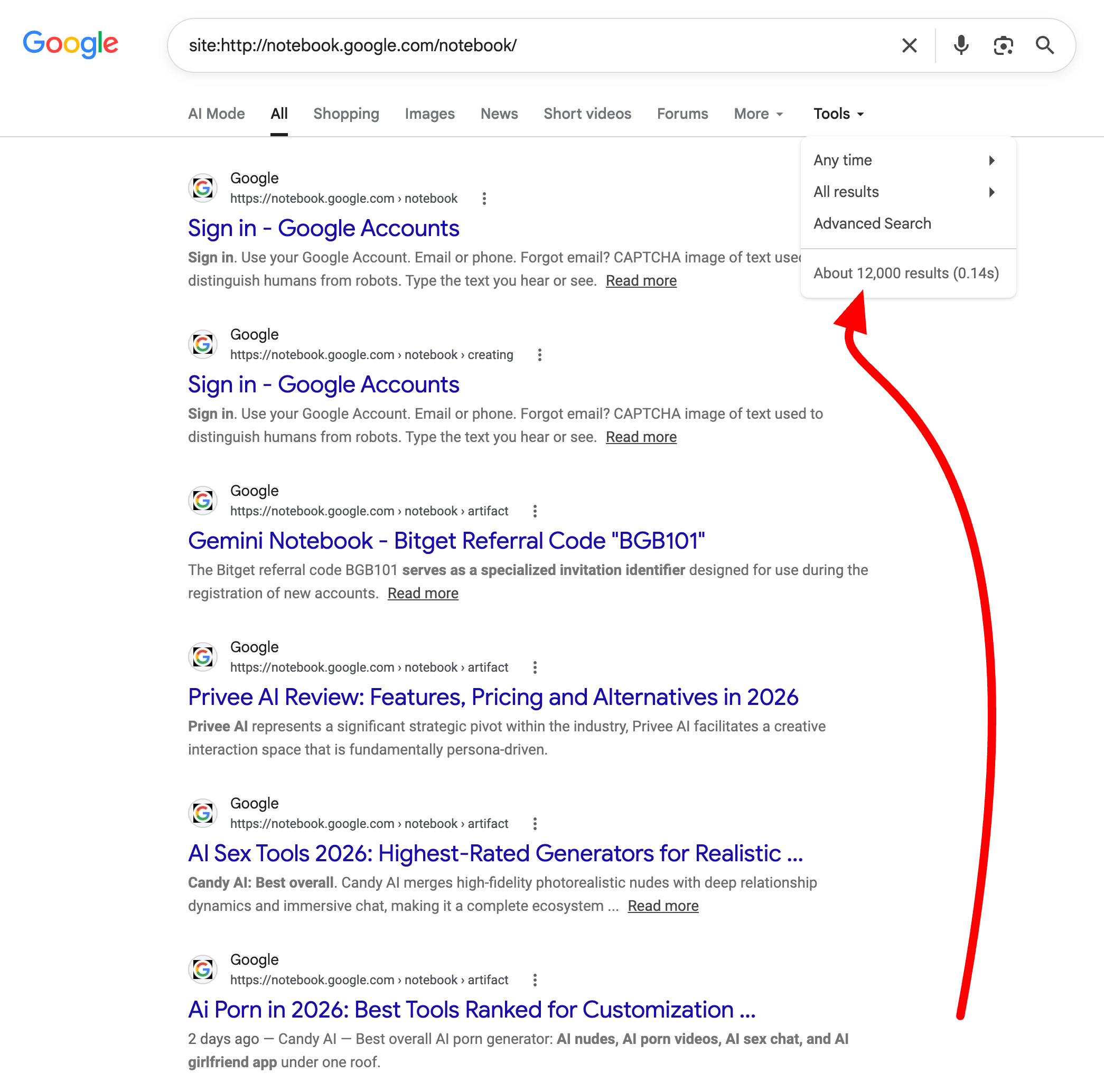
Image: Search Engine Roundtable
Why it mattersA brand whose keyword sits next to one of these NotebookLM pages loses the top result to a Google-hosted subdomain it cannot outrank on authority.
A brand keyword can now be outranked by a spam page hosted on a Google-owned subdomain, because that is what black-hat SEOs have started doing with public Gemini Notebook pages. Search Engine Roundtable's Barry Schwartz reported on 2026-09-22 that spammers are pointing public Gemini Notebook (NotebookLM) pages at coupon codes, adult content, peptides, apps and discount codes, and Google has indexed more than 12,000 of the pages so far.
Schwartz credits the sighting to three named SEOs on X: Gagan Ghotra, Glenn Gabe and Charles Floate. Ghotra's own line, quoted in the article, is that "Black hat SEOs are leveraging public NotebookLMs being indexable by Google as a new parasite SEO tactic!" The 12,000 figure comes from Google's own site: search results counter, which Schwartz cites in the piece.
What a NotebookLM page is doing in the SERPs
NotebookLM lets a user paste sources into a notebook and share the result publicly. The public share pages live under notebooklm.google.com, which is a Google-owned subdomain and therefore inherits some of Google's own domain authority. A spammer who fills a notebook with a synthetic article aimed at a target keyword, then makes it public, ends up with a URL that Google indexes and ranks, without having to run a real site, buy a domain or age it. The categories Schwartz names as showing up so far are the ones that always attract this tactic: sex toys, pornography, peptides, coupon codes and apps.
Schwartz notes that Google could remove them from the index at any time and has not done so yet. One observer's guess in the article is that the pages will disappear "soonish". Neither the article nor the underlying X posts carries an official statement from Google, so the timing sits with Google.
What a marketing team can actually do
An engineer building software rarely reads about black-hat SEO, but this one matters for anyone whose brand keyword or feature-request keyword now sits next to one of these Gemini pages, because the click that would have reached the docs is now going to a Google-hosted spam page instead. Two moves have practical value this week.
First, file a spam report through Search Console for the specific URLs that appear on your keywords. Google's spam reports are read, and hosted-on-Google pages are the easiest case to action once someone in a Trust and Safety queue notices the pattern.
Second, keep your own citation pages tight. A GEO strategy that ships passage-level answers to real user questions on the brand's own domain is what an AI answer engine reaches for when the SERP result is polluted. If the AI Overview at the top of the page cites your docs, it does not matter as much what sits at position seven. Do not spend budget trying to displace a Google subdomain in the classic ten blue links, because the domain math will not let you; spend it upstream, where the answer is composed.
Source
- Search Engine Roundtable: Gemini Notebook Pages Spamming Google Search by Barry Schwartz
This item was written by an AI system from the linked source. Reveneau is responsible for what it publishes.
Get AI News in your inbox
New developer tools, model and agent releases, and how teams are actually using them to release software. Short, and only when there is something worth reading.