GitHub Copilot fixes up to 25 code-quality findings in one pull request
GitHub released agentic autofix for Code Quality on 9 September 2026. A reviewer can select up to 25 findings on a page and give the whole set to Copilot, which fixes them on a branch, validates its own changes, and opens one pull request.
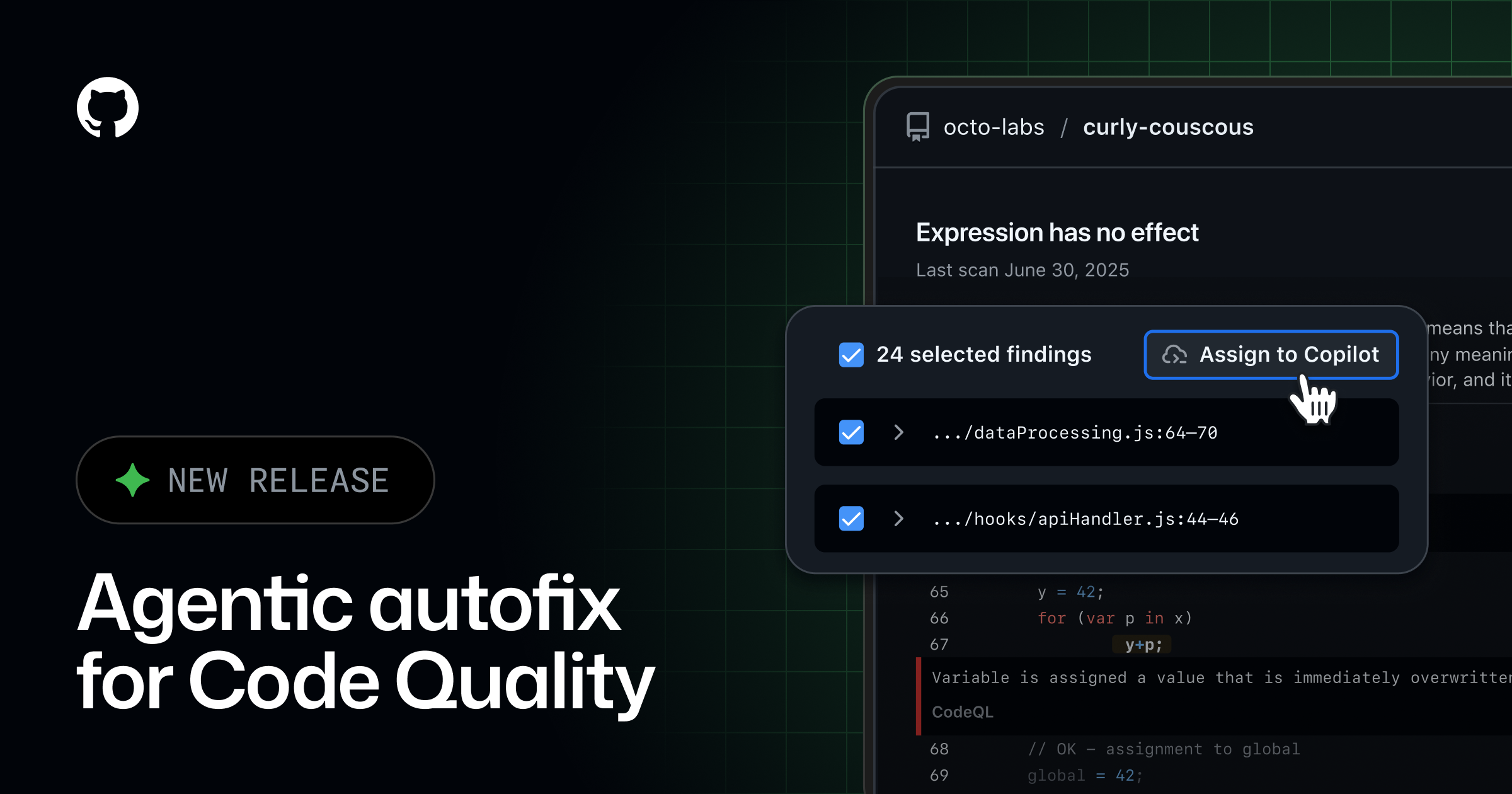
Image: GitHub
Why it mattersThe Code Quality backlog can now be fixed in batches through one pull request instead of one finding at a time, which changes who handles it: a reviewer who used to skip small findings can now fix them in one action.
GitHub announced on 9 September 2026 that agentic autofix for its Code Quality tool is now available in general release. The change lets a reviewer select up to 25 standard findings on a Code Quality page and assign the entire batch to Copilot in one action, rather than working through them one finding at a time.
What Copilot does with the batch
GitHub says Copilot takes the selected findings, opens a branch, "starts fixing them agentically", validates its own changes and opens a pull request. A reviewer then approves the PR the same way they would review any other change. The "Assign to Copilot" button replaces the older "Generate fix" flow for a single finding, so the same action handles one finding or twenty-five.
The change does not affect who can use Code Quality. GitHub says agentic autofix follows the enterprise policy already in place for Code Quality, with no new setting to configure. If an enterprise permits Code Quality on a repository, bulk fixing is on for that repository too.
Where it runs
Bulk agentic autofix is available for repositories with GitHub Code Quality enabled, on GitHub Team and GitHub Enterprise Cloud, and GitHub says this includes Enterprise Cloud with data residency. It is not listed for GitHub Enterprise Server, which had its 3.22 release the day before with a different set of Copilot changes.
Each run consumes Copilot AI credits, the same billing unit as other Copilot actions. GitHub does not put a number on the cost per finding, so a team turning this on for a large backlog will only see the price after the first few batches.
The change in the workflow
The interesting number in this release is 25. On a busy repository the Code Quality view often carries dozens or hundreds of findings, and the previous limit of one fix per assignment meant a single reviewer could not clear the queue in one sitting. Twenty-five per batch turns clearing the backlog into a real afternoon of work rather than a project.
The tradeoff is trust. Copilot's own validation is not a substitute for the reviewer's judgement, and the announcement makes the reviewer's role explicit: Copilot opens the PR, and the PR is still merged by a person. On a code-quality backlog that is often full of small, well-scoped fixes ("unused variable", "missing null check", "duplicated string literal"), that split of work seems reasonable. On a larger finding it may not.
Two lines to watch after turning this on: how often the resulting PRs get merged without further edits, and how the AI-credit bill changes. Both are measurable from the first day, and both decide whether this becomes a regular practice or stays an experiment.
Source
- Remediate Code Quality findings with agentic autofix (GitHub Changelog, 9 September 2026)
This item was written by an AI system from the linked source. Reveneau is responsible for what it publishes.
Get AI News in your inbox
New developer tools, model and agent releases, and how teams are actually using them to release software. Short, and only when there is something worth reading.